

If every AI request your business makes goes to a frontier model in the cloud, you are paying flagship prices for commodity work. This guide to small language models business use is about fixing that mismatch: it explains what small language models (SLMs) are, which ones are actually worth running in 2026, where they beat big models outright, and where they will quietly let you down. By the end, you will be able to decide whether your next AI feature should run on hardware you already own, or whether it still deserves the big model.
Here is the short version. Most business AI work is narrow and repetitive: classify this ticket, extract these fields, summarise this meeting, draft this reply in your tone. A small, well-chosen model does that work faster, cheaper, and inside your own walls. The big model earns its fee on the hard tail: open-ended reasoning and genuinely novel problems. The winning setup in 2026 is not SLM versus LLM. It is SLM by default, LLM by exception, with a router deciding which is which.
What counts as a small language model?
There is no official dividing line, but the working definition most practitioners use is operational: a small language model is one you can run on hardware you already control, at a cost per request low enough that you stop thinking about the meter. In practice that means roughly 1 billion to 15 billion parameters. Frontier large models, by contrast, run into the hundreds of billions of parameters and live in cloud data centres, behind an API, on someone else’s GPUs.
Size is not the whole story. Three techniques did more for SLMs than raw scale. First, quantisation: shrinking model weights to 8-bit or 4-bit precision so a model that once needed a server rack now fits in a few gigabytes of RAM, with only a small accuracy cost on narrow tasks. Second, better training data: carefully curated, textbook-quality data teaches a small model far more per parameter than scraping the whole internet teaches a big one. Third, specialisation: a model fine-tuned for one job, like ticket classification, routinely outperforms a general model ten times its size on that exact job.
You are not buying intelligence in the abstract. You are buying performance on your tasks, under your constraints: budget, latency target, data rules, hardware. Judged that way, the small model often wins, and it is not close.
Small Language Models Business Use: The Models Worth Knowing in 2026
Every major lab now ships a small tier, and the families iterate every few months, so treat version numbers as perishable. These are the names that matter for business deployments right now.
Microsoft Phi-4-mini (3.8B, MIT licence). The reasoning specialist of the small-model world. Its 128K context window is unusually generous for a model this size, making it a strong pick for long support threads, contracts, or reports. Published benchmarks put it ahead of much larger 7B and 8B models on reasoning and maths tasks.
Google Gemma 4 E2B and E4B (Apache 2.0). The on-device pair, released in April 2026 for phones, single-board computers, and ordinary 8GB laptops. The E2B runs in roughly 5GB of RAM at 4-bit precision; the E4B is the better-balanced default. Native function calling and structured JSON output are what let an SLM reliably call your tools and return data your software can use, instead of paragraphs a developer must parse.
Alibaba Qwen3 and Qwen3.5 small tiers (Apache 2.0). The multilingual pick, from under 1B to around 9B parameters, with very wide language coverage and long context on the newer variants. If your business serves customers in several languages, that breadth is a genuine differentiator.
Meta Llama 3.2 1B and 3B, Mistral Ministral 3, and SmolLM3. Llama 3.2 is the dependable baseline most tools already support: the 1B model routes and classifies, the 3B drafts and summarises. Ministral 3 (3B, 8B, 14B, Apache 2.0) adds vision support and a 256K context window for mixed document-and-image workflows. SmolLM3 (3B, fully open) is the transparency pick, with a public training recipe for when a customer or regulator asks exactly what your AI was trained on.
Trying one takes minutes, not a procurement cycle. From Ollama’s local model catalogue, install Ollama, pull a small model such as phi4-mini or gemma4:e4b, and ask it questions from your terminal. That ten-minute experiment tells you more about fit than a week of vendor slide decks.
Where SLMs actually beat big LLMs
Cost, and it is not marginal. Published comparisons of 2026 deployments consistently put self-hosted small models at a fraction of equivalent frontier-API usage, with the gap widest on high-volume, predictable workloads: a cloud API charges per token forever, while a local model costs the same hardware whether it answers ten thousand queries or ten million. One widely cited rule of thumb puts a private SLM endpoint at hundreds to a couple of thousand dollars a month for ten thousand daily queries, against several thousand to tens of thousands for the same volume through a frontier API. Your numbers will differ, but the shape of the curve will not.
Latency you can feel. A cloud API call pays for a network round trip plus queueing plus inference, landing anywhere from half a second to several seconds. A local SLM answers in tens to a few hundred milliseconds. That difference is invisible in a nightly batch job and decisive in a live product: a coding assistant that pauses, a voice agent that hesitates. If your feature is interactive, latency alone can justify the small model.
Privacy and control. This is the argument that closes deals in regulated industries. A model running on your laptop, your server, or your customer’s device sends nothing to a third party: no customer data in an API log, no retention policy to negotiate, no surprise model update changing behaviour overnight. You can freeze a model version and keep it running offline in a factory, a clinic, or a field office with no reliable connection. For healthcare, finance, and legal work, that is often the requirement that decides the architecture.
Fine-tuning speed. Teaching a 3B model your domain takes hours of GPU time and a modest dataset; fine-tuning a 70B-plus model takes serious infrastructure and specialist skill. With an SLM, training on your support history or product catalogue, and retraining when the business changes, becomes practical. With a frontier model, most teams never get past prompt engineering.
Where SLMs fall short, honestly
None of this makes big models obsolete. Small models fail in predictable ways, and you should plan for all of them.
- Open-ended reasoning. Multi-step analysis and novel problems with no precedent in your data still belong to large models. An SLM reasoning far outside its training produces confident-sounding answers that are wrong in hard-to-spot ways.
- Breadth of knowledge. A small model will not have the obscure regulation or niche technical detail at its fingertips, and it will fill gaps with plausible invention if you let it.
- Long, messy documents. Frontier models still handle book-length inputs and sprawling codebases more reliably, and hold a long chain of reasoning together better.
- Multilingual depth. Outside the strongest languages, small-model quality drops faster. If your customers write in ten languages, test each one separately.
- Hallucination risk does not disappear. Grounding a small model in your documents (retrieval, or RAG) helps enormously, but the model can still misread or invent. The smaller the model, the more your system design has to carry accuracy.
The practical consequence is the one NVIDIA’s agentic-AI position paper argues for: small models for the high-volume, repetitive calls that make up most of an agent’s workload, and escalation of the hard tail to a large model. Treat its estimates as a prompt to measure your own call mix: log a week of AI traffic and count how much of it is narrow work repeating with little variation.
The routing pattern: SLM by default, LLM by exception
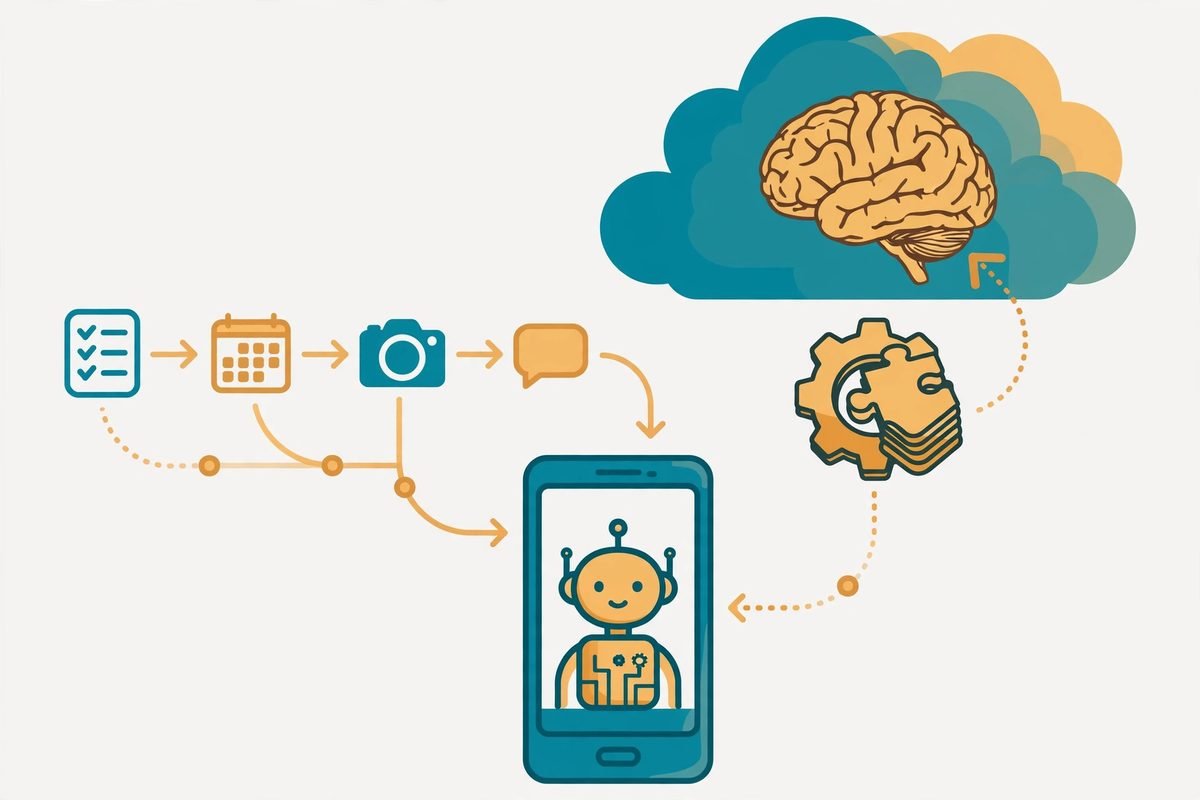
In production, the pattern that works looks like this. A small, fast model sits in front of every request and handles classification, extraction, summarisation, and drafting. It checks its own confidence and the shape of the task: known category, retrieved documents to ground it, verifiable output format? If yes, it answers, and the user never touches the cloud. If the task is novel, low-confidence, or high-stakes, the router escalates to a frontier model, with the small model’s work attached as context.
Three design details make or break this pattern. First, a shared evaluation set: the same hundred real examples, scored for both models, so routing rests on your data rather than vendor benchmarks. Second, verifiable outputs: JSON schemas or cited sources, so a wrong answer gets caught by software instead of by an angry customer. Third, human handoff thresholds for anything irreversible: money moving, commitments made, medical or legal advice given.
From our experience: the pilot we recommend
MTD Technologies has spent 9+ years building software for businesses, and the AI projects that succeed share a boring trait: they start narrow. Begin with one workflow that is high-volume, well-understood, and easy to score: support-ticket triage, invoice field extraction, or internal document search. Each has a clear before-and-after metric: time per ticket, extraction accuracy, or questions answered without escalation.
Run the pilot in four weeks. Week one, collect a hundred real examples and score them by hand; that becomes your evaluation set, the single most valuable artefact of the project. Week two, run two or three candidate small models locally against that set, plus your current big-model setup for comparison. Week three, build the thin system around the winner: retrieval, a JSON output schema, confidence thresholds, and logging. Week four, put it in front of real users on a limited slice of traffic, with a human able to correct it, and measure the metric from week one. If the small model matches the big model at a fraction of the cost, you have a deployment case. If not, you have learned something cheaply.
Two gotchas from real deployments. First, pin your model version. An SLM you host yourself does not change unless you change it, but a hosted small-model API brings silent updates back, so version-pin in the configuration. Second, budget for maintenance, not just launch: a quarterly re-evaluation against a refreshed example set catches the slow decay that otherwise shows up as a mysterious quality complaint six months later. Our AI integration and automation services team builds these pilots the same way for clients, and our workflow automation work often supplies the surrounding plumbing: triggers, human-approval steps, and logging.

When not to use a small model
Sometimes the honest answer is the big model, and recognising those cases early saves a failed pilot. Do not default to an SLM for genuinely open-ended research, for high-stakes answers no human reviews, for very long documents that must be reasoned over as a whole, or when you have no evaluation set to tell whether the small model is performing. In each case the frontier model’s breadth is worth paying for, and the small model’s savings are false economy.
One more caution. The small-model landscape moves fast: families like Gemma, Phi, Qwen, and Ministral release new versions every few months. That argues for the routing architecture, not against small models: when the model behind your router improves, you swap one component, not rebuild the system.
Frequently asked questions
What is a small language model in plain English?
A small language model is an AI text model compact enough to run on hardware you control: a business laptop, a single server GPU, or a phone. Most sit between 1 billion and 15 billion parameters, against hundreds of billions for frontier models. They trade broad knowledge for speed, low cost, and privacy, and shine on narrow, repetitive tasks.
Can a small language model run on a normal business laptop?
Yes, for the smaller end of the range. A 1B to 4B model at 4-bit precision typically needs 2GB to 6GB of RAM, which an ordinary 8GB laptop handles. Larger small models, around 8B to 14B, want 12GB to 16GB of memory or a modest GPU. Tools like Ollama make the first test a ten-minute job.
Are SLMs actually cheaper than using a big-model API?
For high-volume, predictable work, yes, usually by a wide margin. A cloud API charges per token forever, while a self-hosted model costs the same hardware whether it answers ten thousand or ten million queries. For low-volume use, the API is often cheaper, because you pay nothing when idle. Measure your real traffic before choosing.
Is my data safer with a small language model?
When the model runs on your own hardware, your data never leaves your environment: no API logs, no retention negotiation, no surprise model change. That is a strong advantage in regulated work. It does not remove all risk: you still need access controls, logging, and output checks, because a local model can still leak data through its answers.
When should I still use a big LLM?
Use the big model for open-ended reasoning, genuinely novel problems, very long documents, and high-stakes answers no human reviews. Most production systems end up hybrid: the small model handles the routine majority, and the router escalates the hard tail.
The question is no longer whether small models are good enough. For the narrow, repetitive work that makes up most business AI traffic, they already are. The question is whether your architecture lets you use the cheapest model that is good enough for each task, and escalate only when the task demands it. Browse our AI Tools Directory for the current landscape, then talk to us about which workflow in your business should go first.