

If you follow AI agents in 2026 business news, you have heard two contradictory stories this month. One says agents have crossed into the mainstream: according to OpenAI’s October 2026 report on European SMB agent adoption, AI agents now account for more than half of the output generated through its enterprise platforms in the EU, with weekly active agent use among small businesses up more than eightfold since May. The other story says most of it is breaking: industry analyses estimate that 40% of multi-agent pilots fail within six months of production, and research attributed to Google DeepMind suggests multi-agent networks amplify errors dramatically. Both stories are true. That tension — real adoption, real breakage — is the honest picture of where AI agents stand for business in 2026, and it is exactly what this guide unpacks.
This article is written for founders, operations leads, and in-house developers deciding what to do with agents right now. You will learn what genuinely changed between the 2024 demo era and today, which agent architectures actually hold up in production, the failure patterns that kill most deployments, and a practical playbook for shipping an agent that survives contact with real customers and real data. No hype, no futurism — just what works, what breaks, and what it costs, drawn from how these systems behave when you run them.

What actually changed: AI agents in 2026 business moved from demos to workloads
The single biggest change is not a model release. It is a usage shift: agents stopped being conference demos and became daily tooling. OpenAI’s data shows agent-driven tools like Codex and ChatGPT Work generating over 50% of output tokens on EU enterprise accounts by September 2026, and SMB adoption exploding after the July launch of ChatGPT Work. That tells you where the momentum really is — not in giant enterprises with AI task forces, but in smaller firms quietly handing repetitive multi-step work to agents. Businesses moved past the “chat with your documents” phase and started asking software to carry tasks from planning to completion.
Three infrastructure shifts made this possible. First, context windows and tool-use reliability improved enough that an agent can hold a complex workflow in its head for dozens of steps instead of four. Second, the tooling ecosystem matured: orchestration frameworks like LangGraph and CrewAI made it trivial to wire agents to APIs, databases, and browsers, and the Model Context Protocol gave agents a standard way to call into company systems. Third, the cost curve kept falling, so running an agent loop for minutes — not seconds — stopped being a line item anyone noticed on the invoice. None of these was a headline event. Together, they turned agents from toys into plausible employees.
The catch: the same shift exposed the failure modes. When 80% of enterprise applications embed AI agents but only about a third are considered production-ready, the gap between “it works in the demo” and “it works at 3 a.m. on real data” is the entire story of agents in 2026. Everything below is about closing that gap.
What actually works: single agents, narrow scope, tight guardrails
Here is the finding that contradicts most marketing: across the tested orchestration patterns, the systems that succeed reliably and consistently are single-agent systems. One widely cited line of research on multi-agent reliability found that adding agents multiplies error rates rather than dividing them — coordination breakdowns, not model mistakes, account for roughly 37% of multi-agent failures. In practice, the production winners of 2026 share a shape: one agent, a well-defined job, strict tool permissions, and a human reachable for the decisions that matter.
What this looks like in real businesses: a support agent that drafts replies and triages tickets but cannot refund, delete, or reassign without approval. A sales agent that researches prospects and drafts outreach but cannot send without a human click. A code-review agent that comments on pull requests but cannot merge. An invoicing agent that reads receipts and prepares ledger entries but posts nothing until reviewed. The pattern is always the same — the agent does the laborious 80%, and a human owns the irreversible 20%. Boring? Yes. It is also the configuration that survives year one.
If you are evaluating AI integration and automation services, ask the vendor to show you this shape in their proposals. Any proposal whose demo shows five agents collaborating freely with full production permissions is a proposal for a failure you will discover in month three.
Why multi-agent systems keep breaking
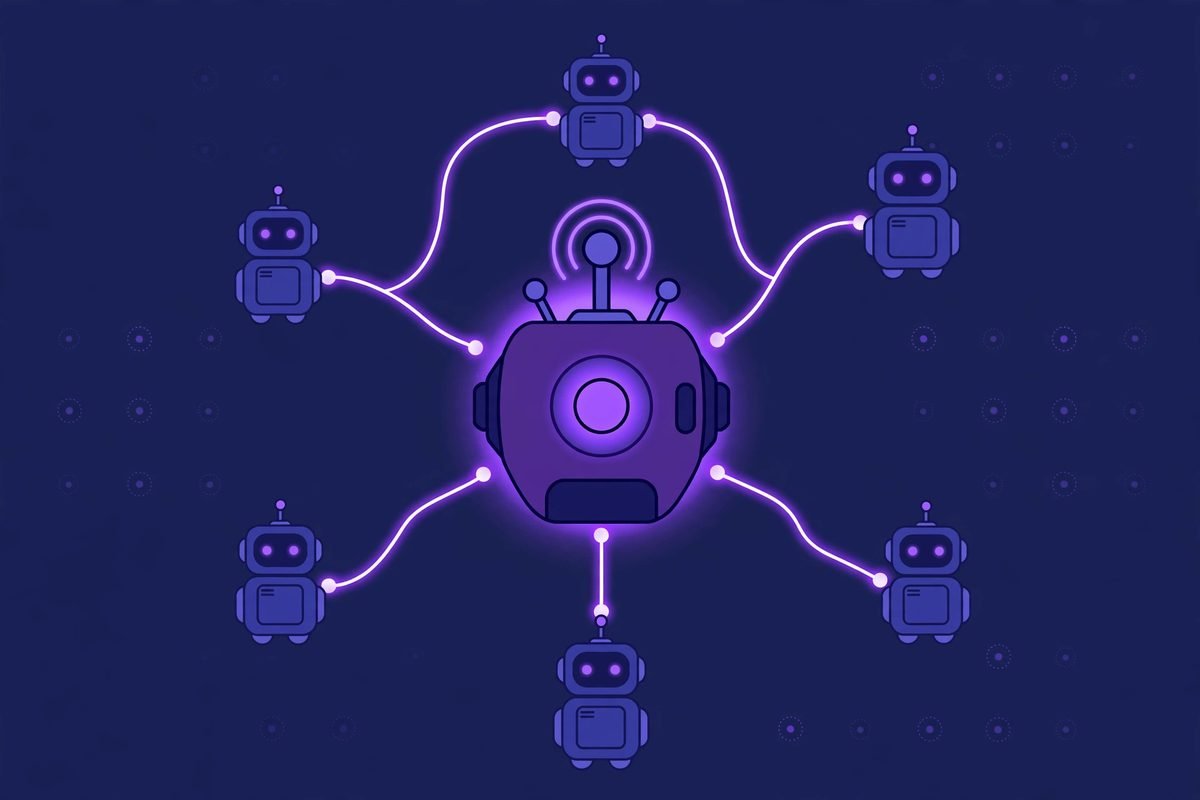
Multi-agent architectures are seductive because they mirror how human teams work: a planner, a researcher, an executor, a critic. The problem is that human teams have shared context, interruptions, and accountability, and agent teams have none of these by default. According to an analysis of why 40% of multi-agent pilots fail within six months, the failure is usually architectural: teams pick a coordination pattern without understanding how it breaks at scale. One practitioner’s canonical example — three support agents that work beautifully for two weeks, then start looping tickets between each other while monthly costs spike to $50,000 — is not an edge case. It is the default outcome of unguarded agent-to-agent handoffs.
The mechanics of failure are now well documented. In workflows longer than about 20 steps, errors accumulate to the point where more than a third of outputs carry defects from an earlier step. Coordination delays — one agent waiting on another’s ambiguous output — routinely exceed several seconds per handoff, which compounds into timeouts. And because every agent’s output becomes the next agent’s input, a single hallucination or misread propagates and amplifies instead of being caught. Metacto’s 2026 failure taxonomy for AI agents groups these into ten recurring causes — cascading errors, tool misuse, prompt injection through retrieved content, context decay, missing guardrails, observability gaps — and notes that most real incidents are combinations, not single bugs. A public open-source catalog of documented agent failure modes now tracks these patterns with real incident data, including cases where agents executed destructive operations without confirmation and cost six figures to remediate.
The practical takeaway for a business owner is blunt: roughly 80–90% of production use cases perform better as orchestrated workflows — a pipeline of deterministic steps with an LLM called at specific points — than as autonomous agent swarms. Reserve true multi-agent designs for problems where no single agent can plausibly hold the whole task, and budget for the observability to watch them.
From our experience: the gotchas nobody puts in the pitch deck
MTD Technologies has spent 9+ years building software across hundreds of projects, and the last two years building AI features into production systems. Here is what that experience teaches about agents — the stuff that does not make it into vendor slides.
- Token costs are the least of your worries; runaway loops are the real bill. A well-scoped agent costs a few dollars a day. An agent with a vague goal and no step cap can burn through a month’s budget in an afternoon retrying the same failing API call. Always set max steps, max spend per run, and a circuit breaker. Cost guards are not optional features; they are the feature.
- Prompt injection is now a security problem, not a research curiosity. The moment your agent reads untrusted content — emails, webpages, uploaded documents — an attacker can hide instructions in that content. One client’s support agent is a short hop from being told by a “customer” to exfiltrate data. Treat every retrieved document as untrusted input and sandbox the agent’s permissions accordingly.
- Observability decides whether the project survives year one. The strongest predictor of which agent projects make it is not model choice but whether the team can see what the agent did, step by step, with costs attached. Log every tool call, every decision, every dollar. If you cannot replay a bad run, you cannot fix it.
- When NOT to use an agent: deterministic business logic with clear rules (use code), anything where an error is catastrophic and unreviewable (use a human), tasks with fewer than a handful of decision points (a script is cheaper and more reliable), and anything regulated where you cannot explain the decision trail to an auditor.
- The 90/10 rule of agent projects: expect 90% of the effort to go into the surrounding system — permissions, evaluation, logging, fallbacks, UI for human review — and 10% into the agent itself. Teams that budget only for the agent end up shipping the easy 10% and stalling on the hard 90%.
This is why, when we scope n8n workflow automation or custom agent builds for clients, the discovery phase is mostly about boundaries: what the agent is allowed to touch, what it must never touch, and exactly where a human steps in. That document is more valuable than the agent code.
A practical playbook for deploying AI agents in 2026
If you take one thing from this article, take this sequence. It is the order that minimizes expensive rework.
- 1. Pick one painful, frequent, reviewable workflow. Good first candidates: meeting-note summarization, lead research, first-draft support replies, invoice data entry, QA report generation. The workflow should happen daily, hurt when done manually, and produce output a human can check in under a minute.
- 2. Start with a single agent, not a swarm. Give it 3–5 tools, read-only access where possible, and a narrowly written goal. Measure: success rate, cost per run, and how often the human reviewer changes the output. Run it shadow-mode (human does the real work, agent proposes) for two weeks before it touches anything real.
- 3. Put guardrails in before the first real run. Step caps, spend caps, allowlists of tools and actions, confirmation gates on anything irreversible, and a kill switch. Research from late 2026 found only 37% of organizations assess AI-tool security before deployment — and 13% had already suffered a breach involving AI models or applications. Do not join the 63%.
- 4. Build observability on day one. Every run gets an ID, a step log, tool-call records, and cost. Alert on anomalies: sudden cost spikes, repeated tool failures, long stalls. Debugging an agent without logs is archaeology; with logs it is engineering.
- 5. Evaluate continuously, not once. Agents drift as models update, websites change, and data shifts. Keep a small set of golden test cases — inputs with known-good outputs — and run them weekly. A regression caught in testing costs minutes; one caught by a customer costs the relationship.
- 6. Expand scope only after 30 clean days. Add a second agent, or widen permissions, only when the first one has run a month without a guardrail trip. Most teams expand too early because the demo phase felt easy. The demo phase is always easy.
What to budget — and what to watch
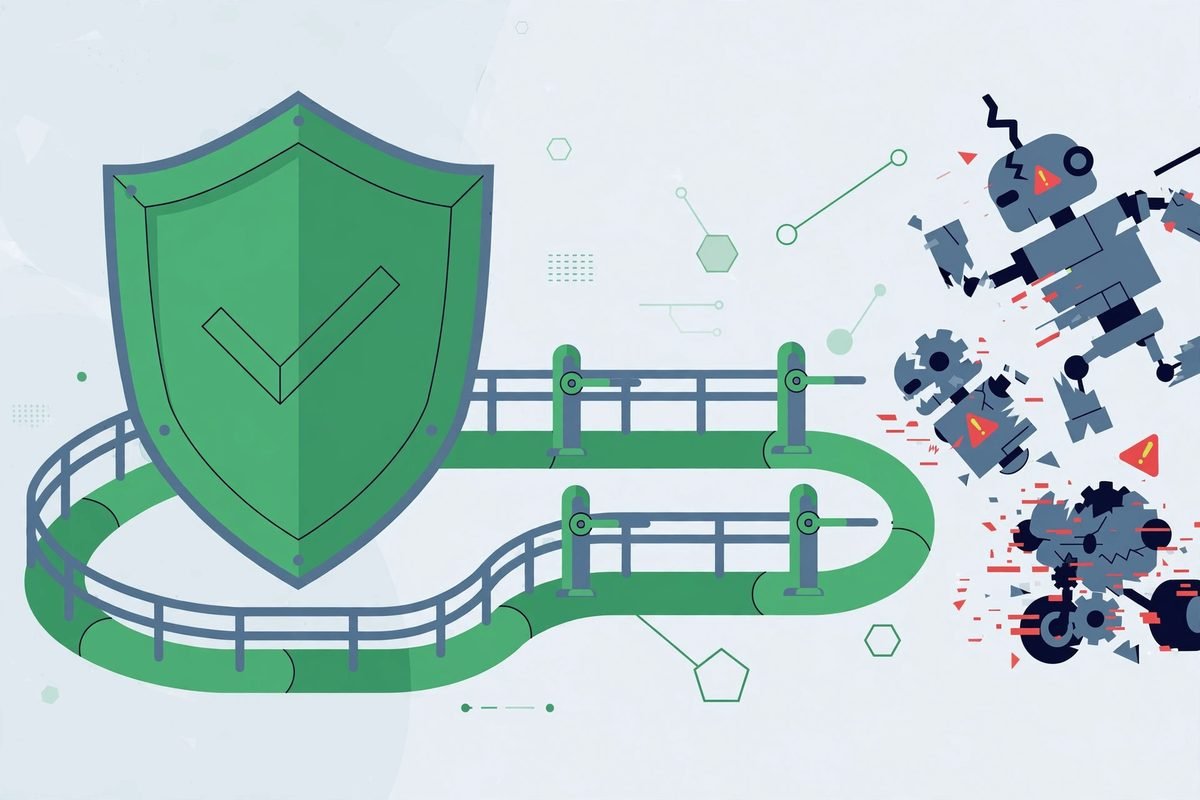
Budget an agent project in three buckets. Run costs — the API tokens and compute — are the smallest and most predictable; a scoped support agent typically costs a few hundred dollars a month at SMB volumes. Build costs — integration, guardrails, evaluation harnesses, review UIs — dominate the first quarter and are where agencies earn their keep. Incident costs — the price of the failure you did not prevent — are the wildcard; the documented cases run from wasted months to six-figure remediation, and every one of them traces back to missing guardrails, not model quality.
What to watch through 2026 and into 2027: agent identity and permissions standards (agents will need their own credentials, scoped like employee accounts), the gap between adoption and governance (81% of leaders expect agents in their strategy within 12–18 months, but security assessment lags far behind), and whether the multi-agent reliability problem gets solved by better frameworks or abandoned in favor of orchestrated workflows. Our bet, based on what we see in production systems: the winners will be boring — single agents, tight permissions, excellent logs — while the spectacular multi-agent demos keep failing in the same instructive ways.
Frequently asked questions
What is the biggest change in AI agents for business in 2026?
The shift from demos to daily workloads. Agents now handle a major share of output on enterprise AI platforms, with SMB adoption growing roughly eightfold in five months. The change is not one breakthrough model — it is reliable tool use, standard protocols like MCP, and falling costs making multi-step agent runs economically normal.
Are multi-agent systems worth it for a small business?
Almost never as a starting point. An estimated 40% of multi-agent pilots fail within six months, and 80–90% of real use cases run better as orchestrated workflows with a single agent called at the right steps. Start with one narrowly scoped agent; consider multi-agent designs only when a single agent genuinely cannot hold the whole task.
How much does it cost to deploy an AI agent in 2026?
Run costs for a scoped agent are modest — typically a few hundred dollars a month at small-business volumes. The real budget goes to build costs: integration, guardrails, evaluation, and review tooling. The expensive failure mode is an unguarded agent looping on a failing task, which has produced five-figure monthly bills in documented cases. Step caps and spend caps are mandatory.
How do you secure an AI agent before deployment?
Give the agent its own identity with least-privilege permissions, treat all retrieved content as untrusted (prompt injection defense), require human confirmation for irreversible actions, and log everything. Only 37% of organizations currently assess AI-tool security before deployment, and 13% have already reported a breach involving AI applications — a security review is not optional.
Should my business build a custom agent or buy an off-the-shelf tool?
Buy when the workflow is generic (support triage, meeting notes, lead research) and build when it touches your proprietary systems, data, or compliance requirements. Custom builds via custom API development make sense when the agent needs deep integration with your stack; off-the-shelf tools win on speed for standard tasks. Either way, apply the same guardrail discipline.
AI agents in 2026 are no longer a question of whether — the adoption data settled that. The question is whether yours will be the deployment that quietly pays for itself or the cautionary tale in next year’s failure statistics. The difference is never the model. It is scope, guardrails, and observability — the unglamorous engineering that turns a clever demo into a reliable worker. If you want help scoping an agent for your business, talk to our team — we will tell you honestly whether an agent is even the right tool for the job.