
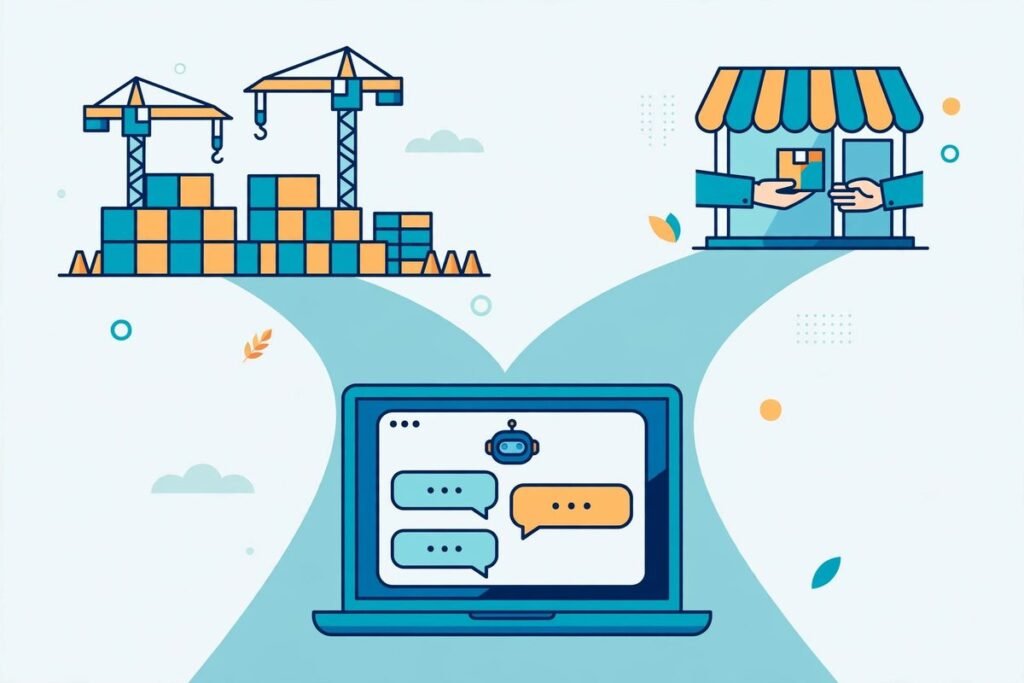
Choosing an AI chatbot for your website is no longer a question of whether to add one — most business sites now benefit from an instant-response layer that answers questions, captures leads, and deflects repetitive support tickets. The real question is the one every owner and marketing lead now faces: AI chatbot for website: build or buy? Buy a SaaS platform and you can be live this week, but you rent the capability forever and hand your customer data to a vendor. Build a custom chatbot and you own everything, but you carry the engineering cost and the maintenance burden. This guide lays out the decision the way we walk clients through it: the three paths, the real cost math, the data-control trade-offs, and when each option genuinely wins.
If you run a business website and want a chatbot that actually understands your products — not just generic small talk — read on. By the end you will be able to estimate the three-year cost of each path, know the conversation volume at which custom beats SaaS, and spot the situations where a bought chatbot will quietly fail you.
The three paths: buy, build, or adapt
Most articles frame this as a two-way choice, but there are really three paths, and the middle one is where most mid-sized businesses land.
1. Buy: a SaaS chatbot platform
Tools like Intercom, Tidio, Freshchat, and Crisp give you an AI chatbot as a subscription. You configure the widget, point it at your website content or FAQ pages, and it starts answering visitors. Typical launch time: hours to a couple of days. Typical cost: anything from free tiers up to roughly $100–$500 per month for small businesses once you include the features you actually need, with enterprise platforms reaching several thousand per month at high volumes. Per-resolution pricing has become common — Intercom’s AI agent, for example, charges around $0.99 per resolved conversation on top of seat plans — which makes the monthly bill a function of your traffic rather than a fixed number.
2. Build: a fully custom chatbot
A chatbot developed specifically for your business — typically a retrieval-augmented generation (RAG) system that searches your documents, product pages, and policies before generating an answer. You choose the models, you control the data pipeline, and you own the code. Typical launch time: 4–8 weeks for a focused lead-qualifying bot, 3–9 months for enterprise-grade systems with deep integrations. Typical cost: $15,000–$40,000 for a well-scoped business chatbot, rising to $75,000–$150,000+ for AI-powered builds with multi-system integration. Custom builds also carry an ongoing maintenance cost of roughly 15–20% of the initial build per year, plus LLM API and hosting fees.
3. Adapt: the hybrid middle path
This is the path people underestimate. You start from an open-source foundation or a vendor-managed platform and customise the layers that matter: your data pipeline, your business logic, your integrations. You keep vendor-managed infrastructure for hosting, security, and core AI capabilities, but you own the custom parts. Typical launch: 2–4 weeks. Typical cost: $10,000–$40,000 up front, with a three-year total ownership cost usually falling between the other two options. For businesses that need more than a generic widget but cannot justify a six-figure build, this is often the sensible default.
The honest cost bands across all three paths are well documented in recent industry comparisons — for instance, Tekrevol’s build-vs-buy breakdown puts custom builds at $60K–$150K up front with a $300K–$600K three-year total, and Elfsight’s 2026 chatbot cost guide documents the full range from free widgets to enterprise builds. Use those as calibration, not gospel: your number depends on the five factors below.
AI chatbot for website: build or buy — the decision framework
Here is the framework we use when advising clients. Walk through each question honestly; your answers point at a path.
Conversation volume
Volume is the single biggest economic driver. Under roughly 2,000 conversations per month, SaaS beats custom on total cost without hesitation — the fixed cost of a build can never be amortised across so few interactions. Between 2,000 and 5,000, the two paths approach parity and the decision moves to other factors. Above 5,000–10,000 monthly conversations, a custom or hybrid build typically reaches breakeven within about 12 months, because per-conversation SaaS pricing scales linearly with your traffic while custom costs flatten out. Above 50,000 monthly conversations, per-resolution pricing becomes the dominant cost driver and building almost always wins on three-year total cost.
Accuracy requirements
A bot that answers opening-hours questions can be generic. A bot that quotes prices, describes product specifications, or explains policy terms must be grounded in your documents — otherwise it will invent confident-sounding wrong answers. SaaS platforms offer moderate hallucination control through their settings, but strong control requires your own retrieval pipeline: chunking your documents, tuning the search, and testing edge cases. If a wrongly quoted price or policy could cost you a customer or create liability, accuracy alone justifies the build or adapt path.
Integration depth
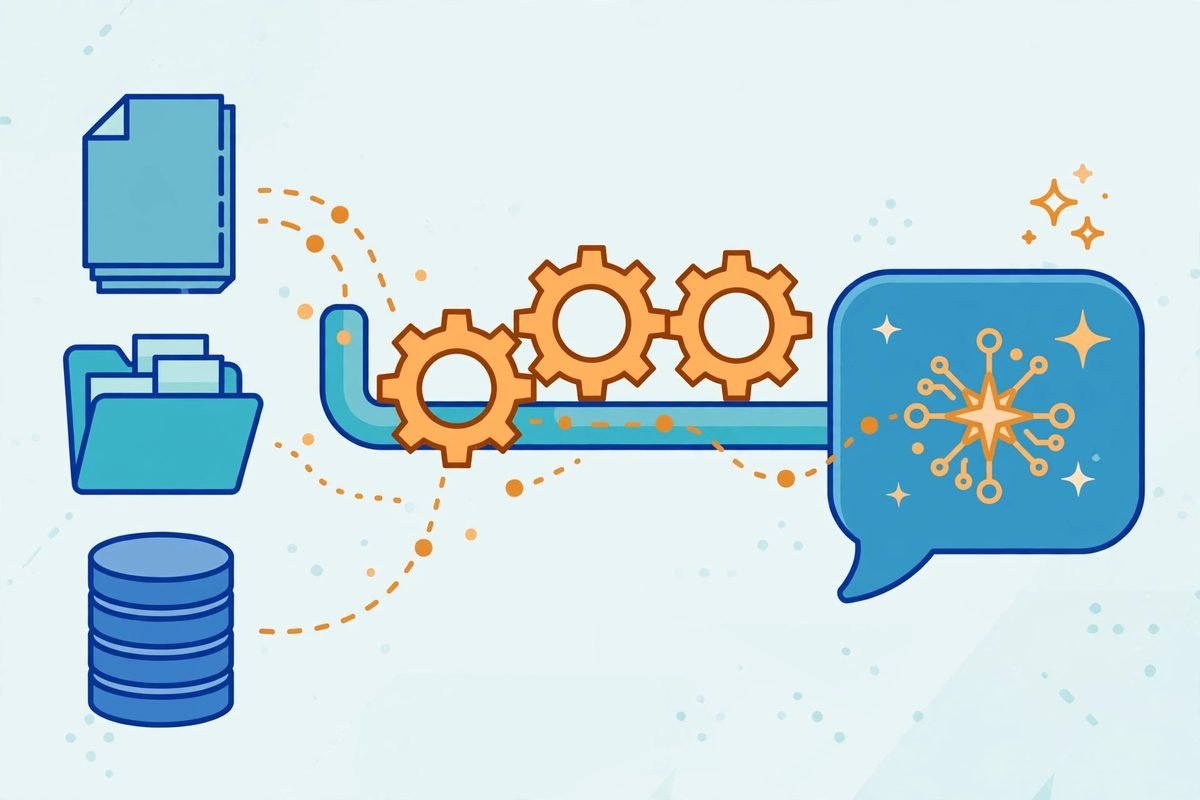
A chatbot that merely answers questions needs little integration. A chatbot that checks order status, books appointments, qualifies leads into your CRM, or personalises answers from your inventory system needs deep integration — and this is where bought platforms hit their ceiling. SaaS bots integrate with standard platforms (Salesforce, Zendesk, Shopify) through connectors; anything proprietary, and you are waiting on the vendor’s roadmap or paying for the enterprise tier. Custom builds have unlimited integration depth: your CRM, your booking system, your warehouse data.
Data control and compliance
With SaaS, your conversation data lives on the vendor’s infrastructure, governed by their policies and SLAs. For most businesses that is acceptable. For healthcare, finance, legal, or any business with customer data that must not cross borders or be used for model training, it is not — and the answer is either a custom build with full data sovereignty or a carefully vetted platform with contractual guarantees. If you need HIPAA or SOC 2-aligned handling with full control, budget for the build.
Team and timeline
A bought chatbot needs no engineering team — someone on the marketing side can usually configure it. A custom build needs 2–4 engineers for the duration of the project, plus ongoing attention afterwards (retraining data, monitoring quality, adapting to model changes). The adapt path typically needs about one engineer. If you have no in-house technical team and no appetite to manage a vendor relationship, buy — and buy from a platform whose support is genuinely good, because you will need it.
The true cost nobody quotes: total cost of ownership
Vendors quote monthly prices; agencies quote project fees. Both hide the real number, which is the three-year total cost of ownership. Here is how to compute it honestly.
- Buy: (monthly subscription + per-resolution/usage overage + add-on features + seats) × 36 months, plus the cost of the hours your team spends configuring, tuning, and working around platform limits. Realistic small-business three-year totals: roughly $9,000–$45,000 — but that assumes you stay within the plan’s usage bands, which traffic growth quietly breaks.
- Build: project cost + 15–20% annual maintenance + hosting and LLM API fees + the ongoing cost of keeping your knowledge base current. The LLM API line item is smaller than people fear — at 5,000 conversations per month on an efficient model, you are looking at roughly $20–$75 per month in API fees — but engineering maintenance is the real line item, and it never goes to zero.
- Adapt: customisation cost + platform subscription for the managed layers + maintenance on your custom parts. Usually $45,000–$100,000 over three years for a mid-sized deployment.
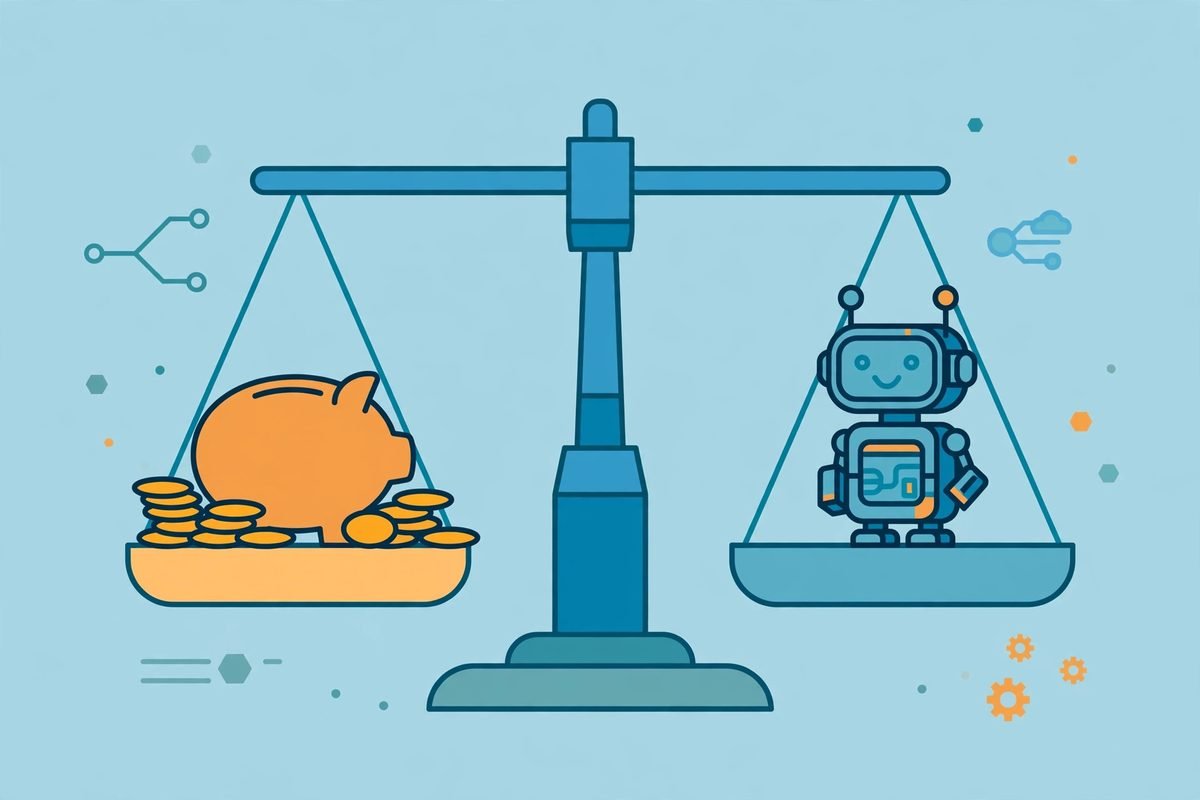
The recurring number matters more than the setup fee. A platform that looks like $99/month can become $600/month once your traffic doubles and the features you actually needed sit in the next tier. Always compare three-year totals at your projected volume, not today’s.
From our experience: when each path actually wins
After building chatbots both ways for businesses — from simple FAQ widgets to RAG systems grounded in thousands of pages of documentation — here is where the theory meets reality.
Buy wins when: you need something live this month, your question set is stable and simple (hours, pricing, FAQs), your monthly conversations are under a few thousand, and your integrations are standard platforms. Be honest about the growth assumption, though — the classic failure mode is buying at 1,500 conversations a month and hitting 8,000 a year later, when the per-resolution bill suddenly costs more than the custom build you declined.
Build wins when: your product knowledge is complex and changes often, accuracy is a liability issue, you need proprietary integrations, or your volume makes SaaS pricing punitive. The gotcha we always flag: a custom chatbot is a living system. The knowledge base rots — prices change, products are discontinued, policies are rewritten — and somebody must own keeping it current. Budget that maintenance before you sign the build contract, or the bot’s answers decay and your support team stops trusting it.
Adapt wins when: you want launch speed and ownership of the parts that matter. In practice this is the most common recommendation for businesses in the 5–50 employee range: a managed platform for the plumbing, a custom RAG pipeline over your own content, and your business logic wired to your CRM. You get live in weeks, you keep your data pipeline, and you can always take the whole thing in-house later without starting from zero.
One more honest note: a bought chatbot that nobody tunes is worse than no chatbot. We have seen businesses install a widget, point it at an outdated FAQ page, and let it misquote prices for months. Whatever path you choose, assign an owner, review conversation logs monthly, and measure resolution rate — the percentage of conversations that end without a human having to step in. If that number is below 60%, your bot is a liability wearing a friendly face.
The risks nobody puts in the sales deck
Vendor lock-in (buy): your conversation history, training data, and configuration live in the vendor’s format. Migrating means rebuilding. Check export capabilities before you commit, not after.
Model changes under you (buy and adapt): when the platform upgrades its underlying model, your bot’s tone, accuracy, and edge-case behaviour can change overnight with no warning. This is a real operational risk we watch for in every automation engagement — regression-test your critical conversation flows after every announced platform change.
Scope creep (build): “just add voice,” “just make it remember visitors,” “just connect it to the warehouse.” Each “just” is a feature with real engineering cost. Lock the v1 scope in writing.
Data rot (all paths): a chatbot is only as good as the knowledge behind it. Whoever owns the website content should own the chatbot’s knowledge base — put that responsibility in someone’s job description, or it will not happen.
Frequently asked questions
How much does it cost to build a custom AI chatbot for a website?
A focused, well-scoped business chatbot typically costs $15,000–$40,000 to build and takes 4–8 weeks, plus roughly $200–$800 per month to run at low volume. Enterprise-grade builds with deep multi-system integration run $75,000–$150,000 or more, with 15–20% of the build cost per year in maintenance. For a full pricing breakdown by tier, see our custom development services page.
Is it cheaper to use a SaaS chatbot platform or build one?
At low conversation volumes (under ~2,000 per month), SaaS is cheaper — there is no contest. Above roughly 5,000–10,000 monthly conversations, a custom or hybrid build usually wins on three-year total cost because SaaS per-conversation pricing scales linearly with traffic. Always compare three-year totals at projected volume, not the first month’s price.
How long does it take to build vs buy a website chatbot?
Buying gets you live in hours to two days. The hybrid adapt path typically takes 2–4 weeks. A fully custom chatbot takes 4–8 weeks for a focused build and 3–9 months for enterprise-grade systems — much of that time is knowledge-base ingestion and testing, not just coding.
Can I switch from a SaaS chatbot to a custom one later?
Yes, and it is a common trajectory: start with SaaS to validate that visitors actually use the chatbot, then build custom once volume or accuracy demands justify it. The main cost is rebuilding your knowledge base and conversation flows, since export formats vary by vendor. Planning for this from the start — keeping your FAQ and document source in your own system rather than only inside the platform — makes the migration dramatically cheaper.
Do I need a developer to maintain a website chatbot?
For a SaaS chatbot: no, but someone must own the knowledge base, review conversation logs, and track the resolution rate. For a custom build: yes — model updates, API changes, and knowledge-base maintenance need technical attention, which is either in-house engineering or a maintenance agreement with your development partner. If you are curious what real chatbot projects look like, browse our AI tools directory for the platforms we evaluate.
When should a small business definitely build rather than buy?
Build when any one of these is true: your answers carry liability (prices, medical, legal, financial specifics), your data must stay on your own infrastructure, you need proprietary system integrations no platform offers, or your monthly conversation volume makes per-resolution SaaS pricing more expensive than a build. If none of those apply, buying is almost certainly the rational first move.
MTD Technologies has been building web platforms, custom software, and AI automation for businesses for over nine years, and we have shipped chatbots on all three paths — SaaS integrations, custom RAG systems, and hybrid builds. The honest answer for most businesses: buy to validate, adapt to grow, build when the economics or the risk demand it. If you want help running the numbers for your traffic and your content, talk to us — we will tell you which path fits, even when the answer is “just buy the $49 plan.”