

If you run a business that gets leads — contact forms, WhatsApp messages, ad campaigns, website chat — you already know the bottleneck. Every lead needs a human to look at it, judge it, and decide whether it is worth a sales call — slow, inconsistent, and expensive. AI lead qualification automation is the workflow that replaces the manual first pass: it captures every lead, enriches it, holds a real conversation with it, scores it, and routes only the good ones to your sales team. This post is for business owners and sales managers: the five stages, a build-vs-buy view, and the numbers that matter.
One note before the stages: the “AI” is only one of five. Most of the real work is the automation around it — capture plumbing, CRM sync, routing rules.
Stage 1 — Capture: every lead in, within seconds
Qualification can only start when the system knows the lead exists. The capture stage listens to every entry point and normalises everything into a single lead record:
- Website forms — contact, quote, and demo forms; each submission fires a webhook instantly.
- Chat and WhatsApp — the conversation itself is the entry point; no form needed.
- Ad platforms — Facebook and Instagram lead ads push contacts in automatically; comment-to-DM flows turn engagement into conversations.
- Your CRM — a new contact triggers the workflow (in n8n, a “contact created” trigger).
- Missed calls and email — a missed call fires an instant text-back; a new email opens a qualification thread.
Discipline: deduplicate every source into one record, keyed on email or phone — otherwise the AI qualifies the same person three times.
Stage 2 — Enrich: give the AI something to work with
Most raw leads arrive nearly empty — a name, a phone number, maybe an email. Enrichment fills in the gaps before the AI talks to anyone:
- Company lookup — domain-based enrichment (industry, size, location) from a data provider or simple web research.
- Intent signals — which pages they visited, whether they opened the pricing email, what they downloaded. Behavioural signals often beat anything the lead says.
- Fit against your ICP — the ideal customer profile you define once: right industry, right size, right geography. Leads outside it get scored down before a word is exchanged.
This is the cheapest win in the workflow. One practitioner who documented building such a system with n8n reported that enrichment plus structured extraction removed the large majority of manual lead review — most “leads” are obviously unqualified once you look at five data points.
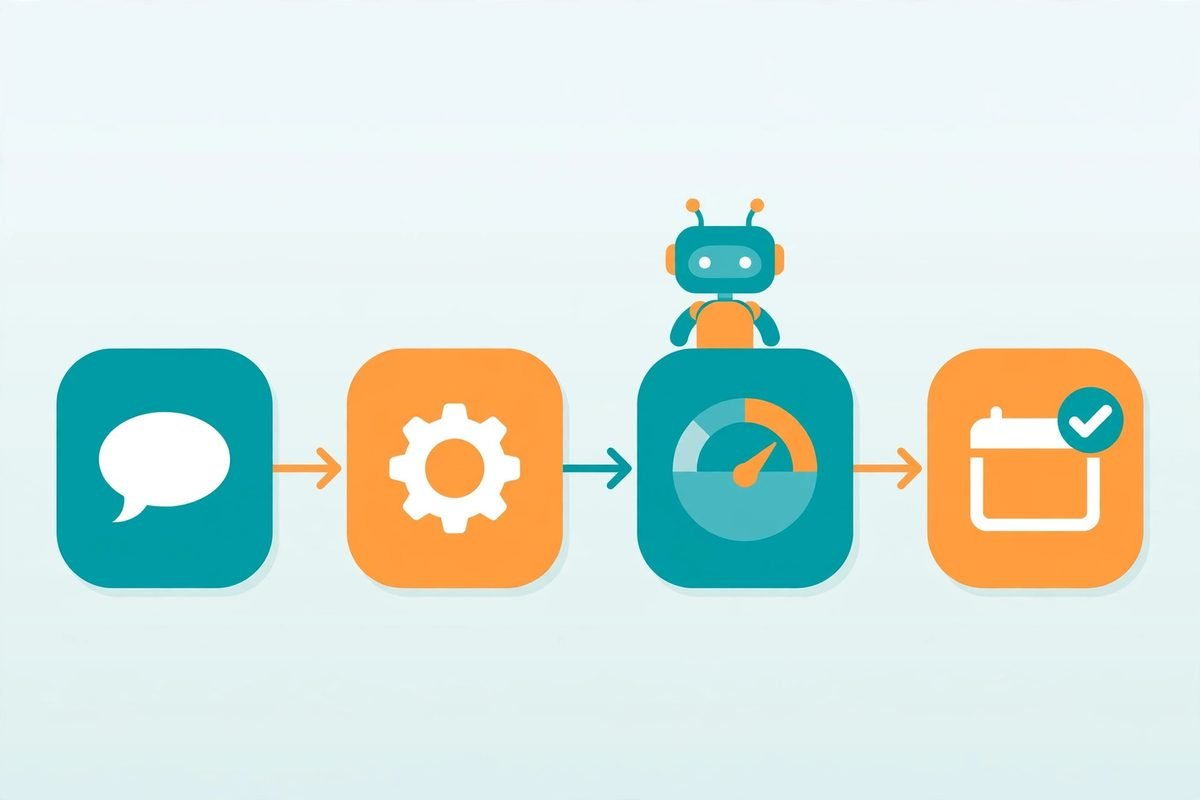
Stage 3 — Converse: the AI asks the questions your sales team asks
This is the stage everyone pictures: a conversational AI engages the lead — over chat, WhatsApp, SMS, or email — and runs through the qualifying questions — budget, timeline, decision authority, the problem — conversationally.
Two design decisions make or break this stage. First, the AI should extract structured data, not write essays. The best implementations ask the model to return a fixed JSON shape — intent, problem clarity, budget signal, suggested next action. That structured output is what the rest of the workflow can act on; free-form transcripts are useless to automation.
Second, guardrails matter more than personality. Give the AI a strict knowledge base of what you sell, what it costs, and what it does not do — and stop it from quoting unapproved prices or making promises you never approved. An AI that invents a discount is worse than no AI at all.
One caution from real conversation data: a study of hundreds of thousands of AI conversations, summarised by SetSmart, found that 53% of DM conversations die before the third message. The lesson: the AI’s job is not long conversations. It is to reach a verdict fast — qualified, nurture, or reject — in as few exchanges as possible.
Stage 4 — Score: hybrid rules the sales team can read
Most off-the-shelf “AI scoring” loses sales teams here: a black box hands down a score nobody can explain. What works is hybrid scoring — AI judges, deterministic rules do the math.
A concrete example from that n8n build: high intent plus a clear problem equals 90 points; medium intent, 60; low intent, 20. Thresholds then drive routing automatically — 80+ becomes a marketing-qualified lead pushed to the CRM with a Slack notification to sales, 40–79 goes into a nurture sequence, and below 40 is archived with no human action. Sales teams accept this because the rules are legible — anyone can see why a lead scored what it did.
That legibility answers the number-one objection from sales leaders: “why did the system qualify this lead?” Store the original message, the AI’s interpretation, the score breakdown, and the routing decision with every lead. Build that audit trail from day one.
Stage 5 — Route: the right lead, the right place, instantly
The final stage acts on the score, and speed is the whole game. One practitioner breaks it into three levels:
- Level 1 — Instant acknowledgement. A form submitted at 11 PM gets a reply within 60 seconds. No AI needed — a $0–50/month Zapier or Make job, and where most businesses should start.
- Level 2 — Qualification via conversation. The AI does the back-and-forth, decides fit, and routes the lead — the full workflow in this article, where real language models enter and costs start to rise.
- Level 3 — Persistent multi-channel follow-up. A 7–14 day sequence across email, SMS, and sometimes voice that pauses on response and adapts to what was said. The most sophisticated — and best for longer sales cycles.
Hot leads get a calendar booking link plus an instant Slack or CRM notification to the assigned owner. Warm leads enter a nurture sequence: email drips, retargeting, check-ins. Cold leads get archived cleanly: a bloated CRM full of dead leads poisons every report you run.

From our experience: what goes wrong in real implementations
We have built automation around CRMs and sales pipelines for years. The failure modes of AI lead qualification are remarkably consistent — here are the ones that actually bite:
The handoff gap. Teams automate qualification beautifully and then route hot leads into a queue that a rep checks “a few times a day.” A lead waiting four hours for a call is a lead already lost. If nobody owns the hot-lead notification, fix that before buying anything.
Over-automating the conversation. The AI should qualify, not close. The moment a lead asks a hard question, expresses frustration, or shows real buying intent, a human should step in. The multi-agent systems people are demoing in 2026 — capture, converse, score, book — all converge on the same insight: the AI’s job ends at the calendar booking.
No feedback loop. If sales marks qualified leads as junk and nobody feeds that back into the scoring rules, the system never improves. The highest-leverage habit: a weekly 15-minute review of which qualified leads converted and which were duds, then adjusting the rules.
When not to do it. Under ~20 leads a month, you do not need this — a human qualifies them in an afternoon and does it better. For deeply consultative six-figure deals, AI should only triage. And if your CRM is full of duplicates and stale data, clean it first; AI qualification on dirty data produces confident-sounding garbage.
Build vs buy: what it actually costs in 2026
You have three realistic paths. Self-hosted workflow automation (n8n plus a WhatsApp connector and an LLM agent node) costs almost nothing in software — mainly LLM API usage — but needs someone who can build and maintain the logic and keep it compliant. A recent platform comparison frames the trade-off: n8n gives full control but demands expertise; managed platforms ship pre-built flows.
Managed platforms bundle channels, conversational AI, and CRM sync into one product — flat-rate tools start around $25/month, while full-stack AI sales automation runs into the hundreds per month depending on volume. Conversational AI platforms like Intercom or Drift (now Salesloft) sit in the middle: real-time website qualification for teams already living in those tools. A current roundup of AI lead tools covers the landscape if you are comparing options.
Our honest take: if lead qualification is core to how you sell, build it on a workflow platform you control (we build n8n-based automation for exactly this reason) rather than renting it from a vendor whose pricing you do not control. If it is a side problem, buy the managed tool and move on.
What people are actually building right now
The most-discussed pattern in 2026 is the multi-agent qualification stack: one agent captures leads, a second holds the WhatsApp or email conversation (asking about budget, timeline, and pain points), a third scores the lead hot, warm, or cold, and a fourth books the qualified meeting straight into the calendar. The architecture is sound — but the “zero-code, instant results” demos show the happy path. Production is all edge cases.
Industry analysts expect the large majority of B2B sales organisations to be using AI-driven selling by 2026 — one vendor writeup cites a Gartner prediction of 75% adoption — and early adopters report meaningful time savings, including a manufacturing firm that cut initial sales-call time by 40% with AI filtering first. The trend is real; the timelines in the marketing are not.
Measuring whether it works
Do not run this on vibes. A practical KPI framework tracks the core numbers:
- Response time: median seconds from lead arrival to first contact. Should collapse to near-zero.
- Lead-to-MQL rate: rises as unqualified leads get filtered earlier.
- MQL-to-SQL rate: the core quality metric — are the leads sales accepts actually good? Target a substantial lift within six months.
- Booked-meeting rate: the outcome the pipeline exists to produce.
- Sales hours saved: calls and emails per rep rise as admin work falls.
- Cost per qualified lead: total system cost per qualified lead — compare honestly against your old cost per lead.
Review monthly — qualification quality is noisy week to week — and close the loop with sales every time.
Frequently asked questions
What is AI lead qualification?
The automated evaluation of new sales leads: capture, enrich, converse, score, and route hot leads to sales while nurturing or archiving the rest.
How much does AI lead qualification cost to set up?
Self-hosted on n8n: mainly LLM API usage (tens of dollars a month at small volumes) plus setup and maintenance. Managed platforms start around $25/month for basic qualification and run into the hundreds for full-stack sales automation. A custom agency build is a one-time project cost plus running costs.
Do I need a CRM for AI lead qualification to work?
You can start without one, but should not. The CRM is the system of record — it holds the deduped lead, the score, the conversation summary, and the routing decision. Without it, qualified leads scatter across inboxes and chat apps with no audit trail and no reporting.
Will the AI qualify leads badly or make things up?
It can, which is why production systems use guardrails: a constrained knowledge base, fixed structured output (intent, budget signal, next action), hybrid scoring where rules do the math, and full traceability so sales can see why any lead was qualified. Borderline leads get human review.
How fast should the system respond to a new lead?
Aim for an acknowledgement within a minute and a real qualification conversation starting within minutes, around the clock. Speed of response is the biggest lever — most value comes from never letting a lead sit uncontacted, not from clever scoring.
AI lead qualification is not about replacing your sales team — it is about spending sales time only on leads worth it. Build the five stages, keep scoring legible, close the feedback loop with sales, and measure. If you would rather have the whole thing designed and built for your stack — CRM integration, WhatsApp or chat channels, calendar routing — talk to us.