
AI voice agent appointment booking is the point where voice AI stops being a demo and starts doing real business work: a caller rings, talks to an agent, and hangs up with a confirmed slot in your calendar. Done well, it answers every call, fills empty slots, and chases no-shows without adding headcount. Done badly, it double-books your busiest day, confidently confirms the wrong time, and leaves a frustrated caller who never rings back. This guide covers the setup, the real costs, and the failure modes, so you can judge whether it belongs in your business.
Who this is for: clinics, salons, trades, law firms, and any service business where the phone still drives revenue but nobody is free to answer it all day. By the end you will know what to buy, what to build, what it costs per month at your call volume, and exactly where these systems break.
How AI voice agent appointment booking actually works
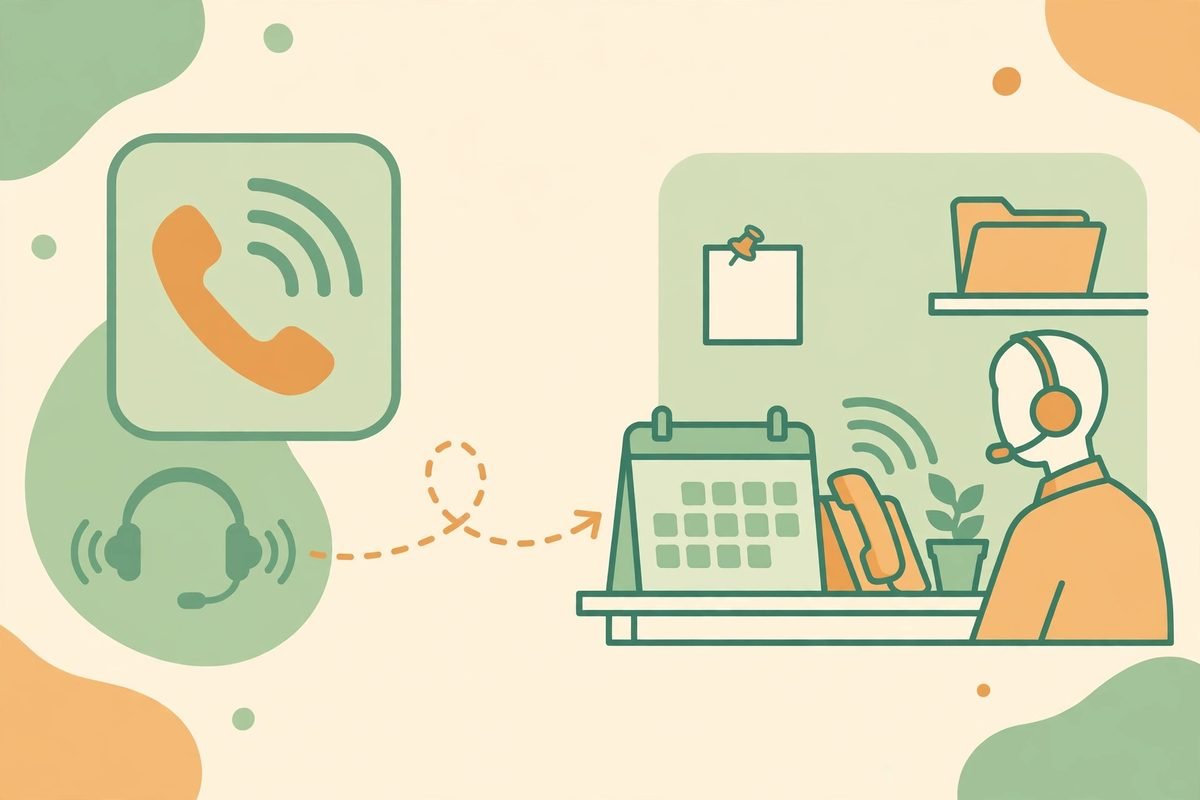
The call runs through four stages in under a second of round-trip latency. Speech recognition turns the caller’s words into text, a language model decides what to say and what action to take, a voice model speaks the reply, and a booking tool checks your calendar and writes the appointment. The booking step is the one that matters most. A voice agent that cannot read your real calendar, respect buffers between appointments, and write back a confirmed event is not a booking agent at all. It is a voicemail with better manners.
Three calendar rules separate a working system from a liability. First, two-way sync: the agent must see cancellations and reschedules made by your team, not just its own bookings, or it will offer slots that no longer exist. Second, buffers and service durations: a 45-minute consultation plus a 15-minute buffer is not a one-hour slot, and an agent that treats every service as the same length will quietly compress your day. Third, confirmation in writing: every booking should trigger an SMS or email to the caller immediately, so a misheard time is caught by the customer, not discovered at the door.
Setup: the five pieces you need before launch
Most failed rollouts are not technology failures. They are setup failures: the agent goes live before anyone has defined what it is allowed to do. Work through these five pieces in order.
- Services and durations. List every bookable service, its real duration, and its buffer. If a haircut takes 40 minutes and a colour takes two hours, the agent needs both, plus the rule for back-to-back bookings.
- Availability rules. Which staff, which rooms, which days, and how far ahead can someone book? An agent with no cutoff will happily book next Tuesday at 2am into a calendar nobody monitors.
- Identity and verification. Decide what the agent asks before confirming: name, phone number, and for clinics or law firms, whatever your privacy rules require. Never let it read out or change an existing booking without verifying the caller first.
- Escalation paths. Define the exact triggers for a human handoff: complaints, refunds, medical symptoms, legal advice, anything the agent cannot answer, and any caller who says “let me speak to a person” twice. A handoff that dumps the caller back to a ringing phone is worse than no handoff at all.
- Call recording and consent. Tell callers they are speaking to an automated assistant, and check the recording-consent rules in your jurisdiction. The disclosure costs you nothing and saves you from the one complaint that poisons an otherwise good rollout.
On the technical side, the usual stack is a telephony provider for the phone number, a voice-agent platform such as Retell AI, Vapi, or Synthflow for the conversation, and a calendar connection through Google Calendar, Calendly, or your CRM. Teams that already run automation often wire the booking flow through n8n workflow automation so a new booking also updates the CRM, fires a reminder sequence, and notifies the right staff member.
What AI voice agent appointment booking costs in 2026
Published pricing in October 2026 falls into two models. Pay-as-you-go voice platforms typically charge around 0.07 to 0.14 dollars per minute at the low end, with some providers reaching 0.31 dollars per minute depending on the voice and language model chosen. Bundled receptionist plans run roughly 50 to 300 dollars per month for a set minute allowance. ElevenLabs Reception, launched in September 2026, lists 29 dollars for 75 minutes, 79 dollars for 275 minutes, and 199 dollars for 1,000 minutes, with overage at 0.30 to 0.45 dollars per minute depending on tier. Synthflow lists a 450-dollar Pro plan with 2,000 minutes included. Treat every published price as a starting point: phone numbers, telephony charges, CRM connectors, and compliance tiers are frequently billed separately.
Do the maths on your own volume before choosing a model. Take a clinic receiving 300 booking calls a month at an average of three minutes each: 900 minutes. At 0.07 dollars per minute that is 63 dollars of voice cost; at 0.31 dollars it is 279 dollars, before telephony and platform fees. At that volume a bundled plan with 1,000 minutes for around 199 dollars is usually cheaper and far easier to budget. At low volume, say 60 calls a month, pay-as-you-go wins because you are not paying for minutes you never use. The expensive mistake is signing a bundled plan for a seasonal business and paying for winter minutes in July, or choosing pay-as-you-go and discovering that rescheduling conversations run twice as long as simple bookings.
Setup costs are separate and often larger than the first month’s bill. A straightforward template setup can be done in an afternoon. A proper deployment, with calendar rules, CRM write-back, reminder sequences, and tested escalation paths, is typically a one-to-two-week project, whether you do it in-house or hire an agency.
Failure modes: how booking agents actually break
Every failure mode below has happened on real deployments. Test for each one before you go live, with real phone calls, not just dashboard previews.
- Double bookings. The classic failure: two callers offered the same slot because the calendar check and the write were not atomic, or because a staff member blocked the calendar in a system the agent cannot see. Fix it with a single source of truth for availability and a confirmation step that re-checks the slot before writing.
- Misheard times and names. “Tuesday at two” and “Thursday at two” sound alike on a bad mobile connection, and names are worse. The agent must read back the full booking, date, time, service, and staff member, and wait for a yes. Any booking confirmed without a read-back is a guess.
- No-show handling that never happens. Booking is only half the job. Reminder calls or messages 24 hours before, a one-tap reschedule path, and a waitlist offer when a slot frees up are what actually protect revenue. A booking agent without a reminder flow will fill your calendar with appointments nobody attends.
- The off-script caller. Callers do not follow scripts. They ask about prices, complain about last time, change their mind mid-sentence, and ask to reschedule an appointment made by someone else. Agents built on rigid scripts fall back to repeating a prompt, which is the moment callers hang up. Test reschedules, cancellations, and multi-service bookings explicitly.
- Silence and interruption. A caller who pauses to check their diary is not finished speaking. An agent that jumps in too fast talks over them; one that waits too long feels dead. Tune interruption sensitivity with real call recordings, and give the agent a graceful line for “take your time, I am still here.”
- Compliance and privacy slips. An agent that reads out another patient’s appointment, discusses a legal matter it should not, or records a call without disclosure creates a problem no amount of saved receptionist time will fix. Keep sensitive topics on an explicit do-not-answer list that routes to a human.
From our experience: what we tell clients before they buy
After nine years of building web, mobile, and AI systems for service businesses, our honest read is this: voice booking pays for itself fastest where missed calls are already costing you money. If your phone rings while your team is with customers and a third of those calls go unanswered, an agent that captures even half of them is a clear win. If your phone barely rings, it is an expensive toy, and a better booking page will do more for less.
Two practical lessons keep coming up. First, launch narrow: one service, one location, daytime hours only, with a human watching the first fifty calls. Broaden only after the failure modes above stop appearing. Second, measure booking accuracy, not call volume. A dashboard showing 500 calls handled means nothing if 40 of those bookings had the wrong time. Track confirmed bookings, corrected bookings, handoffs, and no-show rates weekly for the first quarter, and keep the human escalation path staffed even when the numbers look good. The week you stop watching is the week a calendar integration silently breaks.
When not to use a voice booking agent
Skip it, or delay it, if bookings require judgement the agent cannot make: triage decisions, complex multi-day scheduling with dependencies, or anything where a wrong booking carries safety consequences. Skip it if your calendar lives in someone’s head or on a paper diary, because there is nothing reliable for the agent to book into. And skip it if nobody on your team will own the weekly review. A voice agent is not a install-and-forget product. It is a staff member that needs supervision, and the businesses that treat it that way are the ones still happy with it a year later.
Frequently asked questions
How much does AI voice agent appointment booking cost per month?
For a small business, expect roughly 50 to 300 dollars per month on a bundled plan, or 0.07 to 0.31 dollars per minute on pay-as-you-go pricing, plus phone and telephony charges. Your real cost depends on call volume and average call length, so run the maths on your last three months of calls before choosing a model.
Can it book into Google Calendar or Calendly?
Yes, most platforms connect to Google Calendar, Calendly, and common CRMs, but confirm two-way sync is included in your plan. One-way sync, where the agent writes bookings but never sees changes your team makes, is the most common cause of double bookings.
What happens when the caller asks something it cannot handle?
A well-configured agent transfers the call to a human or takes a detailed message with a callback promise, and passes the full conversation context along. Define these escalation triggers before launch, and test them with real calls, including complaints and refund requests.
Will callers know they are talking to an AI?
They should. The agent should introduce itself as an automated assistant at the start of the call. Disclosure builds trust, keeps you compliant with recording rules in most jurisdictions, and callers are far more forgiving of an AI that is honest about what it is.
How do you stop double bookings?
Use one calendar as the single source of truth, require the agent to re-check the slot immediately before writing, and send the caller a written confirmation they can correct. Test with two simultaneous calls to the same slot before launch, because that is exactly how the failure shows up in production.
If your phone is losing you bookings today, a voice agent is worth a serious look, but only with the calendar rules, escalation paths, and weekly review described above. If you want help scoping one for your business, see our AI voice bot development service, browse the AI Tools Directory for related tools, or contact us to talk through your call volume and booking workflow. The cheapest voice agent is the one you only buy once, because you set it up properly the first time.