

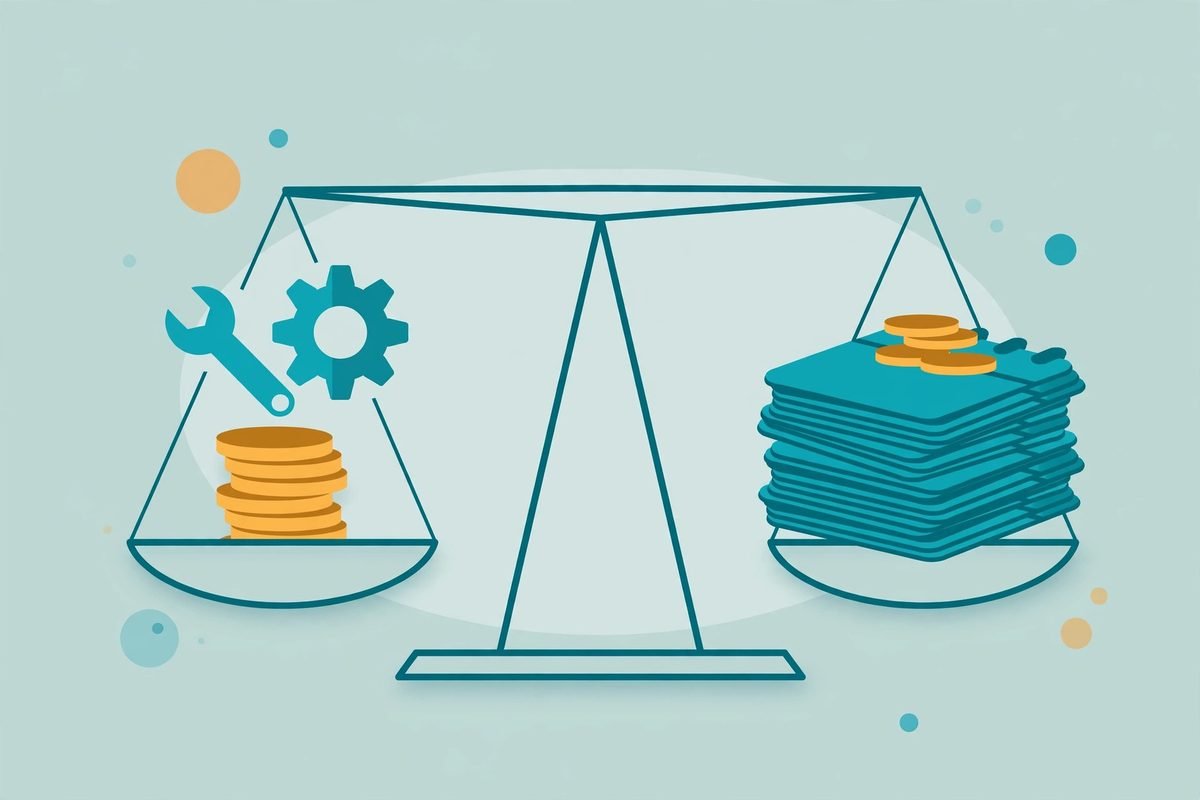
If you are weighing custom CRM development vs Salesforce or HubSpot, you are really choosing between two different cost curves. A platform like Salesforce or HubSpot charges you per seat, per month, forever — and the bill grows every time you hire. A custom CRM flips that equation: a bigger one-off build cost, then costs that scale with your servers, not your headcount. After years of building business software — and rescuing plenty of overgrown, over-licensed CRM setups — here is the honest trade-off, with real 2026 numbers.
What Salesforce and HubSpot actually cost in 2026
In 2026, Salesforce’s Sales Cloud runs from $25 per user per month on Starter Suite, to $100 on Pro Suite, $175 on Enterprise, and $350 on Unlimited — all billed annually. Those are list prices; the detail that matters is that full API access and deep customisation effectively start at the Enterprise tier, which rose from $165 to $175 after the 2025 update (Salesforce Sales Cloud pricing breakdown).
HubSpot looks friendlier at first glance: Sales Hub Starter is $20 per seat, Professional is $90 per seat billed annually ($100 monthly), and Enterprise is $150. But there are two catches most teams discover after signing. First, Sales Hub Professional requires a five-seat minimum, so “$90 per seat” is really a $450-per-month floor even if only two people log in. Second, onboarding is mandatory at Professional and above — $1,500 for Sales Hub Professional, $3,500 at Enterprise (HubSpot’s official Sales Hub pricing guide). One independent HubSpot pricing review models a ten-person setup with Professional-tier automation paying north of $2,500 a month before onboarding — because teams end up mixing hubs, and each hub prices differently. Prices change, so confirm figures on the vendor sites before you budget.
Where the big platforms start to hurt
For a standard sales process with a small team, Salesforce and HubSpot are genuinely good products. The pain starts when your business stops being standard:
- Per-seat economics punish growth. A 20-person team on Salesforce Enterprise is $42,000 a year in licences alone — before implementation, add-ons, or a single integration. Every hire comes with a software tax.
- Customisation has ceilings. Custom objects, complex workflows, and third-party integrations hit API limits and tier walls. The workarounds are usually “hire a certified consultant and a full-time admin,” which is a second payroll.
- You rent your own data. Price rises land on you — Salesforce pushed several tiers up in 2025 — and migrating away means paying to extract what you already typed in.
- Your process bends to the tool. Salespeople adapt to Salesforce’s worldview, not the other way round. Small mismatches become permanent friction, and adoption quietly dies.
What custom CRM development actually gets you
A custom CRM is built around your process instead of the other way round. The pipeline stages match how you actually sell. The fields match the data you actually collect. The reports answer the questions your management actually asks in the Monday meeting. That fit is the whole product — and it is the thing no platform can sell you, because their product has to fit everyone.
The economics favour teams of roughly 15 people and up: no per-seat tax means the tenth new hire costs you nothing in CRM licences. You own the database and the API, so integrations with your email, accounting, inventory, or WhatsApp happen on your terms — no premium tier required to unlock “your own data.” And nobody moves your cheese with a pricing update.
The honest costs: a focused CRM build typically runs 8–16 weeks, and you should budget roughly 15–20% of the build cost per year for maintenance, hosting, and improvements. You are responsible for security, backups, and uptime — either your team or your development partner handles it. A custom CRM is an asset, but assets need upkeep.
Custom CRM development vs Salesforce: five questions that decide it
- How many seats will you have in three years? Under ten and stable? A platform is probably cheaper. Fifteen-plus and growing? Do the three-year licence maths honestly — it surprises most founders.
- Does your sales process look like everyone else’s? Standard lead-to-quote-to-close fits HubSpot beautifully. Multi-step approvals, custom pricing logic, industry-specific workflows — that is where platforms start charging you for the privilege of bending them.
- How much of your business runs outside the CRM? The more systems a CRM must talk to (ERP, inventory, logistics, custom portals), the more a platform’s integration tiers and API limits cost you.
- Do you have technical help? Salesforce needs a certified admin at scale; a custom CRM needs a development partner. Be honest about which relationship you would rather have.
- What happens if the vendor raises prices 20%? If the answer is “we grit our teeth and pay,” you have your answer about lock-in.

This is exactly the kind of decision we help businesses make in our custom software development work: we run the licence maths, map the integrations, and give you a straight answer — even when the answer is “just buy HubSpot.” A good agency tells you when you do not need them.
Frequently asked questions
Is a custom CRM cheaper than Salesforce or HubSpot?
In year one, rarely. Building a custom CRM usually costs more than a year of platform licences. The maths flips over time: with 15–25 users, two to three years of per-seat fees plus mandatory onboarding often exceed the cost of a custom build that then runs on modest hosting. The real win is not just price — it is escaping the per-seat tax every time you hire.
How long does it take to build a custom CRM?
A focused MVP — contacts, pipeline, activities, basic reporting, and one or two integrations — typically takes 8–16 weeks with an experienced team. A full enterprise-grade system with granular permissions, automation, and multiple integrations can take six months or more. Beware anyone who promises it in two weeks; they are reskinning a template.
Can a custom CRM integrate with my email, accounting, and other tools?
Yes — that is one of the strongest reasons to build. Because you own the database and the API, integrations with tools like Gmail, QuickBooks, or WhatsApp are done on your terms, without platform API limits or premium-tier paywalls deciding what is possible.
Will my team actually adopt a custom CRM?
Adoption is usually higher than with off-the-shelf platforms, because the tool is designed around how your team already works instead of forcing new habits. The risk is scope creep: every “could it also do this?” adds build time. The discipline is to ship the core workflow first, then iterate on real feedback.
Still weighing the decision? Run the numbers with someone who has built both sides of it. Talk to us — we will tell you honestly whether you need a custom build or a well-configured platform, because the wrong answer costs you either way.