
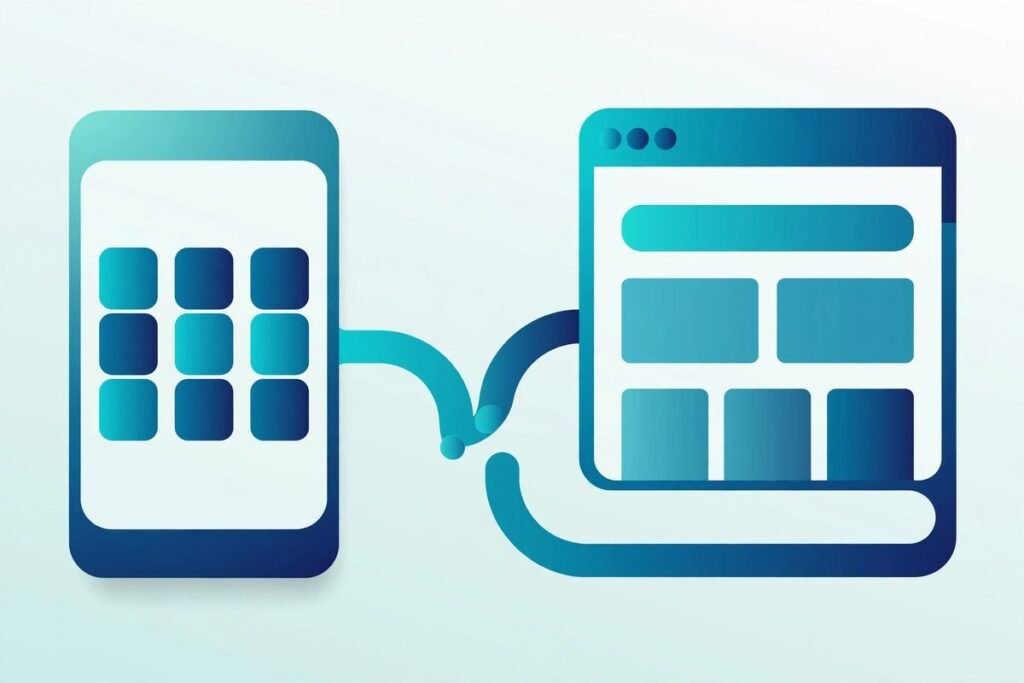
“Does my business need a mobile app?” We hear this question from business owners every other week. It is usually the wrong question – or at least, not the first one. What they are really asking is: will an app pay for itself, or would that money do more good fixing the mobile experience I already have?
Here is the uncomfortable truth from a team that builds both: for most businesses, a better mobile website beats a mediocre app every time. The decision is not about which technology is cooler. It is about how often your customers need you, how they find you, and what each dollar of your budget actually buys.
Where your customers actually spend their mobile time
Start with the landscape, because it explains why this question is harder than it looks. Well over half of global internet traffic now comes from mobile devices, and in high-engagement industries like retail, food delivery and banking, mobile’s share climbs toward 75-80% according to a 2026 mobile app statistics roundup. But here is the twist: roughly 90% of that mobile time happens inside apps, not browsers.
So your mobile site and a potential app are not competing for the same moment. Your site is where customers find you; an app is where they stay with you. A recent comparison of app-versus-mobile-site ROI puts it neatly: apps win on retention and loyalty, while mobile websites win on visibility, discovery and faster payback. The conversion gap is real too – apps convert at roughly 3-5% against 1-2% for mobile web, because saved logins, one-tap checkout and instant loading remove friction.
The real question: how often will people use it?
This is the test we run with every client. Daily or weekly repeat use – banking, food ordering, fitness tracking, loyalty programmes – is the natural territory of an app. Occasional use – finding a plumber, booking a dentist, reading a case study – belongs to the web.
Every app asks for commitment: a download, storage space, an account, notification permissions. Most people grant it grudgingly. Industry data puts average app retention at about 25% after day one, dropping below 11% by day 30, as a native-vs-web-app decision guide notes. An app that gets opened once and deleted is simply the most expensive mobile website you ever built. Daily use means app; occasional use means website – that rule has survived every framework change we have seen.

The middle path most owners never consider: a PWA
There is a third option that ends half of these conversations: a Progressive Web App. A PWA is a website built to behave like an app – it installs from the browser straight to the home screen, works offline, sends push notifications and loads instantly after the first visit. In 2026 the underlying web APIs are standard across Chrome, Safari and Firefox, which removed the fragmentation that used to hold PWAs back, as this guide to PWA fundamentals in 2026 explains.
For an e-commerce store, a content platform or a booking flow, a PWA is often the smartest first move: one codebase for every device, instant updates with no app-store review queue, and – the detail that matters most for businesses – a PWA is indexable by Google. A native app mostly is not, unless you invest in separate app-indexing work. If organic search is your acquisition engine, that is not a minor point. The honest limit: if your product needs deep hardware access – Bluetooth devices, AR, advanced camera pipelines – or serious on-device processing, native still wins. That is a small slice of business software.
Five signs you genuinely need an app
- Repeat use is the business model. Customers open you weekly or daily. Without an icon on their home screen, you are not in their routine.
- Push notifications are central, not decorative. Reminders, alerts, order updates and loyalty nudges drive measurable revenue, not just re-engagement vanity metrics.
- You need the hardware. Camera scanning, GPS tracking, NFC payments or Bluetooth peripherals are core features, not nice-to-haves.
- Offline is non-negotiable. Field teams, travellers and low-connectivity users need the product to work without a signal.
- You already have the audience. Apps retain; websites acquire. As one reach-versus-retention analysis puts it, the web is your discovery engine and the app is your loyalty engine. Launching an app to find customers is doing it backwards.
Five signs a better mobile site is the smarter spend
- Most customer contact is one-off or infrequent. They need your address, your menu, a quote or a booking – then they leave.
- Google is your acquisition channel. Sites rank; apps do not. If search traffic pays the bills, invest where search can see it – our web development team builds mobile-first sites for exactly this reason.
- Your content changes often. A site update ships in seconds. An app update means store review, user downloads and version fragmentation.
- Budget is finite. An app is not a one-off purchase; it is a second product with its own roadmap, QA cycles and OS-update surprises. Our breakdown of mobile app costs in 2026 shows the real bands – if the site upgrade pays for itself, do that first.
- You have not proven demand yet. Ship the excellent mobile site, instrument it, and let real usage data decide whether an app is next. Data first, app second.
Frequently asked questions
Is a mobile website enough for most businesses?
Yes. For the majority of service and local businesses, a fast, well-built mobile site covers discovery, contact and booking – everything the customer journey needs. An app only earns its keep when customers return to you repeatedly.
How much does a mobile app cost compared with upgrading my site?
Broadly, a quality cross-platform app costs several times more than a mobile site overhaul – and the app keeps billing you: maintenance, OS updates, store compliance. Our rule of thumb: if the site upgrade pays for itself, do that first.
Can a PWA replace a native app?
For booking, shopping, content and simple loyalty flows, a well-built PWA covers the job at a fraction of the cost. For hardware-heavy features or a daily-habit product where every millisecond matters, native still justifies itself.
Should I build the app before the website?
Almost never. Your website is your discovery engine – it is how Google, social media and referrals find you. Build the site first, watch how mobile visitors behave, then let real usage data decide whether an app is next.
Here is our advice as builders: start with the web. Make your mobile site genuinely excellent – fast, conversion-focused, measurable. Then check the data. If customers are coming back weekly and your web conversion is strong, you have a real case for an app, with a PWA as a sensible bridge. Our mobile app development team runs this assessment before writing a single line of code – and sometimes the right answer is “not yet.” Talk to us if you want an honest read on yours.