

“How much does it cost to build a mobile app?” is the first question almost every business owner asks us — and the honest answer to the mobile app development cost question is a range, not a single number. In 2026, a professionally built app can cost anywhere from $15,000 for a focused MVP to $300,000+ for a complex platform. The good news: once you understand what actually drives the price, you can budget with confidence instead of guessing.
Below are the real price bands we see in 2026, what each band buys you, and the costs nobody warns you about before you sign. This is written from an agency that ships apps, not from a calculator built to generate leads.
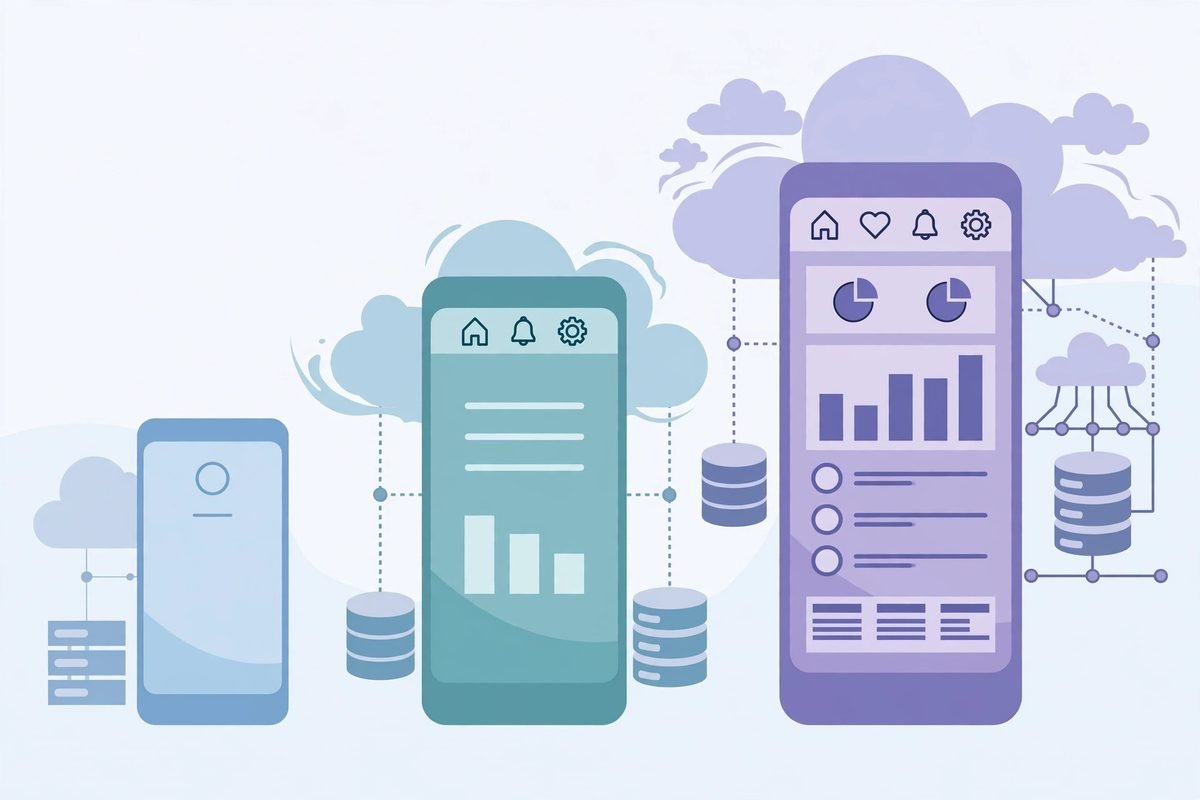
Mobile app development costs in 2026: the price bands
Industry data lines up surprisingly well this year. Clutch’s 2026 pricing survey puts the average agency-built app at $90,780, with the most common project bracket landing between $10,000 and $49,999. Most serious business apps, though, land higher than that common bracket suggests — because the common bracket includes very simple builds.
- MVP / simple app ($15,000–$50,000): A focused first version — a handful of screens, email or social login, basic backend, simple UI. Think booking apps, internal tools, single-purpose utilities. Typical timeline: 8–14 weeks.
- Mid-range business app ($50,000–$150,000): User accounts, payments, API integrations, a real admin panel, custom UI/UX. Marketplaces, fitness apps with subscriptions, client portals. Typical timeline: 4–7 months.
- Complex platform ($150,000–$300,000+): Real-time features, multi-role users, advanced integrations, AI workflows, scalable backend architecture. Fintech, telehealth, multi-vendor platforms. Typical timeline: 7–12+ months.
- Enterprise / compliance-heavy ($300,000+): Healthcare, banking, or anything with serious security and compliance requirements, high-volume infrastructure, and multiple platforms. 12–18 months is normal.
These bands cover design, development, backend, QA, and launch — the full build. They do not include what comes after launch, which we will get to, because that is where most budgets get blindsided. For context on these figures, see the breakdown in Boolean’s 2026 cost guide, which compiles Clutch’s survey data alongside their own project numbers, and Tvisha’s 2026 guide with a similar breakdown by complexity.
What actually drives the cost
The single biggest driver is not “features” in the abstract — it is screens, integrations, and platforms. Every extra platform adds 30–45% if you go native, which is why the React Native vs native decision is the most important budget call you will make. Going cross-platform with React Native or Flutter typically cuts the client bill by roughly a third compared to building two separate native apps.
Beyond platform choice, these are the real levers:
- Backend complexity: A serious app’s backend — database, APIs, admin panel, integrations — often accounts for 40–60% of the build. Apps that look simple on the phone are often complex on the server.
- Third-party integrations: Payments, maps, push notifications, CRMs, ERPs. Each one looks like a line item; together they are a workstream with its own testing surface.
- User roles and logic: A customer-facing app with one user type is one thing. Add admins, vendors, drivers, or partners with different permissions, and complexity compounds fast.
- Design fidelity: A template-driven UI costs far less than a custom, branded design system. Both are legitimate choices — just know which one you are buying.
If someone quotes you $5,000 for a full app, they are building a template. If someone quotes you $400,000 for a booking app, be suspicious too. The ranges above are where honest quotes land.
The ongoing costs nobody puts in the quote
Here is the part that surprises most owners: the build is the beginning, not the end. As a rule of thumb, budget 15–20% of your build cost every year for maintenance — OS updates, store compliance changes, bug fixes, and small iterations. A $60,000 app needs roughly $9,000–$12,000 a year to stay healthy.
The other hidden costs:
- App store fees: Apple charges $99/year, Google Play $25 one-time. In-app purchases hand 15–30% to the platform — price your product with that baked in.
- Backend and hosting: Servers, databases, push notification services, analytics, crash reporting. Small apps: hundreds per year. Serious ones: thousands per month.
- Iteration after launch: The first real users will show you what you got wrong. Plan at least one post-launch iteration cycle in year one — apps that ship once and freeze tend to die quietly.

How to keep the budget under control
You do not need to compromise on quality to spend wisely. The most effective lever is scope discipline: ship an MVP that tests the riskiest assumption first, then let real usage tell you what to build next. In our experience, a lean first version with core features typically lands between $25,000 and $60,000 — a sensible starting point for most businesses.
Three more things that genuinely save money:
- Start cross-platform: Unless you need deep native APIs, React Native or Flutter gets you both stores from one codebase. That is the 30–45% saving mentioned earlier, and it compounds on maintenance too.
- Design once, reuse: A clean design system for iOS and Android is cheaper to build and cheaper to maintain than two custom looks.
- Use a proven backend: Solutions like Supabase give you auth, database, and realtime in one backend, which can shrink the backend bill on MVPs significantly. Save the custom backend architecture for when scale demands it.
Frequently asked questions
How much does a simple mobile app cost in 2026?
A simple app — a handful of screens, basic login, limited backend — typically runs $15,000–$50,000 when professionally built. Quotes far below that usually mean template builds with little QA or a scope that expands later.
How much does it cost to maintain an app per year?
Budget 15–20% of the original build cost per year. That covers OS and store-compliance updates, bug fixes, hosting, and small improvements. A $100,000 app needs roughly $15,000–$20,000 annually.
Is it cheaper to build with Flutter or React Native?
Both are cross-platform and both save roughly 30–45% versus building two native apps. The choice between them usually comes down to your team’s expertise and the project’s needs rather than price — we default to React Native because it is our house stack.
Can I build an app for under $10,000?
For a genuinely custom, professionally built app — realistically, no. Under $10,000 buys you a no-code or template-based build (Glide, Adalo), which is fine for validating an idea or an internal tool, but most businesses outgrow those platforms and rebuild in code within a year or two.
The right question is never really “what is the cheapest app I can get” — it is “what is the smallest version that proves this idea, built well enough to grow.” If you are weighing that trade-off, our mobile app development team scopes MVPs this way every week. Tell us what you are building and we will give you an honest range before you commit to anything.