
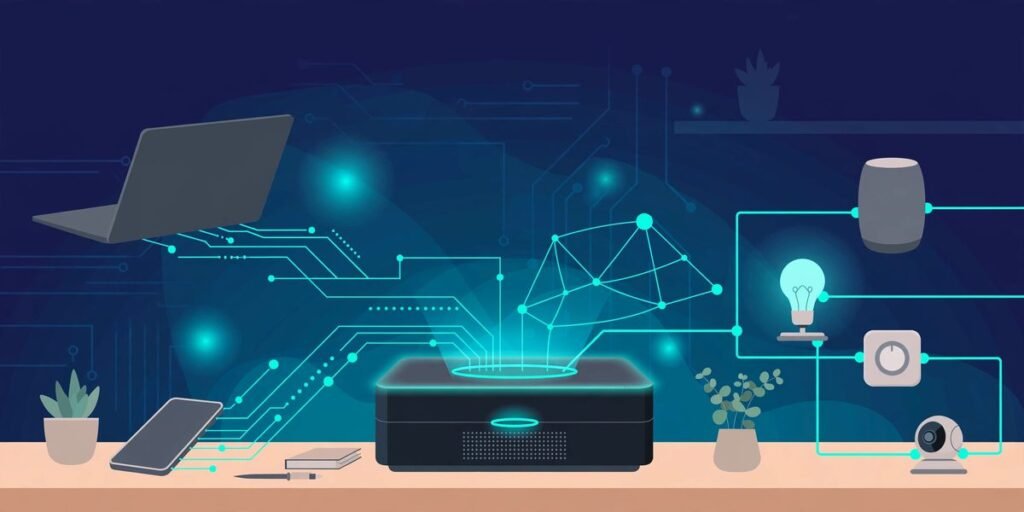
Ghost has built the most interesting AI hardware product of 2026: Core, a $3,499 screenless computer whose entire job is to be your on-device personal AI assistant — running AI agents on your files, your apps and your smart home without sending your life to someone else’s cloud. The verdict up front: the engineering ambition is genuine and the hardware is serious, but you are being asked to preorder unproven v1 hardware from a company that only just emerged from stealth, and the privacy story has more fine print than the marketing suggests. If you handle sensitive data for a living — legal, finance, healthcare, or any founder whose business plans live in their notes — this is worth understanding properly before you decide. This review breaks down what Core actually is, what it costs, who it is for, and the honest limitations nobody in the launch coverage dwells on.
What Ghost Core actually is
Ghost is a startup founded by 19-year-old Zain Javaid, a former quantitative analyst who pivoted to personal AI after the release of ChatGPT in 2022. The company emerged from stealth on 5 October 2026 with an $11 million seed round led by Andreessen Horowitz, alongside Abstract, Audacious Ventures, SV Angel and Nova, and announced its first product the same day. The founding team — Javaid, Nicholas Chua (19), Yifei Chen (24) and Gautam Sharda (23) — spent roughly a year building Core in stealth before opening preorders, with shipping scheduled for the last week of October 2026.
Core is deliberately unlike any computer on your desk. It has no screen and no microphone. It is a compact box you install at home, and you interact with it through a dedicated phone or web app — including voice mode, where you speak into the app rather than the box. Ghost calls it a “brain in a box”: a machine built to continuously run AI agents as personal assistants that learn your routines, build context from your digital life and carry out tasks without waiting to be prompted every few minutes.
The hardware: serious specs, and the GPU is bundled in
For $3,499, you should expect real hardware, and on paper you get it. Ghost’s product page lists an Nvidia RTX Pro 4000 SFF Blackwell GPU with 24 GB of GDDR7 ECC memory, an AMD Ryzen 5 7600 processor, 64 GB of DDR5 RAM and a 1 TB NVMe solid-state drive. The units are built at Ghost’s own San Francisco facility. Javaid has been explicit that the GPU is bundled into the price — you are not buying the box and then hunting for a graphics card on top, which goes some way to explaining why a screenless box costs as much as a high-end laptop.
On the software side, Core ships with three open models preinstalled: Qwen-3.8-Next, Qwen-3.8-27B and Gemma-4-31B. You are not locked to those — Ghost says users can download additional models from Hugging Face or load their own trained weights onto the device. It also runs its own software layer with a dedicated browser and filing system designed for AI-driven workflows, and it receives over-the-air model updates, which Javaid compares to Tesla’s approach: you can enable automatic updates or manually approve each new model generation.

What the on-device personal AI assistant actually does
The pitch is not “chatbot on a box” — it is continuous, proactive agency. Ghost says Core consolidates data from your desktop, your apps, your screen history, wearables and smart-home devices into one piece of hardware, then runs agents that keep working while you are not looking. The example Javaid gave TechCrunch is telling: Core could analyse heart-rate data alongside seasonal flu patterns and flag a possible illness before symptoms appear.
In practical terms, think of it as the automation layer many businesses already run on services like n8n or custom scripts — file organisation, cross-app workflows, repetitive task execution — except it lives on your hardware, builds memory about how you work, and acts without you issuing a prompt every few minutes. The privacy architecture is the core of the argument: all models and personal memory run locally, personal data is encrypted, and Javaid claims even Ghost itself cannot meaningfully access your information. He told TechCrunch: “All of the source code, logic, and model weights live on the device, not the services.”
- Connects your digital life: apps, files, browser, smart-home devices and personal information, building context over time.
- Acts continuously: agents work in the background instead of waiting for a manual start on every task.
- Speaks your models: three open models preinstalled, plus anything you can pull from Hugging Face.
- Firewall layer: Ghost is developing a monitor for every outgoing network request that blocks and flags unsanctioned actions — a genuinely thoughtful safeguard for giving an autonomous agent access to your credentials.
Pricing: $3,499, no subscription, 30-day returns
The price is a one-time $3,499 with no subscription, and Ghost offers 30-day returns — both meaningful in a category littered with devices that locked early buyers into monthly fees (ask anyone who bought a Humane AI Pin). But let us do the honest total-cost-of-ownership maths, because this is where business buyers should spend their time. A ChatGPT Plus subscription is $20 a month, or $240 a year. At that rate, $3,499 buys roughly fourteen and a half years of cloud AI. Core does not win that comparison on price, and it is not trying to: the argument is unlimited local inference with no rate limits, no per-token billing, and your data never training anyone else’s model. If you run heavy agent workloads daily — hundreds of thousands of tokens a week — the cloud API bill can genuinely reach hundreds of dollars a month, and that is where a one-time box starts to make sense.
What the headline price does not include: electricity for a machine designed to run around the clock, and your time. An always-on GPU appliance will add a noticeable line to your power bill, and you are the system administrator of this box — updates, troubleshooting and model management are yours. For a business evaluating it as infrastructure, price it against a cloud VM with a comparable GPU and your engineering time, not just against a chatbot subscription.

The privacy promise — and the fine print
Ghost’s privacy marketing is the strongest in the AI hardware category: local execution, encrypted storage, no cloud fallback for conversational AI and memory, and an architecture designed so the device keeps working even if Ghost itself shuts down. For founders and professionals handling sensitive data, this is the entire value proposition — an AI tool that structurally cannot leak your board decks or client contracts into a training pipeline.
But read the privacy policy, not just the product page, and the boundary narrows. Reporting on the launch noted that online features can send task information through a Ghost-managed gateway to third-party providers, and connected services may receive content — Ghost says its gateway and remote-access relay do not retain what passes through, but third parties may keep task information under their own policies. That is not a scandal; any agent that books flights or checks prices must talk to the internet. It does mean “your data never leaves the home” is the default mode, not an absolute guarantee. Understand the privacy settings and connected services before you grant an agent access to anything sensitive.
Who Ghost Core is actually for — and who should skip it
Buy it if: you are a founder, executive or professional whose sensitive work lives in your files and messages, and you want agentic AI without cloud exposure. Legal, finance, healthcare-adjacent and R&D teams are the obvious fit. It also suits tinkerers who already run local models and want a purpose-built appliance instead of a cobbled-together rig.
Skip it if: you need frontier model quality today — a 31B open model running locally will not match the best cloud models on hard reasoning tasks. Skip it too if $3,499 is a stretch, because this is unproven v1 hardware: at the time of writing, there is no independent hands-on review and no shipping confirmation, only preorders. And skip it if you want an appliance you never think about — an always-on AI computer with agent permissions is infrastructure, and infrastructure needs an owner.
How it compares to the alternatives
- Cloud AI subscriptions (ChatGPT Plus, Claude Pro): a fraction of the cost, frontier model quality, zero setup — but your data lives on someone else’s servers and heavy agent use racks up API bills fast.
- A Mac Mini running local models: Javaid’s own comparison point. General-purpose, flexible, often cheaper — but you configure, tune and maintain everything yourself, and the software is not built around agents.
- DIY home server with Ollama or similar: the tinkerer’s route, and genuinely good now — but it is a project, not a product, and agent orchestration is still on you.
- Failed AI gadgets (Humane AI Pin, Rabbit R1): the cautionary tale. Ghost’s advantage is that Core is a real computer with real specs and an open model ecosystem, not a thin client renting cloud intelligence. The disadvantage is shared: unproven, expensive, and asking you to trust a startup’s roadmap.
The honest frame: Ghost is not competing with ChatGPT. It is competing with the idea that your personal AI should be a tenant on someone else’s computer. That is a philosophical bet as much as a product bet — and it is why the company, not just the box, matters.
From our experience: what we would tell a client
We build AI integrations and automations for businesses, so here is the practitioner read. The single most important question is not the specs — it is whether you have agent workloads worth hosting. Most businesses asking about AI hardware do not; they have three or four automatable workflows that run fine on a $20/month tool or a scheduled cloud function. Core only earns its price if you have continuous, data-sensitive agent work: monitoring, triage, research synthesis across private sources, always-on assistance. Audit your workloads first. If you can list five daily agent tasks that touch sensitive data and would run for hours, the maths starts to work. If you cannot, you are buying a philosophy, not a tool.
The second question is trust in the roadmap. Ghost is promising OTA model updates, an outgoing-request firewall and continued operation even if the company fails. All of that is credible engineering intent — and all of it is unproven. With v1 hardware from a stealth-emerged startup, the sensible posture is: watch the first batch, read the independent reviews when they land, and decide with evidence. The 30-day returns policy at least gives early buyers an exit ramp.
Frequently asked questions
How much does Ghost Core cost?
Core costs $3,499 as a one-time purchase with no subscription, and Ghost offers 30-day returns. The price includes the Nvidia RTX Pro 4000 SFF Blackwell GPU, so there is no separate graphics card to buy. Preorders opened on 5 October 2026, with first shipments scheduled for the last week of October.
Does Ghost Core really keep all data on the device?
Conversational AI and personal memory run locally with encrypted storage, and Ghost claims it cannot meaningfully access your data. However, the privacy policy notes that online features can route task information through a Ghost-managed gateway to third-party providers. Local-first is the default; it is not absolute for internet-connected tasks.
Which AI models does Ghost Core run?
Three open models come preinstalled: Qwen-3.8-Next, Qwen-3.8-27B and Gemma-4-31B. You can also download additional models from Hugging Face or load your own trained weights, and Ghost pushes over-the-air model updates you can accept manually or automatically.
Is Ghost Core better than a Mac Mini for local AI?
It depends on what you value. A Mac Mini is cheaper and general-purpose, but you configure and maintain the AI stack yourself. Core is purpose-built for AI agents with models preinstalled, an agent-oriented software layer and a phone-app control interface. You are paying for integration and specialisation, not raw compute alone.
Who should buy an on-device personal AI assistant like Ghost Core?
Professionals and founders handling sensitive data — legal, finance, healthcare, R&D — who want agentic AI without cloud exposure, plus tinkerers who want a turnkey local-AI appliance. If you need frontier model quality, have light AI workloads, or cannot afford a $3,499 experiment, it is not for you yet.
Ghost Core is the boldest bet yet that personal AI should live in your home, not in a data centre. Whether a $3,499 box from a brand-new company earns that place depends on the first batch shipping, the agents proving useful, and the privacy claims holding up under scrutiny. We will be watching. If you are evaluating AI hardware, local models or agent automation for your business, talk to us — we build AI systems that fit the workload, on whatever infrastructure the workload actually justifies.