

If you have been watching the agent-coding space for the last year, you have felt a shift: multi-agent AI orchestration has quietly become the default architecture for serious automation work. One developer and one prompt is the demo; swarms of specialized agents that plan, delegate, verify, and remember are where production systems are actually heading. Ruflo — ruvnet/ruflo on GitHub — is the clearest expression of that shift: an open-source, MIT-licensed agent harness with over 75,000 stars, nearly 9,000 forks, and a pitch summarized in the project’s own README as “Agent = Model + Harness. The model writes; the harness gives it tools, memory, loops, sandboxes, and controls so it can actually work.”

Concretely, this is what Ruflo puts around your agent environment — and why it matters:
What Ruflo Actually Is
Ruflo describes itself as “the original agent harness,” and the most useful way to understand it is through the project’s own mental model: a model on its own can write code, but it cannot hold context across sessions, coordinate teammates, remember what worked, or enforce policies. Ruflo is the layer that adds all of that around Claude Code and Codex.
Concretely, the project ships:
- 100+ specialized agents — pre-built agent roles for coding, testing, research, planning, review, and more, rather than one generalist agent trying to do everything.
- Swarm coordination — agents self-organize into teams; work is decomposed, delegated, and merged by the harness rather than by the model ad hoc.
- Self-learning memory — adaptive memory that learns from every task and remembers across sessions, backed by local vector retrieval (the project notes that local vector retrieval and contrastive updates can run without an LLM).
- Federation — agents on different machines can collaborate securely “without leaking data,” per the README.
- Enterprise security guardrails — permission levels (read, write, manage, full) with ask-or-auto approval, and confirmation requirements on network, spending, and destructive actions even in auto mode.
- A visual console — a mission-control cockpit (also runnable as a standalone terminal UI via
npx ruflo tui) showing overview, cost, swarm graph, events, and missions. - 35 plugins — covering orchestration, vector memory and Graph RAG, local LLM routing (Ollama), browser testing with Playwright, test generation, knowledge graphs, and more.
How Multi-Agent AI Orchestration Works in Ruflo
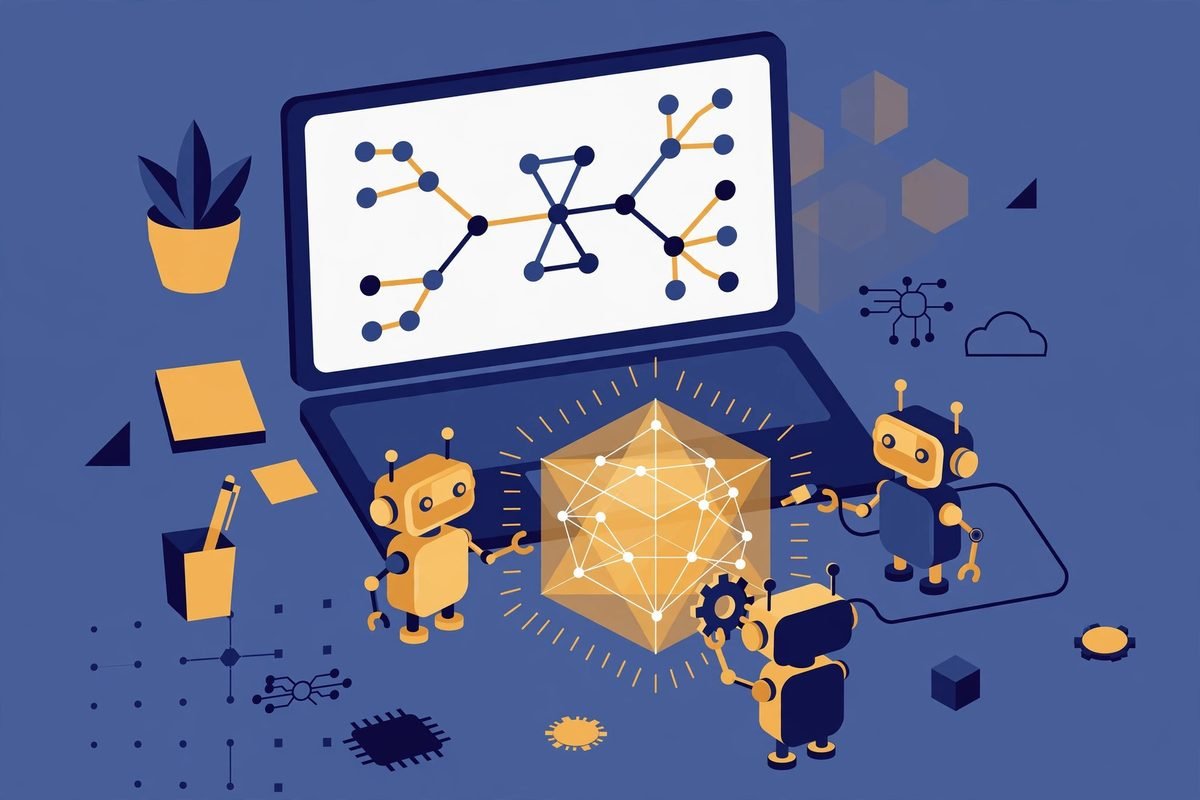
The architecture, as the project diagrams it, is: User → Ruflo (CLI/MCP) → Router → Swarm → Agents → Memory → LLM providers, with memory feeding useful experience back into routing. In plain terms: your request hits a router that decides how to break it up, a swarm of agents executes the pieces in parallel or in sequence, and the memory layer records what happened so the next similar task is faster and better.
Two details matter for anyone evaluating this seriously. First, memory is local-first: vector retrieval and contrastive learning updates can run without an LLM call, so the learning loop does not add token cost on every step — a meaningful design choice in a category where most “memory” features quietly multiply your API bill. Second, the project ships two very different install paths: a lite Claude Code plugin path (slash commands and agent definitions, zero files in your workspace) versus the full CLI install with hooks, MCP server, daemon, 98 agents, 60+ commands, and 30 skills. For production use, the README is explicit: the full CLI track is where “everything works as documented.” After init, you keep using Claude Code normally while a hooks system routes tasks and coordinates agents in the background.
Why It’s Trending: The Problem Multi-Agent Orchestration Solves
Why did 75,000 developers star an orchestration harness? Because the single-agent loop hits a wall that every serious user recognizes: sessions degrade, agents forget instructions, and — critically — you pay for tokens that produce nothing. Token waste is the unglamorous bottleneck of the whole category, and orchestration is how you attack it.
The economics are simple once you see them. A single generalist agent tackling a large task re-reads files, re-discovers context, and makes whole runs that fail at step 12 and must be restarted. A swarm decomposes the work: one agent researches, one implements, one tests, one reviews — each with a scoped context window, each working in parallel. The coordination overhead is real, but it is usually smaller than the cost of a generalist thrashing through a context window it has polluted.
Timing matters too. Ruflo is built on top of Claude Code and Codex — the two agent environments that professional developers actually live in — rather than asking you to adopt a new chat app. It rides the wave instead of fighting it. The project was also updated on the day we checked it (October 17, 2026), with 1,066 open issues being worked through — this is a living, heavily-maintained codebase, not an abandoned demo.
Getting Started with Ruflo
Two paths exist. The lite plugin path is for trying things out; the CLI path is the real harness. Here is the quick start for each, straight from the project documentation.
- Lite path (Claude Code plugins): open Claude Code and run:
/plugin marketplace add ruvnet/ruflo, then/plugin install ruflo-core@ruflo,/plugin install ruflo-swarm@ruflo, and whichever plugins you need, then/reload-plugins. This adds slash commands and agent definitions with zero files written to your workspace. - Full path (CLI, recommended): in your project terminal, run
npx ruflo init. This sets up hooks, the MCP server, agent definitions, and configuration files (.claude/,.claude-flow/,CLAUDE.md). - Open the console: inside Claude Code, run
/rufloto open the mission-control cockpit — overview, cost tracking, swarm graph, events, and missions. Or runnpx ruflo tuiin a plain terminal with no Claude Code at all. - Set your permission boundary first: in Settings → Claude control, choose a permission level (
read,write,manage,full) withaskorautoapproval. The default isread + ask. Do not raise it toautountil you understand what a swarm can do with file writes. - Create your first mission: try something concrete, e.g. “Create a mission to add a dark mode toggle. Show me the mission and its status.” Approve the creation, then verify in the console that the mission and its status appear. Creating a mission is not the same as implementing the feature — verify the actual output yourself.
- Connect other clients via MCP: for Codex or other MCP-enabled tools, run
npx ruflo@latest init wizard, then configure your client with commandnpxand arguments["-y", "ruflo@latest", "mcp", "start"].
One caution the README states plainly and we echo: mods “run with your account’s permissions and are not sandboxed, so read the code first.” This is open-source infrastructure with 75,000 stars, MIT-licensed — but convenience is not a substitute for review.
From Our Experience: When Multi-Agent Orchestration Is (and Isn’t) Worth It
We have built agent-powered systems for clients across nine-plus years and 300+ projects, and our honest position on multi-agent orchestration is that it is both underrated and over-sold. The underrated part: for genuinely decomposable work — research a topic, draft content, verify facts, format output — swarms are faster and cheaper than a single agent doing everything serially. The failure mode of single agents is not that they are dumb; it is that they pollute their own context and keep going anyway. A swarm with scoped agents and a shared memory avoids most of that.
The over-sold part: orchestration adds a coordination tax, and for simple tasks that tax exceeds the savings. If your task fits comfortably in one prompt and completes in one shot, spinning up a swarm is theater — slower, more expensive, more moving parts to fail. The break-even point we have observed is roughly: tasks that would take a single agent more than a few minutes, with clearly separable sub-tasks, and where you care about repeatability. Below that line, keep it simple.
Three honest limitations worth naming. First, this ecosystem moves fast and breaks things: 1,066 open issues on a TypeScript monorepo of this size means you will hit rough edges, especially where hook behavior depends on your client. Second, cost observability is not cost control: the console shows token and cost dashboards, but a swarm that runs wild is a billing incident — set approval gates before delegating, not after the first surprise invoice. Third, federation is a trust boundary: agents talking across machines “without leaking data” is a strong claim that your security review should interrogate, not accept.
Our practitioner rule of thumb: adopt orchestration for your highest-volume repeatable workflows first — the ones where you can measure the before/after — not for everything at once. If you want help designing that first workflow, our AI integration and automation services cover exactly this: picking the right harness, scoping the first swarm, and proving the ROI before scaling. You can also browse more tools we have reviewed in our AI Tools Directory.
A Responsible-Use Note
A harness that can run autonomous agents across machines, with local models and browser automation, is dual-use by nature. Ruflo to its credit builds in permission tiers, approval gates, and action logging. But guardrails in the tool do not replace judgment in the operator: never grant full + auto to a swarm whose code you have not reviewed, never point autonomous agents at production systems without human approval gates, and treat the “ask” approval mode as the default for anything that touches money, data, or customers.
Frequently Asked Questions
What is Ruflo?
Ruflo (github.com/ruvnet/ruflo) is an open-source, MIT-licensed agent harness — an execution layer around Claude Code and Codex that adds 100+ specialized agents, coordinated multi-agent swarms, self-learning memory, cross-machine federation, vector RAG integration, and a visual console. It has over 75,000 GitHub stars.
Is multi-agent AI orchestration better than a single AI agent?
For decomposable, multi-step work — yes: scoped agents work in parallel with smaller context windows, shared memory prevents re-learning, and the per-task cost compounds downward. For simple one-shot tasks, a single agent is faster and cheaper. Orchestration pays off when tasks take minutes, split into separable sub-tasks, and repeat often enough to amortize setup.
Is Ruflo free?
Yes — Ruflo is MIT-licensed and free to use. Your costs are the underlying LLM API usage plus your infrastructure; the console includes cost tracking so you can watch token spend per swarm.
Does Ruflo work with Codex or only Claude Code?
Both. The lite plugin path targets Claude Code (requires version 2.1.287 or later); Codex and other MCP-enabled clients connect through the Ruflo MCP server via npx ruflo@latest init wizard. The console can also run standalone in a terminal with no Claude Code at all.
What are the risks of multi-agent orchestration?
The main ones: coordination overhead that can exceed savings on simple tasks, runaway token costs if approval gates are not set (use ask mode before delegating), rough edges in a fast-moving codebase, and security review needed for federation. Start with one high-volume repeatable workflow and measure the ROI before scaling.
Multi-agent AI orchestration is one of those rare ideas that is both a genuine technical advance and a genuine source of over-hyped complexity. Ruflo earns its 75,000 stars by making the advanced version accessible — local-first memory, a real console, and a plugin ecosystem — without hiding the trade-offs. If your team is running agents at any serious volume, this is the category of tool you should understand before your API bill teaches it to you. And if you want that understanding converted into a working pipeline rather than a weekend experiment, talk to us — we have been shipping automation systems long enough to know where the ROI actually lives.