

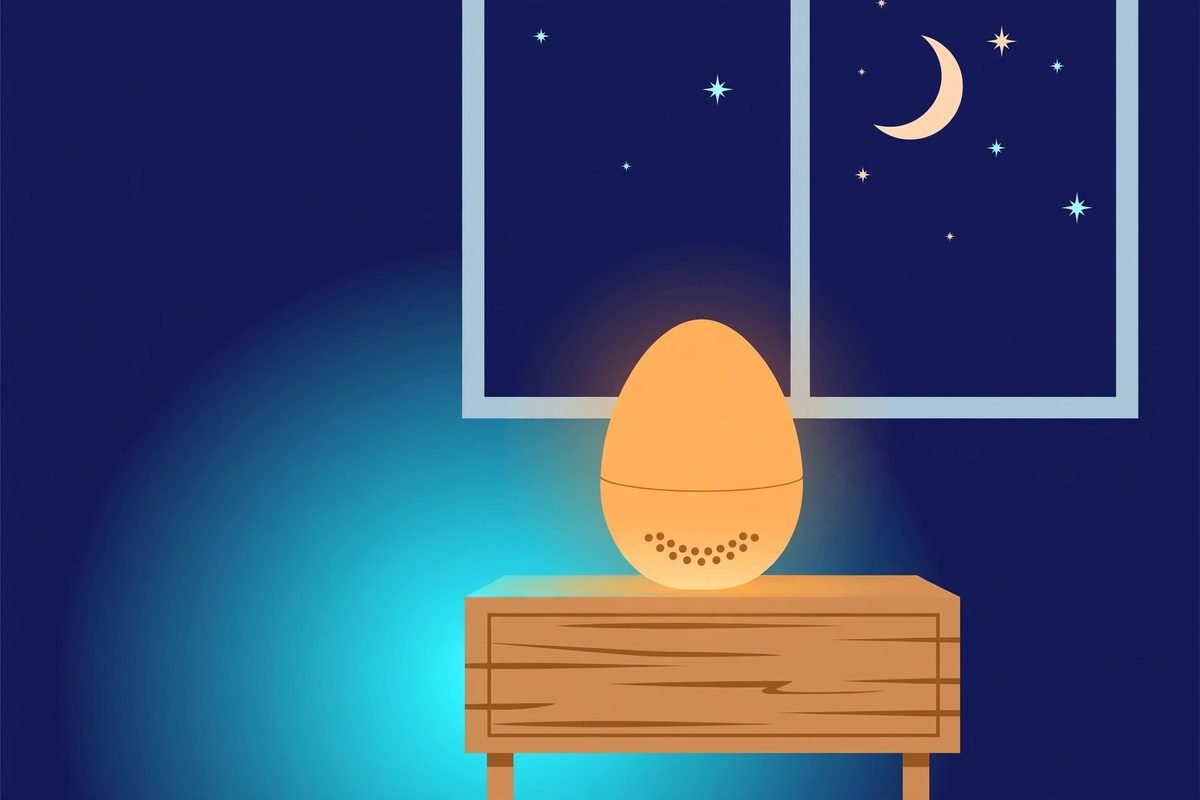
Verdict up front: Naptick is the most interesting AI sleep app we have looked at in 2026, and the reason is embarrassingly simple. It targets the thirty minutes before you fall asleep instead of writing a report on the eight hours after. Most sleep products are morning journalists: they hand you a sleep score, tell you that you slept badly, and leave the fixing entirely to you. Naptick, an egg-shaped bedside device from Naplabs Solutions, reverses the sequence. It checks your room conditions, eases the lighting down, adapts the soundscape to how you are settling, locks your distracting apps, and talks you through the day with an AI sleep coach, all before you close your eyes. This is a pre-launch review based on the company’s published material, its Product Hunt launch, and its sleep-science white paper, not a hands-on test. But as developers who build AI systems for a living, the architecture is what caught our attention: a closed loop of sensing, reasoning, and environmental action. Not another dashboard.
What Naptick actually is: an AI sleep app for the wind-down window
The hardware is a small egg-shaped bedside device, and the company frames the wider vision as a sleep operating system. At its core sits a proprietary sleep language model trained to interpret nightly signals: sleep onset latency (how long it takes you to fall asleep), wake-after-sleep-onset, total sleep time, sleep efficiency, and chronotype. The data comes from syncing with mainstream wearables such as Whoop, Apple Watch, and Fitbit. The point of the model is not scoring; it is diagnosis. It is meant to detect what is holding you back, what is working, and what needs to improve, then adapt the bedroom environment in real time. A companion device called Naphome is on the roadmap: a discreet, ambient unit that would adjust sound, light, and subtle environmental cues through the night. The team has also published a sleep-science white paper, Reclaim Your Nights, mapping each product feature to mechanisms in the sleep literature: thermoregulation, light exposure, sound masking, and wind-down rituals. It is self-published, so read it as a design rationale rather than a clinical trial, but it is a step more serious than most launch marketing.
The six levers it pulls every night
Where a tracker has one trick, measurement, Naptick pulls six levers in a coordinated routine:
- Room condition intelligence: the device assesses whether your bedroom is actually sleep-ready, temperature, light, and noise, and flags what is wrong.
- Over 1,000 adaptive soundscapes: nature, brown noise, piano, and meditation from a licensed content library, evolving as you settle rather than looping a single track.
- An AI sleep companion: talk it through before bed, unload the day’s clutter, get guided breathing or a reflection prompt, as a voice conversation rather than an app screen.
- App-locking for phone discipline: blocks distracting apps as part of the night routine, so the doomscroll hits a closed door.
- Circadian-inspired lighting: warm dimming cues at night to nudge melatonin; gentle sunrise simulation in the morning instead of a jarring alarm.
- Physical bedside controls: tap, double-tap, rotate, and long-press, so you can run the whole routine without picking up your phone.
The phone-free by design choice is the product’s sharpest insight. The app exists mostly for setup and preferences; the bedside device handles the nightly work. Every sleep app that requires your phone at midnight is fighting the very behaviour it claims to fix.

What it costs, and the pre-launch pricing reality
Pricing is still pre-launch, so treat everything here as the company’s current published position rather than a checkout page. The device’s pre-launch listing carried a $149 price point, and the team is taking pre-orders through its launch page ahead of a planned Kickstarter. On Product Hunt, where the product launched in May 2026, the listed price is $0, which reflects the app and waitlist tier rather than the device. For context: an Oura ring starts around $299 plus a monthly subscription, a Hatch Restore is about $169, and Calm or Headspace run roughly $70 a year. Naptick at $149 for the device sits in the middle of that range. If it ships at that price with no mandatory subscription, it is aggressively priced for hardware with onboard sensing. Two unknowns matter more than the sticker price: whether a subscription will be required for the AI coaching features (nothing published yet), and what the shipping timeline is. Pre-order hardware carries real risk, and delivery dates slip. Do not pre-order with money you cannot afford to wait for.
Who Naptick is for
Founder Anubhab Goel’s launch post is explicit about the target: founders and high-performance professionals, people who scroll too much before bed, parents trying to create calmer nights, light sleepers, and wearable users who want interventions instead of scores. Read between the lines and the real persona is narrower: someone whose sleep problem is sleep onset, a racing mind, a glowing phone, a room that is slightly wrong, rather than a medical sleep disorder. If your problem is suspected sleep apnea or chronic insomnia, this is not the tool; talk to a clinician. If your problem is that you take forty-five minutes to fall asleep because your brain replays the workday, that is exactly the problem Naptick was designed around. Parents and shift workers with inconsistent routines are the other natural fit: the value of the device compounds when the wind-down is the same every night.

Five honest limitations
Five honest limitations, in the order they would worry us as practitioners:
- It is pre-launch hardware. There are no independent reviews, no teardown photos, no long-term user data. Everything we know comes from the company’s own material and press coverage of the launch.
- Naplabs Solutions is a small team. Public records put headcount in the single digits to low double digits. Hardware is brutally unforgiving; small teams can ship brilliant first runs and also go quiet for a year.
- The sleep-language-model claims are ambitious and, so far, self-described. A model that detects what is holding you back from wearable data is a genuinely hard personalisation problem. The gap between the marketing and the shipped behaviour is unknowable until real users report back.
- App-locking lives and dies by mobile OS permissions. On iOS especially, deep app-blocking needs Screen Time APIs and user cooperation; the feature will be weaker or clunkier than the marketing suggests on some phones.
- The white paper is a literature review, not a trial. It grounds the design in real sleep science, light, sound, temperature, routine, but nothing here has been tested in a controlled study.
None of this is disqualifying. It is the normal risk profile of pre-launch hardware from a small team, and the price of admission is knowing it.
How it compares to the alternatives
- Versus sleep trackers (Oura, Apple Watch, Whoop): trackers measure, Naptick acts. If you already own a wearable and ignore your sleep score, Naptick is the missing second half, and it integrates with your tracker rather than replacing it.
- Versus the Hatch Restore: the closest comparison. Hatch does light and sound routines well, but it has no AI coach, no room sensing, and no app-locking. Naptick is Hatch plus an interventionist brain.
- Versus sleep apps (Loona, Calm, Headspace): apps live on the phone, which is the scene of the crime. Naptick’s phone-free bedside design is a structural advantage for anyone whose problem starts with the phone in bed.
- Versus white-noise machines: cheaper, and fine if your only issue is noise. They do nothing for light, routine, or a racing mind.
The honest summary: if you want data, buy a tracker. If you want a wind-down ritual you will actually keep, the integrated approach is the more interesting bet. You can explore more tools like this in our AI tools directory.
From our experience: the architecture is the story
From our experience building AI systems at MTD Technologies, what makes Naptick worth watching is the architecture, not the gadget. Most consumer AI products are chatbots stapled onto a database. Naptick is closer to an agent: it senses (room conditions, wearable data), reasons (the sleep model decides what is off), and acts (light, sound, locks) in a closed loop, the same sense-decide-act pattern we build into AI workflow automations for clients, just pointed at a bedroom instead of a business process. That pattern is why agentic systems outperform dashboards: the value is in what happens automatically, not what gets displayed. Who should buy? Anyone with a genuine sleep-onset problem, a tolerance for pre-launch risk, and $149 they can wait on. Who should wait? Anyone who needs proven efficacy, clinical validation, or a device this month, and any business evaluating it for employee wellness programmes, where you would want published outcomes data first. If you are building hardware-adjacent products yourself, device apps, companion platforms, wearable integrations, that is the kind of work our custom development team does every week; the integration patterns, Bluetooth pairing flows, background sync, on-device inference, are directly transferable.
Frequently asked questions
Is Naptick available to buy right now?
Not yet as a shipping product. The company is taking pre-orders through its launch page at a $149 price point, with a Kickstarter campaign planned. Treat any delivery date as an estimate: pre-launch hardware timelines routinely slip.
How is Naptick different from a sleep tracker like Oura or the Apple Watch?
Trackers report what happened after you slept; Naptick intervenes before you sleep. It measures room conditions, adapts light and sound, locks distracting apps, and offers an AI sleep coach, then syncs with your existing wearable so the data feeds the interventions.
Do I need a wearable for Naptick to work?
No. The device works standalone with its room sensing and routines. Wearables like Whoop, Apple Watch, and Fitbit add a feedback loop, the sleep model learns from your actual sleep metrics, but they are not required.
How does Naptick compare to the Hatch Restore?
Both use light and sound routines, but Naptick adds an AI sleep coach, room-condition sensing, adaptive soundscapes, app-locking, and physical phone-free controls. Hatch is a proven, shipping product; Naptick is the more ambitious, pre-launch alternative.
Does Naptick require a subscription?
The company has not published subscription pricing. The device pre-order is $149, and the Product Hunt listing shows a $0 tier, which appears to cover the app and waitlist. Confirm what the AI coaching costs before you pre-order.
Sleep tech has spent a decade perfecting the morning report. Naptick’s bet is that the report was never the product; the wind-down was. A closed loop of sensing, reasoning, and environmental action is a genuinely better architecture for behaviour change than another score to ignore, and $149 is a reasonable price to find out whether the execution matches the idea. If you are evaluating AI tools for your business with the same scepticism, what it actually does, what it costs, where it breaks, that is exactly how we assess technology for clients. Talk to us before your next build-or-buy decision.