
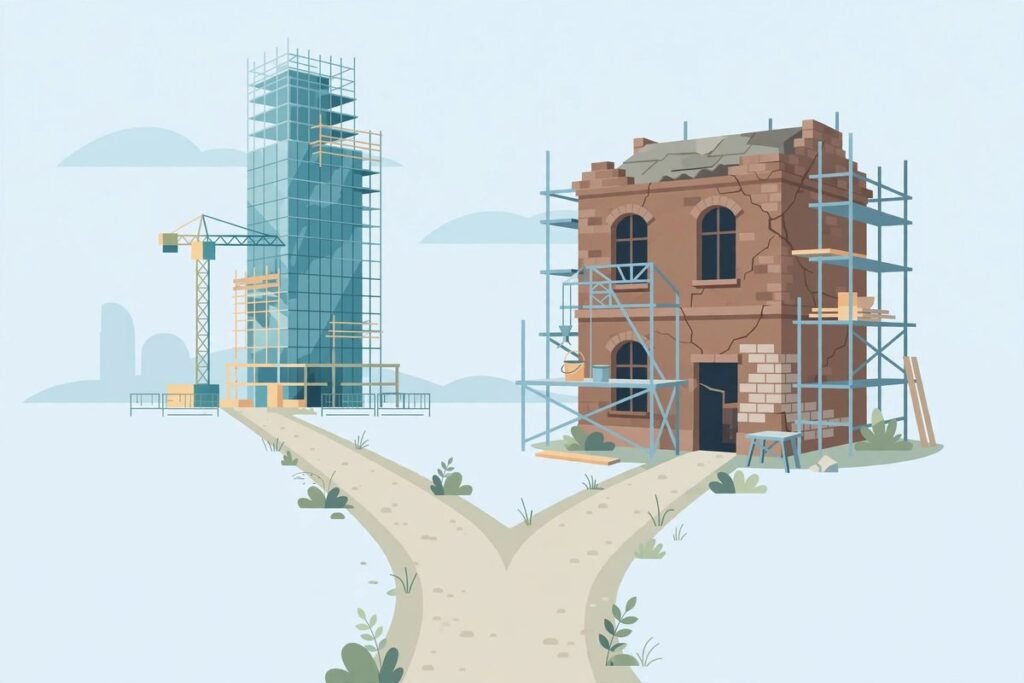
Every business owner with a creaky internal system eventually asks the same question: should we rebuild this software from scratch, or refactor what we’ve got? It’s one of the most expensive decisions a business can make — and one of the most emotional. Developers usually want to rebuild. Finance usually wants to refactor. Both are often wrong.
We’ve rescued and replaced legacy systems for years — aging PHP monoliths, Access databases that somehow run entire companies, internal tools nobody dares to touch. Here’s the framework we actually use to answer the rebuild vs refactor question, grounded in what the industry is saying in 2026.
The Wrong Way to Decide
Most rebuild-vs-refactor decisions get made on vibes. The developers hate the codebase, so they lobby for a rewrite. The owners fear the bill, so they insist on patching. Neither side is reasoning from evidence.
The seductive option — the clean rewrite — is statistically the most dangerous. A working system holds years of buried business logic: edge cases, regulatory rules, pricing quirks, approval flows that exist because of one incident nobody remembers anymore. A big-bang rebuild has to rediscover all of that from scratch, usually under a deadline, while the old system still has to be maintained in parallel. That’s why so many rewrites run over time, miss behaviours of the system they replaced, and stall halfway.
Industry practitioners keep converging on the same conclusion: most systems that feel beyond saving are suffering from accumulated mess, not a broken foundation — and accumulated mess is a refactoring problem. As Ciklum’s analysis of the refactor vs rebuild software decision puts it, the bar for choosing a rebuild should be high, and whichever way the decision leans, default to the incremental path.
The Five Questions That Actually Decide It
Forget gut feel. Score your system against five factors — this five-factor framing matches what consultancies like Omni Care use in their rescue-or-rebuild scorecard:
- Does the business logic still fit? If the software still models how your business works and the pain is contained in a few known areas, refactor. If the core assumptions are wrong — the data model no longer fits how the business operates — a rebuild starts looking rational.
- Can the code be changed safely? If there are no tests, no documentation, and nobody understands the code, every change is a gamble. When discovery (figuring out what the system does) costs more than the change itself, you’re past a threshold where rebuilding a bounded part may be cheaper.
- Is the platform still supported? Frameworks and PHP/Python versions that haven’t seen security updates in two years are a liability, not a quirk. An unsupported platform is one of the clearest rebuild signals.
- Does anyone own and understand it? If the original developers are gone and knowledge transfer never happened, refactoring means reverse-engineering. Sometimes that’s fine; sometimes it’s slower than re-specifying from how the business actually operates today.
- How large is the change the business now needs? A facelift and new integrations are a refactor. Pivoting to multi-tenant SaaS when the system was built as single-tenant is a rebuild.
If most answers are healthy, refactor. If most are broken and the required change is large, rebuild the affected capability. When the answers are mixed — the most common case — the hybrid path wins: keep the parts that work, replace one failing capability at a time behind a stable interface.
When Rebuilding Is the Right Call
Rebuild when the foundation itself genuinely cannot support where the business is going. The clear signals:
- The architecture fundamentally conflicts with the product’s future (e.g., a monolith that must become a distributed, multi-tenant platform).
- Core dependencies are abandoned or impossible to maintain securely.
- Security problems are embedded in the system’s design, not just its code.
- Fixing the existing architecture demonstrably costs more than replacing it — a useful rule of thumb floating around in 2026: when refactoring estimates reach roughly two-thirds of a rebuild’s cost, build new.
- The critical business logic is easier to re-specify from how the business works today than to untangle from the old code.
One caveat that bites nearly everyone: a rebuild must re-learn every rule the old system quietly enforced. Budget real time for behaviour capture — integration tests, production traces, shadowing the old system — not just writing new code. If you can’t afford that validation window, you’re not ready to rebuild.

When Refactoring Wins
Refactor when the foundation is sound and the mess is accumulated, not structural. The clear signals:
- The framework is current but the codebase has rotted — dead code, tangled dependencies, missing tests.
- Performance problems have identifiable causes (slow queries, missing indexes, chatty APIs).
- The team can still understand the system, and tests can be written around the important behaviour.
- The business needs new features fast; a refactor ships incremental value while a rebuild blocks everything for months.
A practical modernisation approach follows tiers: rehost (move infrastructure, 2–6 weeks), refactor (restructure code on the same stack, 2–4 months), rearchitect (change structure incrementally, 4–9 months), rebuild (full rewrite, 6–18 months). Netguru’s legacy modernisation tiers lay this out well — and the key warning is that picking the wrong tier is the single biggest reason legacy projects blow their timelines. Aim for the lowest tier that actually fixes the problem.
The Third Option: Replace It Piece by Piece
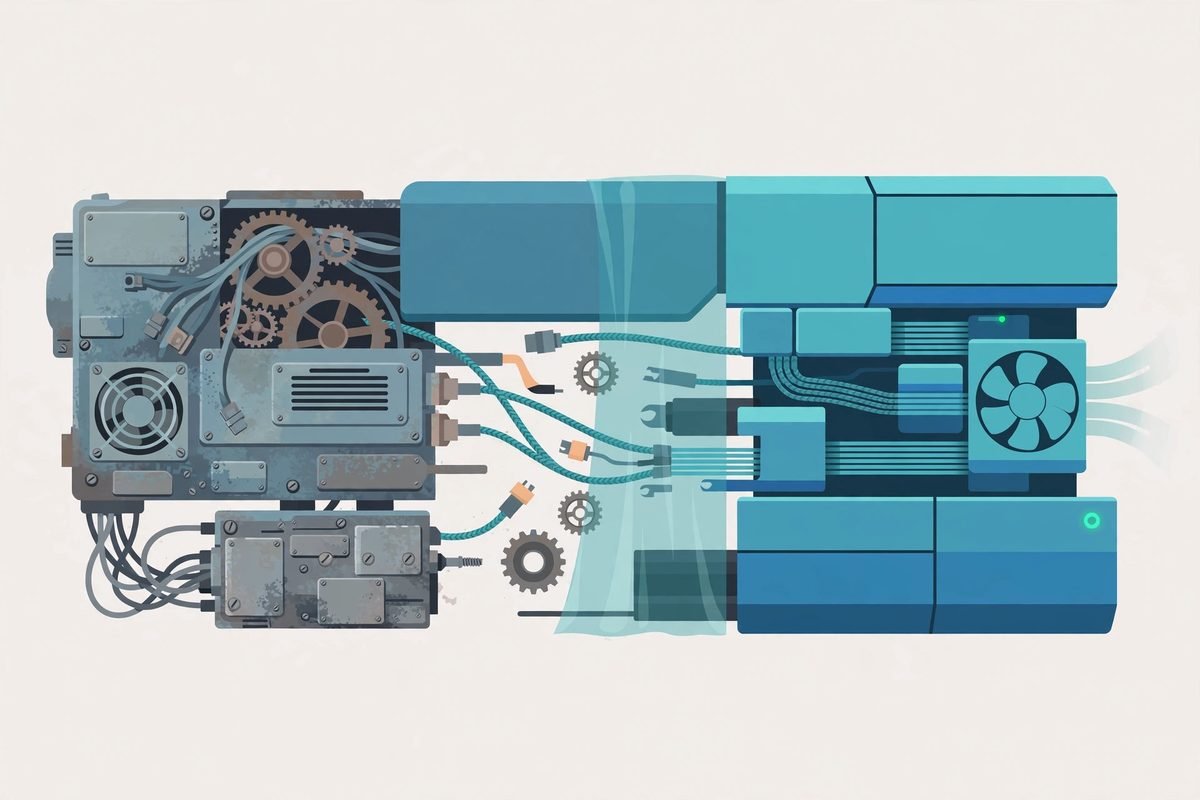
The option teams forget exists is the strangler-fig pattern: build the new alongside the old, route traffic through a stable interface, and migrate capability by capability while the business keeps running. Replace the authentication layer. Keep the database. Rebuild the API. Preserve the stable UI components.
This captures most of the benefit of a rebuild with a fraction of the risk — no big-bang cutover, no parallel-maintenance death march, no rediscovering a decade of edge cases in one go. For most legacy business software, this is the default we recommend: targeted refactors plus selective replacement, not wholesale rewrites.
Costs, Timelines, and the Conversation to Have With Your Vendor
Don’t accept a rebuild quote without a behaviour-capture plan. Ask how they’ll document what the old system does before touching it, how they’ll prove parity, and what the cutover plan looks like if something goes wrong. For a refactor, ask what the first three milestones are and how they’ll demonstrate that change is actually getting safer — test coverage trends and change lead time are honest indicators.
And be honest about sequencing: a business that can’t tolerate downtime needs the incremental path almost by definition. If you’re running custom software that your operations depend on, the cheapest option that keeps you running is usually the right one.
Frequently Asked Questions
Is it usually better to refactor or rebuild legacy software?
Refactoring is the right call more often than teams expect. Most systems that feel beyond saving are suffering from accumulated mess rather than a broken foundation. If the core technology, architecture, and data model can still support where the business is going, refactoring improves the system while keeping it in production at a fraction of a rewrite’s risk. Rebuild only when the foundation itself genuinely cannot support the future.
How long does it take to rebuild a legacy system?
A full rewrite typically takes 6–18 months depending on scope, plus the behaviour-capture and migration work that vendors often underquote. Refactoring the same system usually runs 2–4 months for meaningful improvement, and incremental replacement (the strangler-fig approach) stretches 4–9 months but delivers working software throughout. The timeline that matters most is time-to-first-business-value, not time-to-completion.
Why do software rewrites fail so often?
Because a working system holds years of accumulated knowledge — edge cases and business rules invisible until they’re gone. A big-bang rewrite must rediscover all of it from scratch, under a deadline, while the old system still runs. Rewrites commonly overrun, miss behaviours of the system they replaced, and stall halfway. The failures are almost always about lost knowledge, not bad new code.
Should we keep the old system running during the replacement?
Almost always yes. Run the new implementation in parallel and use integration tests or production traces as the specification for parity, then swap traffic behind a flag and retire old code paths progressively. If your vendor proposes a single cutover weekend with no parallel run, push back — that’s where the horror stories come from.
Rebuilding or refactoring isn’t really a technical decision — it’s a business-risk decision. Score the five questions honestly, favour the lowest-risk tier that fixes the real problem, and remember the third option. If your legacy system is slowing you down and you’re not sure which path fits, talk to us — we’ll audit it and tell you straight, even if the answer is “don’t touch it yet.”