
Every production AI agent has the same quiet embarrassment: it is brilliant on launch day and never gets better. The model underneath it keeps improving with every release from the labs, but your agent — the prompts, the tool wiring, the way it handles your customers’ edge cases — stays frozen exactly as your team left it. That is the gap self-improving AI agents infrastructure is being built to close, and right now the most serious open-source attempt at it is a project called Reef, sitting at 7,662 stars on GitHub and updated within the last day.
Reef describes itself plainly: “infrastructure for continually self-improving agents.” It connects four things that usually live in four different tools — agent inference, feedback collection, learning, and versioned delivery — so that an agent can serve live traffic, learn from real interactions, and ship improvements to itself without a redeploy. If that sounds like CI/CD for agent behaviour rather than code, that is exactly the right mental model, and it is why teams running agents in production should be paying attention.
What Reef actually is
Reef is a Python service (3.12+, Apache 2.0 licensed, distributed on PyPI as reef-infra) that sits between your users and your model. Requests flow through it like any other inference server — its endpoints are OpenAI- and Anthropic-compatible (/v1/chat/completions, /v1/responses, /v1/messages), so most existing agent code needs nothing more than a URL swap to route traffic through it. That compatibility choice is deliberate and smart: it lowers the adoption cost to nearly zero, which is how infrastructure projects win.
Where it departs from every inference engine is what happens after the response is served. Reef records the interaction, matches feedback to it later, runs a learning step to produce an improved candidate, evaluates that candidate against a selection policy, and commits accepted updates to a version history — all while the service stays live. The project’s own comparison table makes the positioning explicit: vLLM and SGLang serve live traffic but do not train; RL frameworks like Slime and veRL train weights but do not serve traffic; only Reef claims to do both, plus version management and hot updates, plus the ability to evolve things beyond weights — prompts, rules, and skills.
What it can do, concretely
Strip away the philosophy and Reef gives you five capabilities that map directly to production pain:
- Feedback plumbing for agents. Every served response carries a receipt (the
x-reef-agent-record-idheader). Later, a client posts a score, a text comment, or a structured feedback object to/reef/report, referencing that receipt. This is the missing primitive in most agent stacks: a standardised way to tie “that answer was wrong” back to the exact interaction that produced it. - Two learning surfaces. Reef can train model weights (using Slime and SGLang) for teams with a trainable model and GPU capacity, or improve an agent’s harness — its prompts, rules, and skills — for teams using third-party model APIs. The latter is the more interesting path for most businesses, because it needs no local GPUs at all.
- A built-in harness recipe. “Reefine” is a ready-made recipe that refines a coding harness from plain-language asks, sitting in front of any OpenAI-compatible upstream model. Point it at a local endpoint and it starts evolving harness behaviour without you writing a training pipeline.
- Versioned delivery with hot updates. Accepted updates synchronise to the serving runtime without restarting Reef. Later inference requests use the current version automatically. For anything customer-facing, that is the difference between “we improved the agent last Tuesday” and “we improved it every Tuesday automatically.”
- Scenario isolation. Requests carry an
x-reef-scenarioheader; a new name creates a scenario using the deployment’s configured recipe. This lets different products, teams, or use cases improve independently on the same deployment instead of contaminating each other’s learning signal.
Self-improving AI agents infrastructure: how Reef’s learning loop works
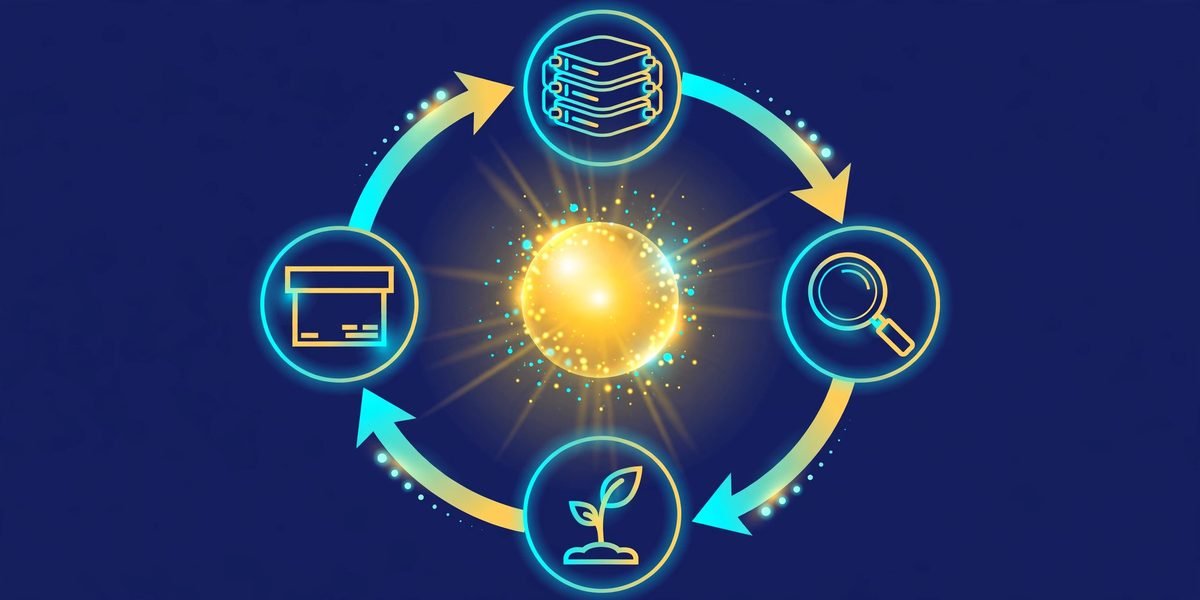
Reef processes each learning cycle in four steps, each implemented by dedicated modules in the codebase:
- 1 · Serve. Reef serves agent requests and records interactions (
reef/servicefor requests and interaction records,reef/runtimefor inference and artifact updates). This is the agent doing its normal job — the only difference is that everything is logged with learning in mind. - 2 · Observe. Feedback is matched to recorded interactions (
reef/storage/records.pyholds stored interactions and feedback;reef/record2recordhandles feedback matching and eligibility). Not every scored interaction is eligible for learning — the recipe defines what counts, which is how you keep noisy or adversarial feedback from poisoning the loop. - 3 · Grow. Eligible records feed a training step that produces an update candidate (
reef/recipefor recipe integration,reef/trainfor the training pipeline, batches, and update jobs). For weight training this means an actual training run; for harness evolution it means revised prompts, rules, or skills. - 4 · Commit. Candidates are evaluated against a configured selection policy, and accepted updates are published to a version history and delivered (
reef/evaluation,reef/artifact,reef/surface). The selection policy is the safety valve: improvement is only shipped if it measures up.
The design detail that matters most here is step 4. An automatic improvement loop without an evaluation gate is just automatic drift. Reef’s architecture puts candidate evaluation and a version history at the centre, which means you can roll back an update that regressed behaviour — the same discipline any sane deployment pipeline applies to code. Teams adopting this should treat the selection policy as the most important configuration they write, because it is the one that decides whether “self-improving” means “getting better” or “changing randomly.”
Why it is trending now
Reef was created on 31 August 2026 and has gathered 7,662 stars and 716 forks in under two months — a pace that signals it has struck a real nerve. Three forces explain the timing.
First, agent deployment has crossed the awkward line from demos to production, and production exposes a new failure mode: agents that cannot learn from their mistakes are expensive to maintain. Every behaviour fix today requires a human to edit a prompt, redeploy, and hope. A system that closes that loop from real usage is attacking the single biggest operational cost of running agents.
Second, the industry has been converging on the idea that the harness matters as much as the model. Anthropic’s own research has shown that well-built scaffolding multiplies agent performance; Reef’s two-surface design — weights or harness — mirrors that insight and makes the project useful to teams that will never train a model but badly need their prompts to get smarter.
Third, the “agent skills” wave of 2026 has taught everyone that agent behaviour is now an artifact you manage, version, and improve — not just code you write once. Reef is the infrastructure that makes that management loop automatic instead of manual. It is trending because it arrives at the exact moment teams are asking, “our agent is live — now how do we make it better without a full-time prompt engineer?”
From our experience: where this fits and where it does not
At MTD Technologies we have spent nine years shipping production software, and the pattern Reef formalises is one we recognise from MLOps: the teams that win are the ones that build the feedback loop, not the ones that build the cleverest first version. Reef is, in effect, bringing the “measure, learn, ship” discipline of modern software delivery to agent behaviour. That is genuinely valuable — and it comes with honest limitations that the README does not shout about.
Feedback quality is everything, and feedback is expensive. Reef’s loop is only as good as the signal fed into /reef/report. Numeric scores from users are noisy; structured feedback requires someone to define what “good” looks like per scenario. Teams consistently underestimate this: building the rubric and the collection habit is most of the work. A learning loop fed on sparse or sloppy feedback will confidently optimise toward the wrong behaviour.
Weight training is not free. The README is upfront that weight training needs “a trainable model, a supported GPU stack, and feedback your recipe can use.” That is a serious infrastructure commitment — the kind of line item that belongs in a budget review, not an experiment. Most businesses should start with the harness-evolution path (the Reefine recipe), which needs no GPUs, and only consider weight training when the harness path has provably plateaued.
Interaction records are sensitive data. Reef stores the interactions it learns from. For any agent handling customer conversations, support tickets, or internal documents, those records inherit your data-retention and privacy obligations. Plan the storage and access policy before the first production deployment, not after.
When not to use it: if your agent serves low, bursty traffic, there will not be enough feedback signal for a learning loop to bite on — you would be building infrastructure for a dataset that does not exist. If your agent’s behaviour is tightly regulated (finance, healthcare, legal), automatic behaviour updates may conflict with change-control requirements; the version history helps, but the governance conversation comes first. And if your prompts are still changing weekly by hand, you have not found the stable baseline a learning system needs — stabilise first, automate second.
A note on responsible use
Self-improvement loops deserve a word of caution that applies to Reef and to everything in this category. An agent that automatically rewrites its own behaviour needs guardrails proportional to its autonomy: a strict selection policy, human review of committed updates in high-stakes scenarios, and monitoring that can detect drift before customers do. The technology is dual-use in the ordinary sense — the same loop that makes a support agent more helpful could make a deceptive agent more persuasive — so the governance around what it is allowed to learn is part of the deployment, not an afterthought. Reef gives you the version history and the evaluation gate; use them deliberately.
Getting started
If you want to evaluate Reef hands-on, the fastest path is the harness-evolution route, which needs no GPUs:
- 1. Install the prerequisites. Reef’s artifact and checkpoint functionality requires the
git-lfssystem package, and the project recommendsuvfor Python environment management. - 2. Install Reef. From PyPI:
uv venv && source .venv/bin/activate && uv pip install reef-infra. Or clonegithub.com/Human-Agent-Society/reeffor the source checkout and training examples. - 3. Run it as a plain inference server first.
uv run reef serve --inference.model-path Qwen/Qwen2.5-1.5B-Instruct— verify your existing agent traffic flows through before you touch any learning feature. - 4. Start a harness-evolving deployment.
reef serve --recipe reefine --inference.upstream-url http://127.0.0.1:11434 --inference.upstream-model gemma4:26b(swap in your own provider URL and model). Send requests with thex-reef-scenarioheader, report scores and feedback via/reef/reportwith thex-reef-agent-record-idreceipts, and watch the harness iterate. - 5. Define the selection policy before you trust the loop. Decide what “better” means in measurable terms for your scenario, configure candidate evaluation accordingly, and review the first several committed updates by hand.
The full quickstart and user guides live in the official documentation at reefinfra.ai, and the project runs public office hours (see the GitHub repo) if you want to ask the maintainers directly.
Frequently asked questions
What is Reef in simple terms?
Reef is open-source infrastructure that lets an AI agent improve itself from real usage. It serves the agent’s traffic, collects feedback on its answers, runs a learning step to produce an improvement, checks that improvement against an evaluation policy, and ships it live — repeating the cycle automatically.
Do I need GPUs to use Reef?
Only if you want to train model weights. Reef’s other learning path — improving the agent’s harness (prompts, rules, skills) via the built-in Reefine recipe — works against any model API and needs no local GPUs. That is the right starting point for most teams.
How is Reef different from vLLM or SGLang?
vLLM and SGLang are inference engines: they serve model traffic fast but do not learn. RL frameworks like Slime train weights but do not serve traffic. Reef does both, adds version management and hot updates, and can evolve prompts and skills as well as weights. It is complementary — Reef can sit in front of those engines rather than replace them.
Is Reef production-ready?
It is a young, fast-moving project (created late August 2026, already at 7,600+ stars with active development). Treat it as promising infrastructure to evaluate in staging with human review of updates, not as a drop-in autopilot for customer-facing agents. The evaluation gate and version history are the features that make cautious adoption possible.
What licence is Reef under?
Apache License 2.0 — permissive for commercial use, including modification and redistribution, with the usual patent grant and attribution requirements.
The uncomfortable truth of production AI is that the agent you ship is the worst version your customers will ever use — unless you build the loop that makes it better. Reef is the first serious open-source attempt at that loop, and even if you never deploy it, its architecture is a checklist for what your own agent operations should eventually include: feedback plumbing, an evaluation gate, versioned behaviour, and hot updates. If you are running agents in production and the maintenance burden is growing, that checklist is worth an afternoon. And if you would rather have a team that has shipped this kind of system before design the loop for you, talk to MTD about AI integration and automation — or browse the AI tools directory for more infrastructure we have reviewed hands-on.