

Ask a room of founders what slows their product down and the backend story is nearly always the same: user accounts, a database, file uploads, and live updates each mean another service to evaluate, wire up, and secure. For most startups we advise, the short answer in 2026 is Supabase for startups — an open-source backend platform that gives you a real PostgreSQL database, authentication, storage, edge functions, and realtime subscriptions from one dashboard and one billing relationship.
We have shipped client products on Supabase and on hand-built backends, and the time-to-launch gap is genuine. This is a practitioner’s breakdown: what the platform includes, where the savings are real, what has changed this year, and the trade-offs we flag to founders before they commit.
What Supabase for startups actually includes
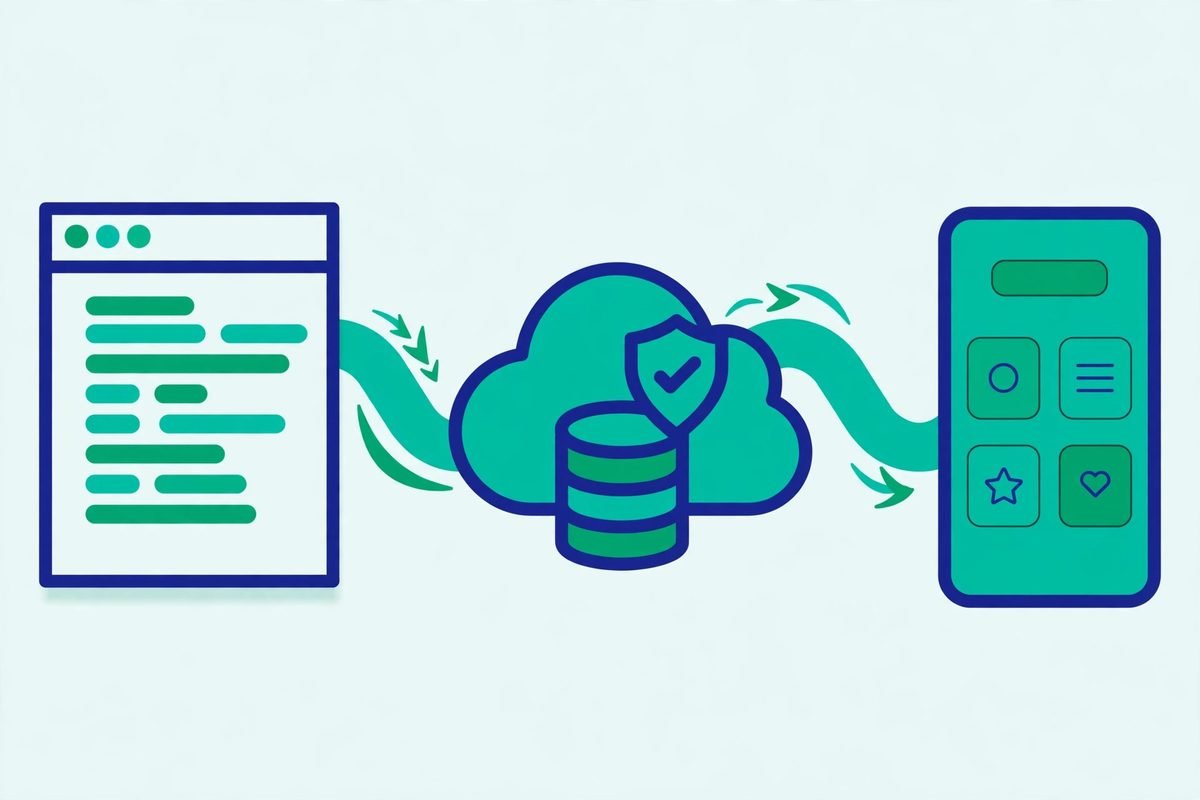
Strip away the marketing and Supabase is six services sharing one project and one Postgres database:
- PostgreSQL database — a genuine Postgres instance with a table editor, SQL editor, and extensions like PostGIS and pgvector. Standard SQL applies, and the data is portable: pg_dump works exactly as you would expect.
- Authentication — email/password, magic links, phone OTP, and social OAuth providers, with row-level security tying user identity straight to data access.
- Storage — S3-compatible file storage with access policies, so “users can only read their own uploads” is a policy row, not application code.
- Edge Functions — TypeScript functions running on Deno at the edge for webhooks, scheduled jobs, and API glue.
- Realtime — websocket subscriptions to row-level changes, so a dashboard or chat view updates the moment the database does.
- pgvector — vector storage and similarity search, which is how most teams add semantic search or retrieval-augmented AI features without a second database.
The point founders care about: one dashboard, one set of API keys, one invoice — instead of a database host here, an auth provider there, and a realtime service somewhere else.

Where the savings are genuinely real
We tell founders to judge a backend by calendar time, not feature lists. Three areas where Supabase consistently compresses the schedule:
Authentication in an afternoon
Rolling your own auth — password hashing, session handling, password resets, OAuth callbacks — is two to three weeks of careful work the first time, and a security liability every time after. Supabase Auth with a few lines of client code gives you sign-up, login, magic links, and social providers. The platform is also aligning auth with the AI-app ecosystem: Sign in with ChatGPT is currently in beta, letting users authenticate with their ChatGPT account.
Security at the database layer
Row-level security (RLS) policies mean access rules live in Postgres itself: “a user can only read rows they own” is enforced no matter which client touches the data. Getting policies right used to be the fiddliest part of a Supabase build; the dashboard’s RLS Tester, added in the June 2026 update, lets you run queries as another user and see exactly which policy fired. It has materially reduced the debugging time on our projects.
Predictable pricing from zero
The free tier — 500 MB of database and 50,000 monthly active users — carries most MVPs through their first real users. Pro at $25 a month adds serious headroom (8 GB database, 100K MAUs) plus daily backups. One honest caveat from the 2026 changelog: logs are moving to usage-based pricing, with a grace period into early 2027. Supabase says over 90 percent of projects sit within the included limits, and that matches our experience — just don’t build a chatty logging pipeline and forget about it.
What’s new in 2026
Supabase has had a busy year, and the direction matters for founders choosing a platform to bet on:
- Pipelines (public alpha) — managed change-data-capture that streams Postgres row changes into BigQuery in near real time, configured from the dashboard. It answers the oldest complaint about all-in-one backends: analytics no longer has to run on your transactional database.
- Sign in with ChatGPT (beta) — users authenticate with their ChatGPT account, and Supabase projects can connect to ChatGPT through the plugins directory.
- Unified Logs (open beta) and one-click Grafana observability — cross-service logs and monitoring without bolting on a third-party stack.
- Dashboard upgrades — the RLS Tester for debugging security policies and a schema visualizer that now supports direct table editing.
The business signal behind the features is worth noting. A recent analysis of backend vendors reports Supabase raised a $500M Series F in June 2026 at a $10.5B post-money valuation, with the developer count approaching 10 million — roughly doubling in eight months. The CEO has said more than 60% of new databases are now created by AI coding tools such as Claude Code and Codex. For a detailed rundown of the August feature drop, see this writeup of the August 2026 update. Translation for founders: this is the backend AI-generated apps default to, which means hiring developers who already know it keeps getting easier.
The trade-offs we’d flag before you commit
No platform is free of lock-in; the honest question is where the lock-in lives and how expensive the exit is.
- The database is portable; the conveniences are sticky. Your data leaves via pg_dump any time. But auth rules, realtime channels, edge functions, and storage policies would need re-implementing elsewhere. We design client schemas with that boundary in mind from day one.
- RLS is powerful and easy to misconfigure. A policy that is slightly too permissive is a data leak; slightly too restrictive is a week of “why can’t I see my rows” tickets. Budget senior review time, and run the RLS Tester before launch.
- Watch the usage-based edges. Compute, bandwidth, and now logs are metered on paid plans. Most startups never notice; a file-heavy or chatty app should model costs before the launch spike, not after.
- Know when it’s the wrong tool. Genuinely multi-region latency requirements or heavy analytical workloads on the primary database are still reasons to look elsewhere — though Pipelines now covers the analytics case for many teams.
- Compliance has tiers. SOC 2 Type II and ISO 27001 are covered on the hosted platform, but HIPAA requires a signed BAA available only on Team and Enterprise plans.
Frequently asked questions
Is Supabase really free for a startup?
For the MVP stage, effectively yes. The free tier’s 500 MB database and 50K monthly active users carry most prototypes and early launches. You’ll move to the $25/month Pro plan when you need daily backups, more database storage, or higher auth and bandwidth limits — which for most teams is a good-problem-to-have moment, not a surprise bill.
Should our startup choose Supabase or Firebase?
If your data is relational — users, orders, subscriptions, anything with joins — pick Supabase. Real Postgres with standard SQL beats wrestling a NoSQL document store into relational shapes. Firebase’s ecosystem is mature, but vendor lock-in runs deeper and the data is harder to take with you. The open-source core of Supabase, which you can self-host, is the tiebreaker for teams that care about exit options.
Can we migrate off Supabase later?
Your data, yes, trivially — it’s Postgres, so pg_dump and standard migration tooling work. Budget real engineering time for re-implementing auth, realtime subscriptions, and edge functions on whatever replaces them. We advise clients to keep business logic in their own API layer rather than scattered across edge functions, precisely so that migration stays a project and not a rewrite.
Does Supabase scale past the MVP?
It does — the platform now serves customers like PwC and McDonald’s, and paid plans add connection pooling, read replicas, and point-in-time recovery. The scaling work is the same as any Postgres system: indexes, sensible queries, caching, and keeping analytics off your transactional database (which Pipelines now makes easy to avoid). What Supabase removes is the undifferentiated plumbing, not the need for good database design.
Supabase is the fastest credible path from idea to a production backend we’ve used for startup clients — provided you respect the trade-offs: real Postgres, disciplined RLS policies, and an eye on usage-based costs. If you’re weighing it against a custom backend or a Firebase build, our custom API development team can scope the decision with you — or if you already know the shape of the product, our web development team ships Supabase-backed applications regularly. Tell us what you’re building and we’ll give you a straight answer on the right backend for it.