
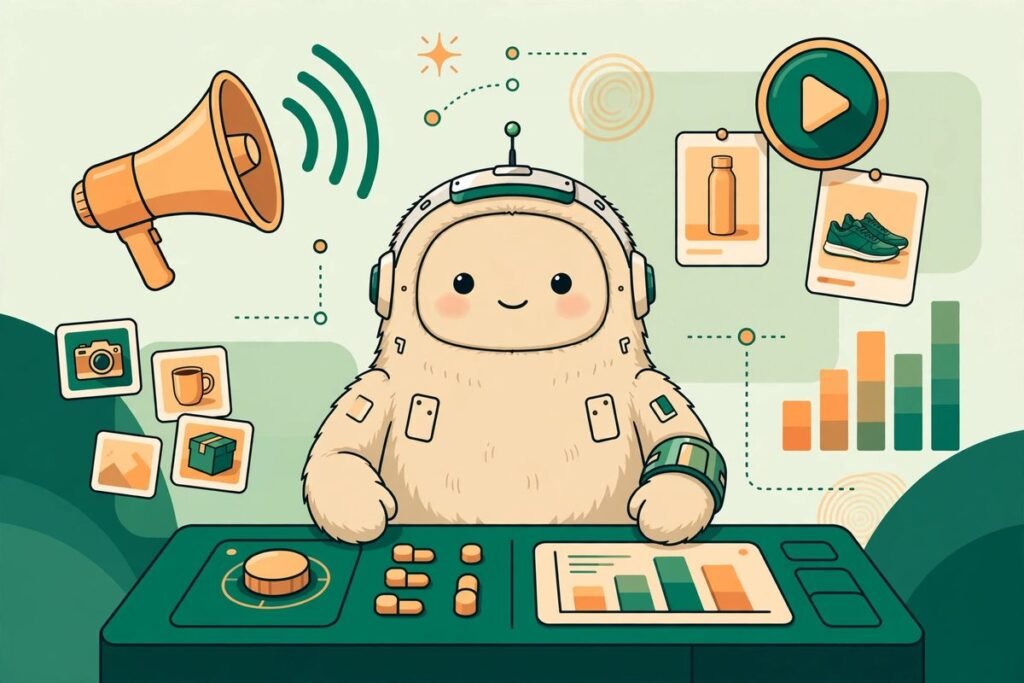
SuperCMO AI is a set of open source AI CMO Claude skills that turns Claude Code, Cursor or Codex into a working marketing chief for a small brand. Give it your website and a product photo, and it learns your brand, studies what your competitors are running, ranks the ad angles worth testing next, writes the copy for each platform, and produces the ads themselves — from UGC-style videos and product ads to image ads and product photography. Our verdict up front: for a small team that already uses an AI coding assistant, it is the most practical way we have seen to get agency-style campaign output without an agency retainer — provided you stay in the approval loop it is built around.
This review is based on the public launch materials: the Product Hunt launch of 20 October 2026, the open-source repository from SupercmoHQ, and the project documentation. We have not run paid campaigns through it, and where the evidence runs out we say so. If you are weighing it for your business, this is the honest picture: what it does well, what it costs once you look past the word “free”, and where a human marketer still earns their fee.
What SuperCMO AI does
Running marketing for a small brand is really five jobs wearing one hat. Someone has to know the brand inside out, watch what competitors are advertising, decide which angles to test next, write the copy, and then make the creative. Most small brands cannot staff all five, and an agency retainer is often more than the marketing budget allows. SuperCMO AI attacks that gap with agent skills: reusable instruction packs that teach a general-purpose AI coding assistant to do the marketing loop end to end.
The loop works like this. First, the agent studies your website to learn your brand: your voice, your audience, what you sell, and who you compete with. Then it studies your competitors’ ads alongside your own, looking for what is working and for angles nobody has tried yet. It ranks what you should test next instead of leaving you with a pile of ideas. Then it writes the copy for each platform and makes the ads in the sizes each platform needs. The formats it covers are broad: UGC videos, product ad videos, cartoon-style video ads, image ads, and product photos.
- Brand learning from your own website — voice, audience, products, competitors
- Competitor ad research and angle discovery, ranked by what to test next
- Copywriting for each platform, matched to the format
- Ad production: UGC videos, product videos, cartoon ads, image ads, product photos
- Every size a platform needs, from one brief and one product photo

How open source AI CMO Claude skills actually work
The key idea to understand is that SuperCMO AI is not an app with a dashboard. It is a set of skills that plug into an AI coding assistant you already run — Claude Code, Cursor, Codex, and, according to the repository, other agent hosts such as Hermes. A skill is a structured set of instructions, examples, and tool definitions that tells the agent how to carry out a specialised job. The agent you already pay for supplies the intelligence; the skills supply the marketing craft.
Installation is one command, though it does require the uv Python package manager on your machine:
npx --yes github:SupercmoHQ/superCMO-skills --all
In Cursor, you run it inside your project with the cursor flag so the skills land in that project directory. Then you ask your agent to “set me up”, and it walks through key setup: either bring your own model keys and pay the model vendors directly, or sign in and pay per use with SuperCMO’s own keys. The whole package is Apache-2.0 licensed, which means a business can use it, modify it, and build on it without a licence fee.
Once it is running, the production pipeline follows a fixed sequence. You provide a product photo and a brief — anything from a one-liner to a detailed creative brief. The agent extracts the product details, selects the AI image and video models best suited to the job, casts AI actors, and edits the generated clips into finished, campaign-ready assets. One claim worth noting: it promises consistent actors and consistent product appearance across videos of any length, which is exactly where most AI video tools fall apart. A character whose face drifts between clips is unusable for a brand; consistency is the feature that makes the output shippable rather than merely impressive in a demo.
The control that matters most is the approval loop. The agent checks in with you at every step, and nothing expensive renders until you approve it. Every generation also supports a dry run mode that shows the exact request and its cost before any API call is made. For a business owner, that is the difference between a tool and a liability: you can preview the spend on a campaign before a single frame is generated.
Pricing: free skills, paid models
SuperCMO AI is listed at zero cost on Product Hunt, and the skills themselves really are free — Apache-2.0, no subscription, no seat licence. But “free” here means the software, not the output. Video and image generation runs on commercial AI models, and somebody pays those model vendors for every render. You have two ways to pay: bring your own API keys and pay the vendors directly at their rates, or pay per use through SuperCMO. The first option is cheaper per generation and keeps your spend with the vendors you already use; the second is simpler if you do not want to manage keys. Either way, budget for model costs on top of the free skills, and use the dry run feature to price a campaign before you commit to it.
That distinction is also the honest answer to the “open-source alternative to closed AI marketing agents” positioning. Closed platforms typically wrap the same underlying models in a subscription with credits that expire and a markup on top of the model cost. SuperCMO removes the wrapper: you pay the model vendor, not a middleman. Independent coverage of the launch has put that markup at roughly half the base model cost on some subscription platforms, though the exact figure varies by platform and plan, so treat it as a direction of travel rather than a precise saving. The real saving for a small team is structural — no expiring credits, no seat fees, and no lock-in to one vendor’s model menu.
Who SuperCMO is for — and who it is not for
SuperCMO fits best in three situations. First, a small ecommerce or product brand that already creates its own content and wants to test more ad angles faster than a founder can brief a freelancer. Second, a marketing freelancer or tiny agency that wants to offer video ad production without hiring an editor — the skills turn one person’s coding assistant into a production bench. Third, a business already paying for Claude Code, Cursor, or Codex, where the marginal cost of adding marketing skills is close to zero.
It is a poor fit if you want marketing handled entirely for you. The approval loop is a feature, but it is also work: you review brand research, approve angles, approve copy, and approve renders. If nobody on your team will do that review, the pipeline stalls — or worse, you approve blindly and publish ads nobody checked. It is also a poor fit for brands whose value rests on real human faces and real customer stories. AI actors are consistent, but they are not your customers, and audiences can tell the difference when a testimonial-style ad has nobody real behind it.

Watch-outs and honest limitations
- Setup is technical. Installing via the command line and the uv package manager is trivial for a developer and a wall for a non-technical founder. Budget an hour with someone technical, or use the hosted route the project points to.
- Model costs scale with ambition. Testing ten angles with video each is ten times the render cost of testing one. The dry run feature exists for a reason — use it before every batch.
- AI UGC needs disclosure. A video that looks like a real customer recommending your product, made by an AI actor, should be labelled as AI-generated wherever your ad platform and local rules require it. Platforms are tightening these rules, and undisclosed synthetic testimonials are the fastest way to lose an ad account.
- Brand learning is only as good as your website. If your site is vague about who you serve and what makes you different, the agent’s brand model will be vague too. Fix the positioning on your site first; the tool amplifies what is there, it does not invent it.
- Output quality varies by model. The skills pick models for you, but model quality moves monthly. An ad format that looks great today can look dated in six months, and the skills will need updates to keep pace. Open source helps here — the community, not one vendor, keeps the model menu current.
- Approval fatigue is real. A pipeline that asks you to approve every step saves money but costs attention. For a founder already doing ten jobs, that attention is the scarcest resource in the business.
How it compares to the alternatives
Against a closed AI creative platform, SuperCMO wins on cost structure and loses on convenience. A closed platform gives you a dashboard, managed keys, and support; SuperCMO gives you direct model pricing, no expiring credits, and no subscription, but expects you to run a coding assistant and manage keys yourself. Against a marketing agency, the comparison is output volume versus judgement. An agency brings strategy, positioning, and taste earned across clients; SuperCMO brings speed and volume for testing angles. The sensible shape for most small brands is both: use SuperCMO to test ten angles cheaply, then put real budget behind the two winners, with a human deciding which two those are.
Against hiring a fractional CMO, SuperCMO is not a replacement at all. A fractional CMO decides what the brand should say; SuperCMO produces many ways of saying it. If your problem is that nobody has decided your positioning, no tool fixes that. If your problem is that you know your positioning and cannot produce enough tested creative to find winners, SuperCMO is aimed directly at you.
From our experience
We build AI automation for clients at MTD Technologies, and the pattern we see repeatedly is this: the tool is rarely the bottleneck — the approval process is. Teams adopt an agent, generate a flood of content, and then discover that reviewing it all takes longer than making it did. SuperCMO’s design understands this, which is why the approval checkpoints and the dry run cost preview matter more than any single ad format. If you adopt it, set a rule before your first campaign: a fixed weekly review slot, a maximum number of angles tested per week, and one person who can say no to an ad. Without that discipline, the cheapest creative pipeline becomes the most expensive one in attention terms.
One more practical note from shipping AI features for clients: keep your model keys separate from your production systems. SuperCMO needs keys with spending power, and keys in a shared coding-assistant environment deserve the same care as any other credential — scoped permissions where the vendor allows them, spend caps, and rotation if a key ever leaks. The project’s documentation includes security and telemetry sections; read them before you connect keys that can spend real money. If you would like help wiring this kind of agent setup into your business safely, our AI integration and automation service covers exactly that kind of implementation, and you can browse more tools like this one in our AI Tools Directory.
Frequently asked questions
Is SuperCMO AI really free?
The skills are free under the Apache-2.0 licence, and the Product Hunt listing shows zero cost. But generating images and video costs money at the model vendors, so you pay either through your own API keys or through SuperCMO’s pay-per-use option. Think of it as free software with metered materials.
Which AI tools does SuperCMO work with?
It is built for AI coding assistants: Claude Code, Cursor, and Codex are the named hosts, with other agent hosts also supported according to the repository. It is not a standalone app — you need one of these assistants installed first.
Do I need to know how to code to use SuperCMO?
You need enough command-line comfort to install it with one command and set up the uv package manager, plus an existing coding-assistant subscription. A non-technical founder can absolutely use the marketing side of it, but the first setup is a developer-shaped job — budget an hour with someone technical.
Can SuperCMO replace a marketing agency?
For producing and testing ad creative, it replaces a large part of what a small brand pays an agency for. For positioning, strategy, and judgement about which winning angle to scale, it does not. The best setup we have seen is SuperCMO for volume testing plus human judgement for the final calls.
Who owns the ads SuperCMO creates?
The skills are Apache-2.0 licensed, so you can use and modify them freely. The ads themselves are your output, but check the terms of whichever image and video model generated them — commercial-use terms vary by vendor, and that is the licence that governs the finished creative.
SuperCMO AI will not make your brand famous on its own, but it does something genuinely useful: it turns the most expensive part of small-brand marketing — producing enough tested creative to find winners — into a cheap, repeatable pipeline with cost controls built in. If you already run Claude Code, Cursor, or Codex, and you are willing to own the approval loop, it is worth an afternoon of testing. Start with one product, one brief, and the dry run switched on, and judge it on the second campaign, not the first. If you want help setting up AI marketing pipelines or evaluating whether this kind of tooling fits your business, talk to us — we have spent nine years shipping this kind of system for clients, and we will tell you plainly when a tool is not the right answer.