
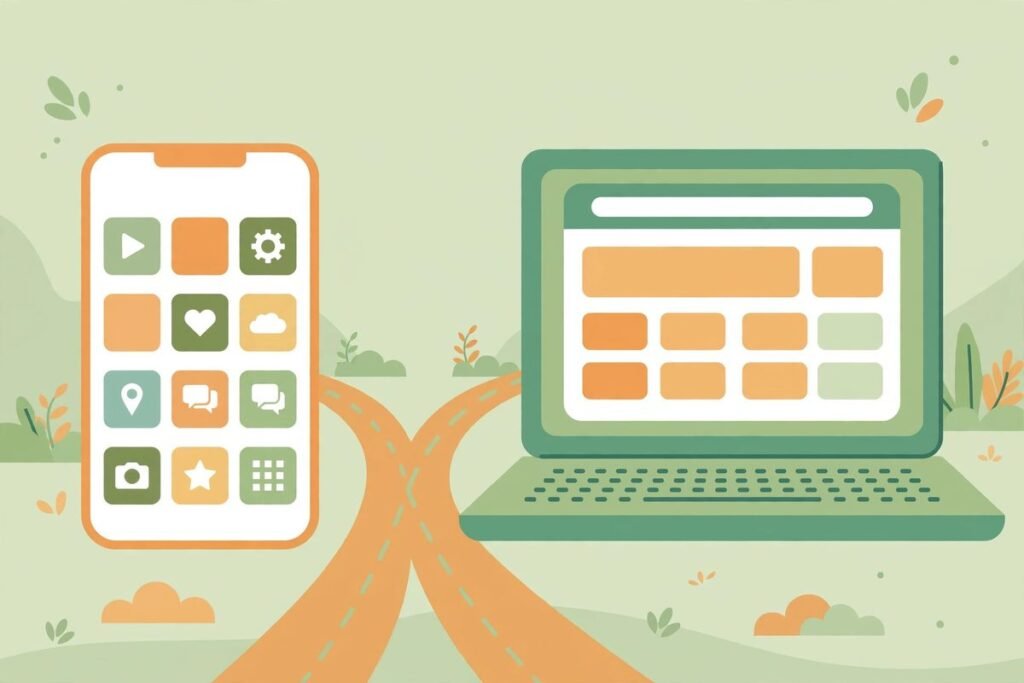
Choosing between a web app vs mobile app startup build is one of the first decisions that genuinely shapes your budget, your launch date, and how users find you. It is also one of the most commonly made on vibes: founders pick “an app” because competitors have one, or pick “a website” because it sounds cheaper, without checking which one fits how their customers actually behave. This guide fixes that. By the end, you will know what each option really costs, where each one wins, and which questions to answer before you commit a single pound, dollar, or developer hour to the build.
It is written for founders and product leads at the idea or early MVP stage. If you already have traction and are deciding whether to add a second platform, the same framework applies — just score it against your existing numbers instead of your assumptions.
What “web app” and “mobile app” actually mean in 2026
A web app is software that runs in the browser: users open a link, sign in, and use it. It works on any phone, tablet, or desktop with no download and no store approval. A native mobile app is built specifically for iOS or Android, installed from an app store, and has the deepest access to the device — camera, sensors, background processing, and system-level notifications.
Between them sits the progressive web app, or PWA. A PWA is a web app enhanced with a manifest and a service worker so it can be installed to a home screen, work offline, and send push notifications. It is still the web — one codebase, no store gatekeeper — but it behaves much more like an app than a plain website. Then there is the hybrid route: one shared codebase (React Native or Flutter, for example) compiled into real store apps for both platforms. It is a genuine middle path, not a compromise to be embarrassed about: many successful products run on it.
The important point is that this is no longer a two-way choice. In 2026 the realistic menu is web app, PWA, hybrid app, or fully native app — and the right answer is usually “web first, then add native where the evidence says it earns its keep.”

The cost question, answered honestly
Cost is where the web-first argument is strongest, and it is worth stating plainly. A web app or PWA means one codebase for every device. A native route means two codebases (or one hybrid codebase plus platform-specific work), two sets of store processes, and two surfaces to test on every release. In practice, across agency builds, maintaining two native apps typically runs at roughly double the ongoing effort of maintaining one web codebase — not exactly double, because shared design and backend work carry over, but close enough that the budget conversation should start there.
The store costs themselves are small but real. Apple charges $99 per year for its Developer Program, and Google Play charges a one-time $25 registration fee. The bigger number is commission: both stores headline at 30% on in-app purchases and paid apps, dropping to 15% for smaller developers under their respective small-business terms. If your revenue runs through in-app purchases, that percentage is a permanent line item in your unit economics. A web app that takes payment on the open web pays its payment processor, not a store — a structural difference that matters enormously for subscription and marketplace products. Note that store terms have been shifting through 2026, so check the current terms before you lock your pricing model.
Then there is the cost nobody puts in the quote: version fragmentation. A web deploy reaches every user the moment it ships. A native update reaches users only when they update, which means your support team answers questions about three versions of your app for months. For a fast-moving MVP, that lag is a tax on every experiment you run.

Distribution: how users actually find and keep you
Distribution is the argument founders underestimate most. A web app is discoverable: Google can index it, a link in a message opens it instantly, and a QR code on a flyer works. Every step a user must take before seeing value — search the store, tap install, wait, open, sign up — costs you a slice of your audience. For products whose users arrive via search, content, ads, or referrals, that friction is the single biggest reason web-first wins.
Native apps win the opposite game: retention. An icon on the home screen, a push notification, and a presence in the store charts are powerful retention machinery. If your product depends on daily habit — fitness tracking, language learning, messaging — that machinery earns its keep. But notice the precondition: retention machinery only helps once you have users to retain. Many startups pay the native price before they have solved acquisition, which is like buying a loyalty programme before opening the shop.
The hybrid path many teams land on is deliberate: launch on the web to prove demand and learn what users do, then ship a native or hybrid app for the proven core audience once retention, not acquisition, is the bottleneck. That sequence spends the expensive build only after the market has voted.
What users can actually do: capability in 2026
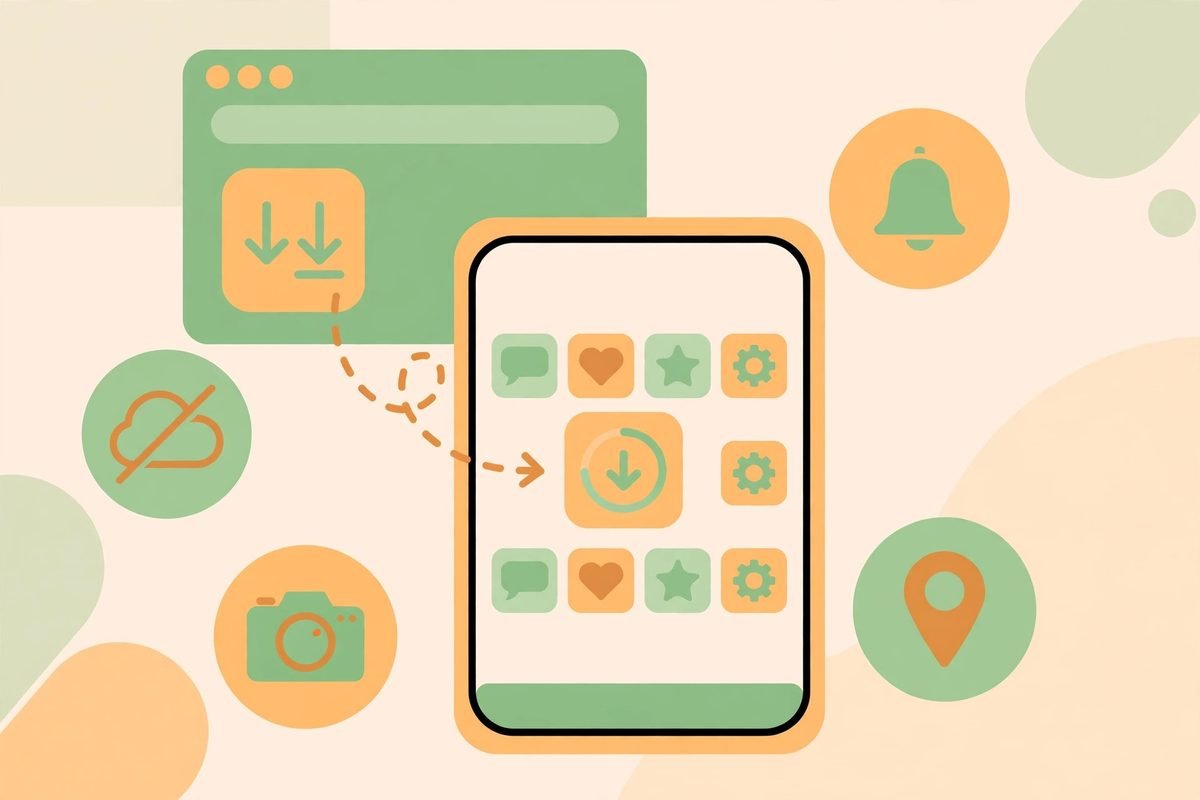
The capability gap between web and native has narrowed a lot, but it has not closed. On Android and desktop, PWAs now cover most of what users expect: offline access through service workers, full push notifications, camera and microphone access, and GPS. On iPhone, the picture is more limited. Since iOS 16.4, Safari supports web push — but only for PWAs the user has added to their home screen, and background processing remains very limited. Bluetooth and NFC are largely unavailable to web apps on iOS.
So the capability test is simple: list the three features your product cannot live without. If any of them are heavy background processing, Bluetooth hardware pairing, advanced camera processing, or deep system integration, you are looking at native. If your list is accounts, content, payments, bookings, dashboards, messaging, and notifications, the web covers it — and a PWA covers the installable, offline, push-notification parts too.
From our experience: the mistakes we see most
Across years of shipping both kinds of product, the same patterns repeat. First, founders overestimate how much users want “an app” and underestimate how much they want the problem solved with one tap from a link. We have seen products double their trial starts simply by moving the first experience from a store listing to a link that opens straight into the product.
Second, teams budget the build and forget the maintenance. Stores change their rules, operating systems update twice a year, and every native app needs regression testing against new devices. A realistic annual maintenance budget is a meaningful fraction of the original build cost — and for two native apps, that fraction applies twice.
Third, and most expensive: building native first locks your roadmap. A feature that takes a week on the web can take a month across two native apps with store review in between. Early-stage products change direction constantly; the platform that lets you change direction cheapest is the platform that protects your runway. When not to go web-first? When your core value is hardware interaction, when your audience lives inside app stores (mobile games are the classic case), or when offline-first field work with heavy device integration is the whole product. Those are real cases — they are just rarer than the pitch decks suggest.
The decision framework: score your idea in ten minutes
Answer these five questions honestly, and the choice usually makes itself:
- Where do users come from? Search, links, and referrals point to web. Store browsing and word-of-mouth about “the app” point to native.
- How often must they return? Weekly or less, web wins. Daily habit with streaks and reminders, native earns its place.
- What hardware do you need? Standard camera, GPS, and notifications: web or PWA. Bluetooth, sensors, or background processing: native.
- How do you charge? Subscriptions or marketplace fees kept off-store favour web. In-app purchases where users expect store billing favour native.
- How fast must you change? If you expect to pivot features monthly, web-first protects your speed. Stable, proven features can justify native investment.
If three or more answers point to web, start there. If three or more point to native, build native — or build a hybrid app that gives you store presence at a lower cost than two fully native codebases. If the answers split, the tiebreaker is almost always the same: launch on the web, measure real behaviour, and let the data decide whether native is worth it. Our web development and mobile app development teams both start client conversations with this same scorecard, because the cheapest correct decision is worth more than the most impressive build.
Frequently asked questions
Is a web app cheaper than a mobile app?
Usually, yes — and the gap grows over time. One web codebase serves every device, while native means iOS and Android work plus store processes. The ongoing maintenance difference, not just the first build, is where web-first saves the most.
Can a web app send push notifications?
Yes. Android and desktop browsers support web push fully. On iPhone, push works for PWAs the user has added to their home screen since iOS 16.4, with narrower targeting than native apps. If push is your core retention channel and your audience is mostly on iPhone, native still has the edge.
Can a web app work offline?
A progressive web app can, using a service worker to cache content and queue actions until connectivity returns. A plain website without that setup cannot. Offline support has to be designed in from the start, whatever platform you choose.
Should a startup build iOS and Android apps at launch?
Almost never. Launch where your users already are — usually the web — prove the idea, and add native apps once retention is the constraint. Building both native apps before product-market fit spends your scarcest resource, runway, on your least-proven assumption.
What is a progressive web app, in one sentence?
A PWA is a web app with a manifest and service worker that lets it install to a home screen, work offline, and send notifications — app-like behaviour from a single web codebase, with no app store required.
The web app vs mobile app startup debate has no universal winner, only a right answer for your users, your revenue model, and your runway. Start with the scorecard, be honest about where your users come from and how often they must return, and choose the platform that lets you learn fastest. If you want a second opinion on your specific idea, talk to our team — we will tell you when web-first is wrong, too, because a product that ships on the right platform is worth more to everyone than a product that ships on the impressive one.