

Good AI chatbot human handoff design is the difference between a support bot that saves your team time and one that quietly costs you customers. Most businesses measure their chatbot by how many conversations it deflects. That is the wrong scoreboard. The real test is what happens in the conversations the bot cannot finish: does the customer reach a human smoothly, with their problem intact, or do they hit a wall, repeat themselves three times, and leave? This guide is for business owners and support leaders who already have, or are about to buy, a chatbot. By the end, you will know the triggers that should force a handoff, the context that must travel with the customer, and how to measure whether handoffs save sales or leak them.
Why most chatbot handoffs lose the sale
The failure rarely looks dramatic. There is no crash, no error message. A customer asks about a refund, the bot gives a generic policy answer, the customer rephrases, the bot repeats itself, and the customer closes the tab. Support teams call these silent abandonments: no ticket was ever created, so standard dashboards never see them. The customer did not escalate; they evaporated.
This happens because most chatbots are built as gatekeepers rather than triage nurses. A gatekeeper keeps people out. A triage nurse understands the problem fast, handles what is safe, and gets hard cases to the right specialist without delay. If your bot treats every conversation as something to deflect, it will eventually deflect a paying customer straight to a competitor. The principle that fixes this is simple: escalation is not failure. A clean, early handoff is one of the best outcomes a chatbot can produce.
There is also a commercial asymmetry worth stating plainly. A wrong confident answer from a bot is far worse than a clean escalation. A customer who is handed to a human with a short wait feels looked after. A customer who was confidently told the wrong refund policy, the wrong delivery date, or the wrong account status now has two problems: the original issue, and a trust problem with your business. When in doubt, the bot should hand over, not guess.
What good AI chatbot human handoff design looks like
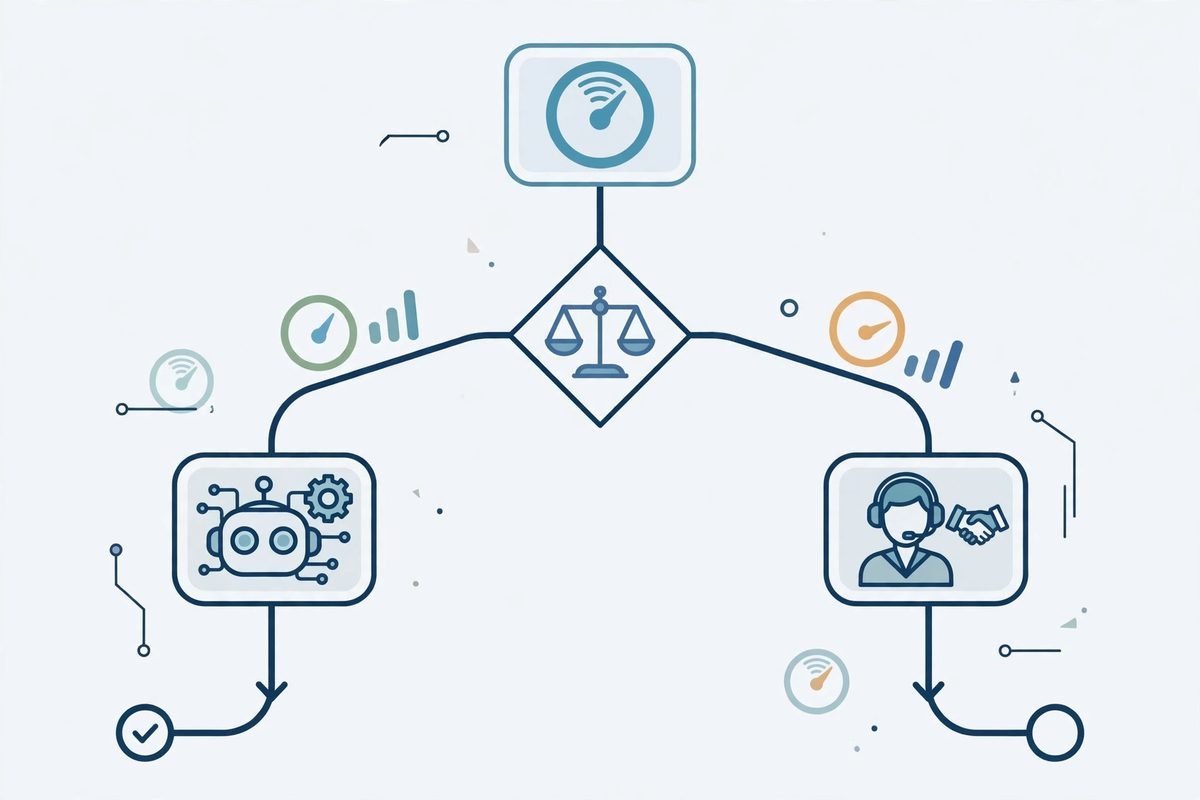
A well-designed handoff has three properties. It is proactive: the system escalates before the customer has to demand a human. It is transparent: the customer is told what is happening, who they are being passed to, and roughly how long the wait is. And it is continuous: the agent receives the full story, so the customer never starts again. If any one of the three is missing, the handoff feels broken even when the routing worked.
Think of it as a relay race, where the baton is the customer’s context. A good relay passes it at full speed; a bad one drops it, and the next runner must go back for it while the customer watches. Every decision below exists to protect that baton pass.
The escalation trigger stack: five signals that should force a handoff
Never rely on a single escalation rule. A robust design layers several triggers, each cheaper to fire than the last, so that different kinds of trouble are caught by different nets. Here are the five that matter most, drawn from current practitioner guidance on human handoff patterns and support escalation design.
1. The customer asks for a human
Any variant of “agent”, “human”, “person”, or “representative” should transfer immediately, with no confirmation dialog and no “are you sure?” gate. This sounds obvious, yet many bots answer an escalation request with one more attempt to help — which reads as refusing to let the customer speak to a person. The customer’s preference is the trigger; respect it instantly.
2. Confidence falls below the floor
When the bot’s retrieval score or intent confidence drops below a tuned threshold, it should escalate rather than guess. Practitioner guidance suggests floors around 0.6 to 0.72 depending on how the score is computed — the exact number matters less than the discipline of picking a floor, measuring how often it fires, and tuning it weekly. Two cautions: a raw confidence number is not a probability, so calibrate it against real transcripts; and keep a hard rule-based classifier alongside any model judgement, because a system-prompt rule alone is fragile.
3. Frustration is rising
Run a cheap sentiment check over the last few user turns. Two consecutive negative turns plus stalled task progress means the bot is making things worse — hand off before the third turn. Add a loop detector too: if the customer rephrases the same question twice, or the bot repeats itself, escalate. Cap clarification attempts at two or three. Loops are where bot rage starts, so treat a loop as an incident, not an edge case.
4. The task crosses a hard boundary
Some categories should never be bot-resolved, however confident the bot feels: refunds and chargebacks, account access and security resets, legal or privacy requests, threats, and anything involving a vulnerable customer. These are policy decisions, not model decisions, implemented as hard rules routing to the right queue — billing, trust and safety, or account recovery — with a one-line reason the agent sees instantly. Pair keywords with intent: “refund policy” as information is very different from “refund my order” as a transaction, and routing should know the difference.
5. The account or the clock demands it
High-value or enterprise accounts should bypass standard deflection and go to their account team: the cost of mishandling them dwarfs any deflection saving. Likewise, if a service-level deadline is approaching, escalate with a priority flag rather than letting the bot burn the remaining time. The trigger stack should know what is at stake, not just what was said.
The context package: what must travel with the customer
The most common complaint after a handoff is: “I already explained this to the bot.” That sentence is a preventable design failure. Before the transfer completes, the system should assemble a context package for the agent: the full transcript, account and order status, issue classification, what the bot already tried and what failed, and the trigger that caused the escalation. A one-line summary on top — “refund request, order delayed twice, customer frustrated” — lets the agent open with understanding instead of interrogation.
The handoff message to the customer matters just as much. “I am transferring you to a specialist who can help with refunds” beats a silent hold. Tell them what happens next, whether they keep their queue place, and what to do if the connection drops. If no agent is available, be honest: offer a callback or email follow-up with full context attached, rather than leaving the customer in a chat window nobody is watching.
From our experience: the gotchas nobody puts in the sales demo
Having built automation across support, sales, and service delivery over 9+ years and 300+ projects, we have seen the same handoff mistakes repeat. The first is tuning for deflection instead of resolution. If your team is rewarded for keeping the escalation rate low, thresholds quietly drift upward until the bot guesses at everything — and the cost shows up as churn, not tickets. Reward resolution and post-handoff satisfaction instead.
The second is launching without a weekly tuning ritual. Thresholds decay as language and products change, so a floor that was right in January is wrong by March. The teams that get this right review a sample of real transcripts every week and treat near-misses as new triggers. Twenty transcripts a week is enough to keep the system honest.
The third is forgetting after-hours. A bot that escalates at 2 a.m. into an empty queue, with no callback offer and no ticket created, is worse than one that says upfront the team is offline. Design that path explicitly: capture the context, create the ticket, promise a response window, and keep it. Customers forgive a wait they were told about, not one they discovered.
Finally, do not let the perfect be the enemy of the shipped. You do not need sentiment analysis, retrieval scoring, and a full observability stack on day one. You need the explicit-request rule, two or three hard-boundary categories, a loop cap, and a context package that reaches the agent. That alone puts you ahead of most deployments. Our team builds these workflows with tools like n8n — see our n8n workflow automation services and AI integration services if you want the plumbing done properly.

How to measure whether your handoff is working
Measure the handoff, not just the bot: post-handoff resolution rate, post-handoff satisfaction, handle time on escalated conversations, and repeat-contact rate. Industry write-ups commonly report satisfaction and handle-time improvements in the region of 10 to 30 per cent when context transfer works well, but treat those as directional: measure your own baseline before you change anything.
- False-escalation rate: how often the bot hands off a conversation a human then resolves trivially. Too high, and your thresholds are too eager.
- Missed-escalation rate: how often customers abandon or demand a human after the bot should already have escalated. Too high, and your thresholds are too lax.
- Repeat-explanation rate: how often the customer has to restate their problem after handoff. Anything above rare means your context package is broken.
- Time-to-human: from the moment a trigger fires to a human greeting. This is the number frustrated customers actually feel.
Review these weekly alongside your transcripts. A handoff design that is never measured drifts back into a gatekeeper, because every incentive in support pushes toward deflection.
Frequently asked questions
When should a chatbot hand off to a human?
Immediately when the customer asks for one, and automatically when confidence falls below your floor, frustration rises across consecutive turns, the customer repeats themselves, or the request crosses a hard boundary such as a refund, account access, or legal issue. The best handoffs happen before the customer has to demand a human.
What confidence threshold should trigger escalation?
There is no universal number: practitioner guidance ranges roughly from 0.6 to 0.72 depending on how the score is computed. Pick a starting floor, calibrate it against real transcripts, and tune it weekly using your false-escalation and missed-escalation rates. Pair the model score with hard rules, because a prompt-only rule can be talked around.
What context should the bot pass to the human agent?
The full transcript, the customer’s account and order status, the issue classification, what the bot already tried and what failed, and the trigger that caused the escalation — topped with a one-line summary. If the agent has to ask the customer to repeat anything, the context package has failed.
How do you stop customers repeating themselves after a handoff?
Make the context package a hard requirement of the transfer, not an optional extra, and train agents to open with a summary that proves they have read it: “I can see you already tried X and the issue is Y.” Also carry context across channels, so a move from chat to phone or email does not reset the conversation.
How do you measure whether handoff design is working?
Track post-handoff resolution rate, post-handoff satisfaction, handle time on escalated conversations, repeat-contact rate, and time-to-human. Review a sample of real transcripts weekly and treat near-misses as new triggers. If you only measure deflection rate, you will optimise for the wrong thing.
The handoff is the product
Customers rarely remember a chatbot that answered a simple question. They remember the one that trapped them, and the one that got them to the right human fast. AI chatbot human handoff design is therefore not a footnote to your chatbot project; for every conversation the bot cannot finish, it is the product. Build the trigger stack, protect the context package, measure the handoff honestly, and tune it weekly. If you would like help designing that system, talk to our team — we build support automation that hands off cleanly, because we have seen what happens when it does not.