
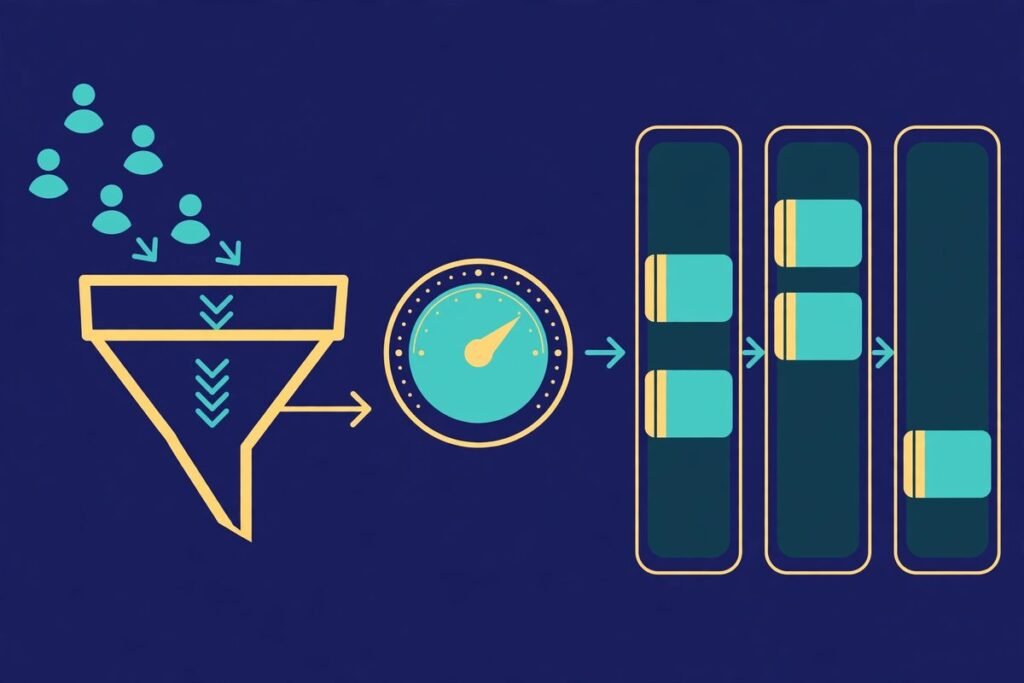
Every CRM has a graveyard of scoring rules nobody trusts. Marketing awards points for every white-paper download, sales ignores the scores entirely, and the hottest lead of the month turns out to be someone’s cousin forwarding a newsletter. AI lead scoring implementation is the attempt to replace that theatre with something empirical: a model that studies which leads actually closed, then ranks new leads by that evidence. Done well, it focuses your reps on the fraction of pipeline that holds most of the wins. Done badly, it is expensive theatre with a confidence score attached. This guide is for sales leaders, revenue operations, and the people who have to implement it: what the work really involves, where projects die, and how to validate that the scores lift close rates instead of merely reorganising them.
What AI lead scoring implementation actually means
Traditional lead scoring is rules-based and hand-built: a marketer decides that a VP title is worth 15 points, a pricing-page visit is worth 10, and an unsubscribe is worth minus 50. It is transparent, easy to game, and almost always wrong in the details because the point values are guesses. Predictive (AI) scoring inverts the process. You feed the system your history — every lead, what happened to it — and it learns which combinations of signals actually preceded a closed deal.
Under the hood there are three common formulations. Binary classification predicts a simple outcome: will this lead convert or not. Regression predicts a continuous probability, the familiar 0–100 score. Multi-class classification predicts the funnel stage a lead is likely to reach — marketing-qualified, sales-qualified, opportunity. For most businesses the regression flavour is the practical choice: a single number that slots into CRM views, routing rules, and dashboards without retraining your team on new terminology.
What changes operationally is where the score lives. In a finished AI lead scoring implementation, the score is a live CRM field, refreshed as new behavioural data arrives. High scores trigger routing to senior reps and same-day follow-up tasks; medium scores drop into nurture sequences; low scores stay with marketing. Nothing about the model is visible to the rep except the number, a shortlist of the top contributing signals, and — this is the part vendors undersell — a feedback loop that lets the rep mark scores as wrong.
Why most scoring projects fail before a model is even trained
The model is rarely the hard part. In our experience, scoring projects die in three places, and all three are organisational.
Dirty data. Models trained on duplicate records, free-text job titles (“VP”, “V.P.”, “Vice President”, “boss”), and stale company sizes learn noise. One startup-focused implementation guide cites a survey in which nearly 60% of smaller companies name data quality as their biggest barrier to effective scoring. Standardising titles, deduplicating records, and filling the gaps in firmographic fields is unglamorous, but it is where accuracy is actually won.
No baseline. If you do not know your current marketing-qualified-to-sales-qualified conversion rate, your cost per SQL, and your average sales cycle length, you cannot prove the model did anything. Worse, you cannot tell drift from improvement later. Measure the before state for at least one full sales cycle before the model touches production routing.
No rep trust. One industry write-up on AI lead generation reported that roughly 70% of sales reps distrust AI scoring at first — but that trust climbs to about three-quarters after six months of proper training and explainability. The lesson is not that reps are Luddites; it is that a score nobody can interrogate gets ignored, and an ignored model is the same as no model. If the system cannot show why a lead scored 87, adoption will stall regardless of accuracy.
AI lead scoring implementation: the six-week playbook
A realistic four-phase implementation path runs about six weeks for a team with a functioning CRM and a year of history. Here is the shape of it.
Weeks 1–2: data preparation
Map every source that will feed the model: CRM records, website analytics, email engagement, ad platforms, and any enrichment or intent-data providers. Then clean ruthlessly — dedupe, standardise job titles, fill or drop empty firmographic fields. As a rule of thumb you want at least 12 months of history with several hundred closed outcomes (won and lost both; the model learns as much from losses). Smaller businesses can start with as few as 40–100 closed outcomes, but expect wider confidence intervals and plan an earlier retrain.
Weeks 3–4: model training and validation
Choose your features in three families. Behavioural signals: pricing-page visits, webinar attendance, email replies, trial engagement, recency of activity. Demographic signals: job title seniority, department, role. Firmographic signals: company size, sector, revenue band, geography. Add negative signals deliberately — unsubscribes, non-target regions, personal email domains, student job titles. Train on a holdout split so you are validating against leads the model has never seen, and resist the urge to build the 100-attribute model on day one. A scoring guide for B2B teams puts it well: launch with something basic like job title plus website activity, and let observed performance tell you what to add.
Weeks 5–6: deployment into the CRM
This is an integration project as much as a data-science one. Native options exist — Salesforce Einstein and HubSpot’s predictive scoring ship inside the CRM — or you can score externally and write the number back via API, which is how most mid-market teams do it. Wire the score into three things: routing rules (score bands to reps, territories, or queues), alerts (a Slack or email nudge when a lead crosses the hot threshold), and sequencing (score-triggered follow-up cadences). Agree a service-level agreement in writing: marketing commits to delivering leads above an agreed score; sales commits to contacting them within a defined window. Scoring without an SLA is decoration.

From our experience: what the vendor deck leaves out
We build automation and AI integrations for clients as a matter of course — scoring models included — and the gap between the demo and the working system is always the same handful of unglamorous details.
Start embarrassingly simple. The model that ships beats the model that is perfect. We have seen teams spend three months engineering features while a two-signal model (title seniority plus meaningful site activity) would already have been beating their rules-based scores. Complexity is a dial you turn up after the pipeline works end to end.
Score decay matters as much as scoring. A lead that visited the pricing page in January is not hot in October. If your platform does not decay scores on inactivity automatically, build the decay into your routing rules — for example, hot leads that go untouched for 14 days drop a band and re-enter nurture. Stale high scores are how reps learn to distrust the system.
Explainability is a feature, not a luxury. “87” means nothing. “87 — VP Operations, 3 pricing-page visits this week, opened last two emails” is something a rep can act on and, crucially, argue with. That argument is data: every “this score is wrong” is a labelled correction for the next retrain.
Watch the compliance surface. Behavioural scoring runs on tracked prospect data, which puts privacy regulation squarely in scope: GDPR expects consent for the tracking and gives prospects deletion rights, and training sets should be anonymised of personal data before they touch a model. Sort this with your legal footing in weeks 1–2, not after the first complaint.
Know when not to build it. AI lead scoring implementation is the wrong project if you close fewer than a few dozen deals a year (there is nothing to learn from), if your CRM is a spreadsheet nobody updates (garbage in, gospel out), or if one founder does all the selling (the rep already is the model). In those cases, spend the budget on workflow automation that fixes your data capture first — scoring can come later.
Validating that the scores lift close rates
A model that is never validated is a superstition. The validation pattern that actually builds organisational confidence has three layers.
The parallel period. For four to six weeks, let reps see the AI score alongside the existing process without changing any routing. Reps learn what the numbers mean, you collect a clean record of score versus outcome, and nobody’s pipeline is disrupted while you calibrate. One B2B implementation guide recommends exactly this: validate accuracy in parallel before switching workflows over.
The holdout test. Before launch, the model should be scored against leads it never trained on. Vendor-reported benchmarks for predictive systems run around 70–85% accuracy against 45–60% for manual rules-based approaches — treat those as directional, then beat them with your own numbers. The metrics that matter are business metrics, not model metrics: MQL-to-SQL conversion rate, win rate by score band, and sales cycle length. Industry write-ups cite 15–30% lifts in MQL-to-SQL conversion as the typical reported range; your pilot should be designed to confirm or refute that for your funnel.
The quarterly recalibration. Markets move, your ideal customer profile evolves, and buyer behaviour drifts — a model trained on last year’s wins slowly goes stale. Schedule a formal review every quarter: score distribution, conversion by band, which signals gained or lost weight, and a retrain on fresh closed outcomes. One best-practices guide adds the discipline that makes the numbers believable: run the rollout as a controlled pilot with a holdout group for at least 30 days, so the improvement you report is measured, not assumed.
Frequently asked questions
How much historical data does AI lead scoring implementation need?
Aim for 12 months of CRM history with several hundred closed outcomes, won and lost. Teams with less history can start with 40–100 closed deals, but should plan shorter retraining cycles and treat early scores as directional until the dataset grows.
How long does it take to implement?
Six weeks is realistic for a team with a working CRM and clean-ish data: two weeks of data preparation, two of training and validation, two of CRM deployment. Add the four-to-six-week parallel period for validation, and budget a full quarter from kickoff to trusted production scores. Most of the calendar time is data cleaning and organisational alignment, not modelling.
Can our CRM do this natively, or do we need a separate platform?
Salesforce (Einstein) and HubSpot both ship predictive scoring natively, which is the lowest-friction path if you already live in one of them. Standalone platforms add richer behavioural and intent data and more control over the model. Mid-market teams often land in the middle: score externally via API and write the number back into the CRM field the reps already look at.
Should AI scoring replace our existing rules-based scoring?
Not on day one. Run both in parallel, let the AI scores prove themselves against outcomes, and only retire the rules when the data says the model wins. Many teams keep a small set of hard rules permanently — compliance exclusions and disqualification logic — with the model handling the ranking.
What does AI lead scoring implementation cost?
Native CRM scoring is typically bundled into higher CRM tiers. Standalone predictive platforms commonly run from a few hundred to several thousand per month depending on contact volume, plus implementation effort. The honest total cost of ownership includes the data-cleaning work and the quarterly retraining discipline — budget for those and the project survives its first year.
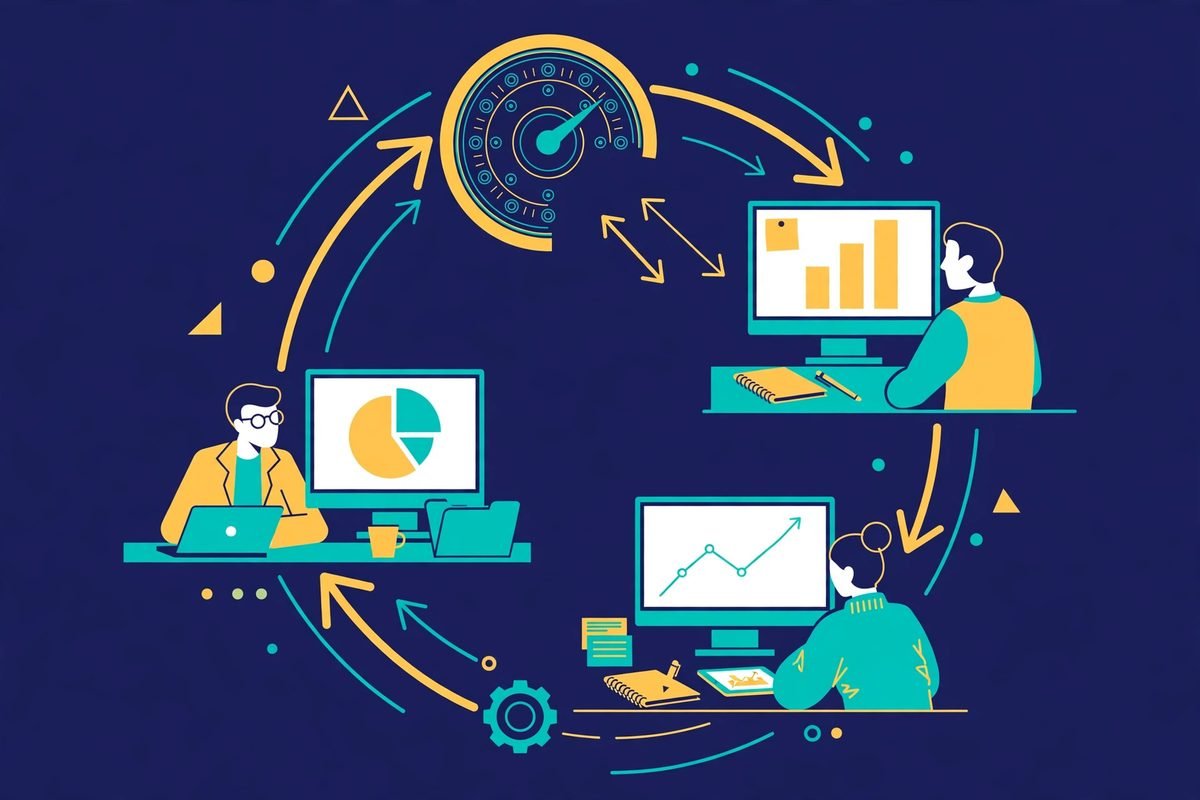
AI lead scoring implementation is not a model you buy; it is a loop you run — clean data in, validated scores out, rep feedback back in, retrain quarterly. Teams that respect the loop get the compounding benefit: every closed deal makes the next quarter’s scoring sharper. Teams that skip straight to the dashboard get a number nobody trusts. If you want help designing that loop around your CRM and your data, our AI integration work starts with exactly this kind of unglamorous foundation. Talk to us about what your pipeline data can actually support — we will tell you honestly if the answer is “not yet”.