
“How much will this actually cost us?” It is the first question in almost every discovery call we take, and it is a fair one. The custom software development cost question gets vague answers everywhere online — “$20,000 to $500,000, it depends” — which is technically true and practically useless when you are trying to plan a budget. So here is the honest version: the real 2026 price bands, what actually moves your number up or down, the costs vendors rarely mention, and how to keep the budget from running away.
Custom software development cost in 2026: price bands by project size
Start with the market data. Clutch’s 2026 pricing data puts the average custom software project at roughly $132,480 over about 13 months, as Brights’ 2026 outsourcing analysis summarises. A GoodFirms 2026 survey found that nearly 66% of companies land in the $30,000–$100,000 range for small and medium projects. But an average hides the spread, so here is the tiered picture we see in practice:
- Simple internal tool or automation: $10,000–$30,000, typically 4–8 weeks. A reporting dashboard, an internal form that replaces spreadsheets, a data-import utility.
- Small business application: $20,000–$60,000, typically 2–4 months. A customer portal, a booking system, an internal operations tool with real users.
- SaaS MVP: $40,000–$150,000, typically 3–6 months. Multi-tenant product, billing, user management — the full machinery, scoped tightly.
- Custom CRM or operations platform: $50,000–$200,000, typically 4–8 months. This is the category we build most: software that runs how your business actually runs. (If you are weighing this against Salesforce or HubSpot, we wrote a full build-vs-buy breakdown.)
- Mobile app with backend: $60,000–$250,000, typically 4–9 months.
- Enterprise platform: $250,000–$1,000,000+, typically 9–24 months. Multi-department, heavy integration, compliance requirements.
Treat these as orientation, not quotes. As DianApps’ 2026 cost guide puts it, a “simple” tool with heavy compliance or unusual integrations can cost more than a mid-complexity project with a clean scope. The range that matters is yours, and it is set by the drivers below.

What actually drives the price
Ask five vendors for a quote and you will get five different numbers. That is not cageyness — it is because “custom software” spans an enormous range, and the drivers are rarely the ones buyers focus on. The hourly rate a developer charges is not the driver. What drives cost is how much genuinely custom work, security engineering, and integration the project needs.
1. Feature scope and depth
The single largest driver, and the most underestimated. More features do not just mean more screens — they mean more backend logic, more edge cases, more testing scenarios, more failure handling. A basic email-and-password login takes a few hours. Role-based access with audit logs, permission hierarchies, and session security across devices becomes a multi-week system component. When scoping, always price features at their full depth, not their demo version.
2. Integrations
Every connection to another system — Stripe, QuickBooks, Salesforce, an ERP, a government API — is custom work. APIs lie: the documentation says one thing, the sandbox does another, and edge cases like rate limits, webhooks that never arrive, and data-format drift are where the hours go. A project with six integrations will cost meaningfully more than a similar project with one, even if the feature list looks identical.
3. Compliance and security
HIPAA, GDPR, SOC 2, industry-specific data rules — compliance multiplies design, development, and testing effort across the whole build. It also never stops: audits, penetration tests, and documentation are ongoing line items.
4. Team location and seniority
Location is the largest pricing lever. US agencies commonly charge $120–$250 per hour; hybrid or nearshore teams run $35–$90 per hour, with rates in Central and Eastern Europe and Latin America often 40–60% below comparable Western costs. Seniority matters as much as geography: a senior team that scopes correctly will often cost less overall than a cheap team that builds the wrong thing twice.
The costs nobody quotes you
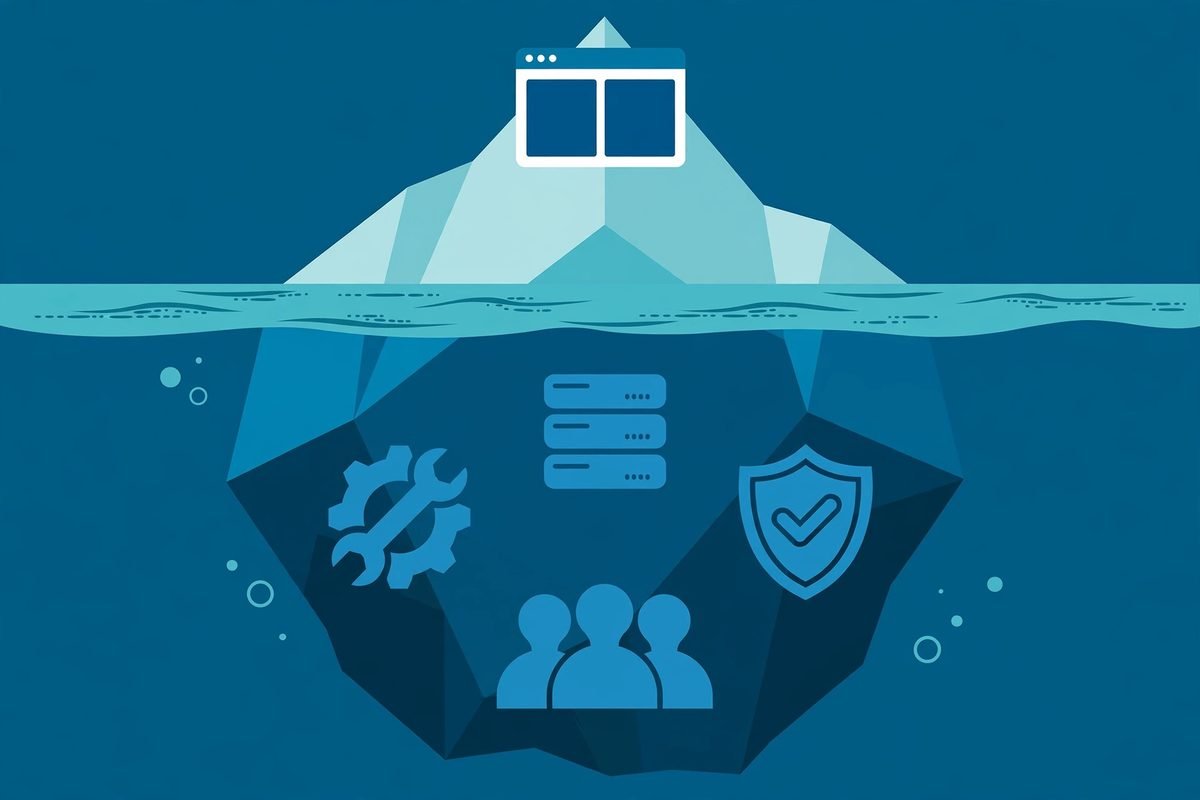
The build quote is the visible part of the spend. The rest is below the waterline, and budgeting only for the visible part is how projects blow up. Expect these:
- Maintenance: budget 15–25% of the build cost every year. Software is not a one-time purchase; libraries go end-of-life, dependencies get security patches, and the platform evolves whether you use it or not.
- Hosting and infrastructure: cloud costs scale with users and data. A modest app might run a few hundred dollars a month; one that processes heavy data or media can be ten times that.
- Third-party licences: payment gateways take a percentage, mapping APIs charge per request, some SaaS components you embed are licensed per seat. Map these before you sign off on the build.
- Change requests: fixed-price contracts typically bake in a 15–30% risk premium for this. On time-and-materials work, every “can we just add…” costs real hours. Neither model is free of scope change — the difference is where the cost hides.
- Training and adoption: the best internal tool fails if the team does not use it. Budget time and possibly training sessions for rollout.
How to keep the budget from running away
Over half of software projects — 52.7% — exceed their original budgets by at least 89%, according to industry research quoted in a 2026 cost analysis on Medium. That is not a rounding error; it is a planning problem. The single best defence is a written requirements document before any quote is compared. Do not compare bottom-line numbers — compare quotes against the same written scope. This is the advice we give every prospect: the vendor who scoped thoroughly and quoted $60,000 is cheaper than the one who guessed and quoted $40,000.
- Start with an MVP. Ship the core problem first, get it in front of real users, and let feedback set priorities. Starting small can cut initial costs roughly in half.
- Match the pricing model to the certainty of the scope. Fixed price works when the requirements are genuinely locked and you want budget certainty — with the understanding that you pay a risk premium for it. Time-and-materials works better when the plan will evolve, and is usually more cost-efficient in that case.
- Put one person in charge of decisions. Nothing inflates a budget like a committee with veto power over every screen.
- Ask what is excluded. Hosting, licences, maintenance, content entry, training — the quote that omits them is not cheaper, it is incomplete.
Frequently asked questions
How much does custom software development cost for a small business?
Most small business projects in 2026 cost between $15,000 and $50,000 for a complete web application, while simple tools and automations start around $5,000. The final price depends on feature complexity, integrations, and the team you hire.
Why do custom software quotes vary so much between companies?
Quotes differ because of hourly rates, how thoroughly each company scopes the project, and overhead costs. Always compare quotes against a written scope document, not just the bottom-line number — a thorough quote at $60,000 beats a guessed one at $40,000.
Can I start small and add features later?
Absolutely — and you should. Starting with an MVP that solves your core problem first can cut initial costs roughly in half and lets real user feedback guide what you build next instead of assumptions.
How long does it take to build custom software?
Simple tools take 4–8 weeks, typical small business applications take 2–4 months, and larger platforms take 4–9 months. A clear requirements document at the start is the single best way to keep the timeline on track.
Every budget story starts with a scope. If you are trying to put a real number on your project, talk to us — we will scope it properly and give you an honest range, not a guessed one. You can also read more about our custom software and API development services to see how we work.