

Every AI project reaches the same fork in the road: should you fine-tune a model, build retrieval into it, or just write better prompts? Getting the fine-tuning vs RAG for business decision wrong is expensive in both directions. Fine-tune too early and you pay for training, data labelling and retraining cycles before you know what users actually need. Skip retrieval and your chatbot answers confidently from stale knowledge it memorised months ago. This guide is for business owners and operations leads who are buying or building an AI feature and want a decision they can defend to a board, a budget holder, or their own team. By the end, you will be able to pick the right approach for your use case, budget for it honestly, and recognise the warning signs that you picked the wrong one.
The three approaches in plain English
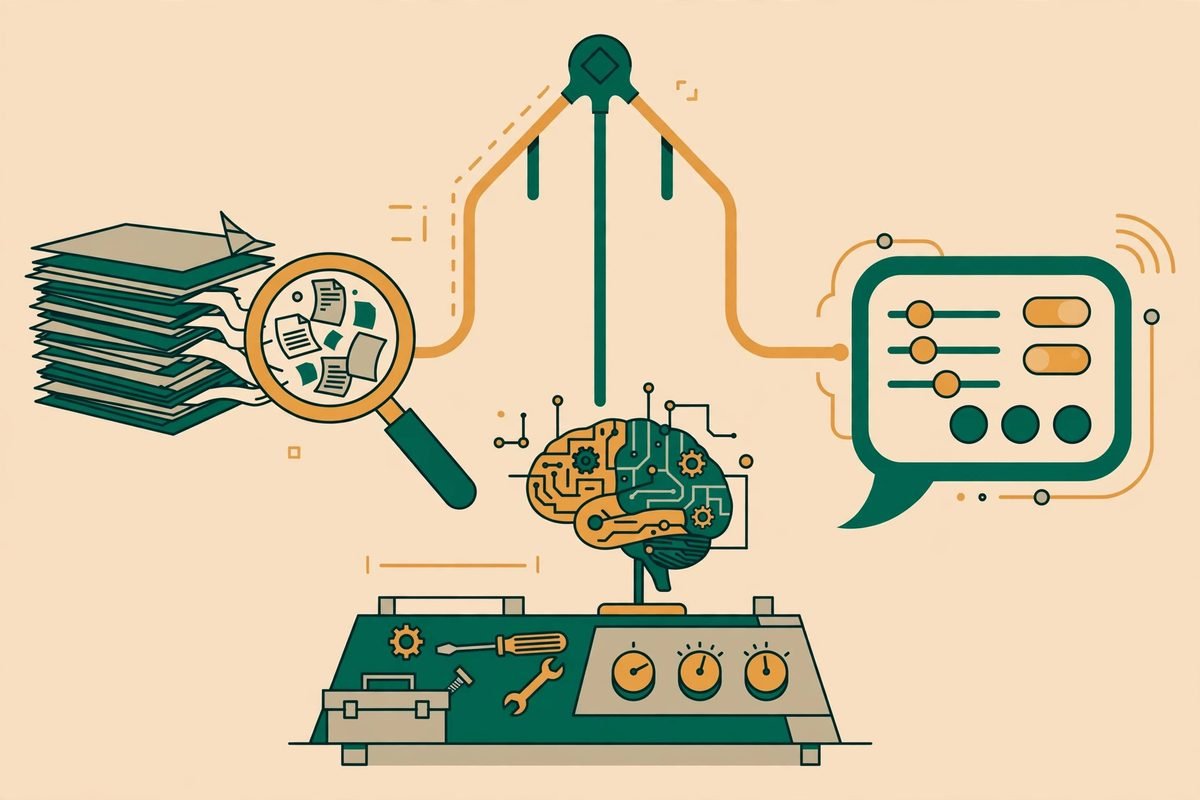
Strip away the jargon and the three options change different things. Prompt engineering changes neither the model nor its knowledge: you write better instructions, give examples, and ask the model to reason step by step. It is the cheapest option and the fastest to test, which is why every serious project starts here. Retrieval-augmented generation, or RAG, changes what the model can see: at answer time it searches your documents, pulls the relevant passages, and generates an answer grounded in them. The model itself is untouched, but its knowledge becomes your knowledge. Fine-tuning changes the model: you retrain it on your examples so that a behaviour, tone, format or domain skill becomes part of how it responds, even with a short prompt.
A useful shorthand is that RAG adds knowledge, fine-tuning adds behaviour, and prompt engineering adds control. When a support bot gives the wrong refund policy, that is a knowledge problem, and RAG is the natural fix. When it gives the right policy in the wrong format, or in a tone that would embarrass your brand, that is a behaviour problem, and fine-tuning is the natural fix.
Fine-tuning vs RAG for business: the decision framework
Work through these four questions in order, and most use cases answer themselves.
- Does the knowledge change? If prices, policies, product specs or regulations update more than a few times a year, RAG wins. Updating a RAG system means re-indexing documents, which takes minutes. Updating a fine-tuned model means a retraining cycle, which takes weeks and a fresh evaluation pass.
- Is the problem knowledge or behaviour? Wrong facts, missing facts and hallucinations point to RAG. Wrong format, inconsistent tone, unreliable JSON or SQL output, and sloppy classification point to fine-tuning.
- Do answers need citations or an audit trail? RAG can show its sources, because every answer traces back to retrieved passages. A fine-tuned model cannot cite a training example, which matters enormously in regulated work, legal and financial contexts, and any customer-facing deployment where someone will ask “says who?”
- Do you have labelled examples? Fine-tuning needs them, typically hundreds to thousands of good examples, and data preparation is routinely 60 to 70 percent of the total effort. If you only have raw documents and no labelled pairs, RAG is the only honest starting point.
The default order that experienced teams follow is prompts first, RAG second, fine-tuning last. Each step is only taken when the previous one demonstrably falls short on a measured evaluation, not on a hunch. Independent comparisons reach the same conclusion, including the fine-tuning vs RAG vs prompt engineering decision framework published by OpenHelm and the 2026 RAG vs fine-tuning decision guide from Metacto.
What prompt engineering can and cannot do
Prompt engineering is routinely underestimated because it looks like typing. Done properly, it is a genuine engineering discipline: system prompts that define role, constraints and refusal behaviour; few-shot examples that pin down format; chain-of-thought instructions for multi-step reasoning; and prompt caching so repeated instructions do not get re-billed at full price on every call. For internal tools, prototypes and low-volume features, this layer alone is often enough, and it ships in hours rather than weeks.
Its limits are real, though. Prompts are fragile: small wording changes can shift outputs unpredictably, and long example lists bloat every request, raising per-query cost and eating context window. A prompt cannot teach a model facts it has never seen, nor guarantee format compliance the way a trained behaviour can. The practical test is simple: build an evaluation set of fifty to a hundred representative questions, score prompt-only outputs, and only move on when the failures cluster into a pattern prompts cannot fix.
What RAG actually costs, to build and to run
RAG looks cheap because there is no training run, but it has a cost profile of its own. On the build side you pay for document ingestion, chunking, embeddings, a vector store, and usually a re-ranker. On the run side every query pays for retrieval plus a longer prompt, because retrieved context travels with the question. That per-query premium is modest at low volume and becomes the dominant cost line at high volume, which is exactly when fine-tuning starts to look attractive.
The failure mode of RAG is almost never the model. It is the data. If your knowledge base contains three versions of the same policy, contradictory price lists, or PDFs nobody has reviewed since 2023, RAG will faithfully retrieve the wrong one and answer with confidence. Budget for document governance, freshness checks and access control from day one, and treat a retrieval system with no evaluation set as unfinished. The payoff for doing it properly is large: fresh answers, source citations, and updates without retraining, which is why RAG is the right default for customer support, legal and compliance question-answering, and any task where the answer must be verifiable.
When fine-tuning earns its keep
Fine-tuning earns its keep in four situations. First, format discipline: a model that must emit valid JSON, SQL or log lines every single time, with no deviation, is a classic fine-tuning win. Second, consistent voice: regulated, medical, legal or financial writing where tone and terminology must not drift. Third, narrow specialisation: classification, extraction and structured-output tasks repeated thousands of times a day. Fourth, unit economics at scale: a smaller fine-tuned model answering with short prompts can be dramatically cheaper per query than a frontier model fed long retrieved contexts, and it answers faster because there is no retrieval step.
Modern parameter-efficient methods such as LoRA have lowered the bill considerably, because they train a small adapter rather than the whole model. But they have not removed the surrounding costs: curating training data, building an evaluation set, running training and safety checks, deploying the adapter, and repeating the cycle whenever the behaviour or the world changes. Fine-tuning is also the wrong tool for fast-changing knowledge, for problems where you have fewer than a few hundred good examples, and for any deployment where you cannot say in advance how you will measure success.

The hybrid pattern most production systems end up with
Here is the part most comparison articles bury: the best production systems use more than one approach. A common winning pattern is a lightly fine-tuned model for behaviour, reading retrieved context supplied by RAG, with prompt engineering governing conversation flow and guardrails. The fine-tuning makes the model reliable at following instructions and emitting the right format; the retrieval keeps its facts fresh and citable; the prompts handle edge cases, refusals and tone. One well-known competition result even showed a hybrid approach cutting hallucinations by double digits compared with RAG alone, and practitioner guides consistently report the same ordering: RAG for truth, fine-tuning for depth, prompts for control.
There is also a cheaper hybrid worth knowing about: fine-tuning only the retriever. Keeping the generator general-purpose but training the embedding model on your domain’s query-and-document pairs can capture much of fine-tuning’s quality gain at a fraction of the cost, while keeping the system easy to update because the generator never changes.
From our experience: the mistake we see most often
Across more than nine years and 300-plus projects at MTD Technologies, the most expensive AI mistake we see is not a bad model choice. It is sequencing. A team hears that a competitor fine-tuned a model, commissions the same, and discovers three months later that their real problem was an unorganised document library and no evaluation set. The training run finishes, the demo looks impressive, and production quietly disappoints, because nobody measured the baseline first. The fix is unglamorous and it works: define the task, build a hundred-question evaluation set with expected answers, score the prompt-only baseline, add retrieval, and only then discuss training. Teams that follow that order usually find that RAG closes most of the gap, and the fine-tuning they eventually do is smaller, cheaper and aimed at a behaviour they can name. That is also why we scope AI work through our AI integration and automation services starting from the workflow, not the model: the workflow tells you which of the three levers to pull, and in which order.
Two more honest warnings. First, never fine-tune on data you do not have the right to use, and never put sensitive customer data into a training set without a data-processing agreement and a clear retention policy; retrieval systems are easier to govern here because a document can be removed from an index in minutes, while knowledge baked into weights cannot be cleanly deleted. Second, budget for maintenance, not just launch. Retrieval indexes drift as documents change, adapters drift as products change, and prompts drift as models update. If you are scoping a custom build, our custom software and API development team can scope it, and the AI Tools Directory is a useful place to compare the current generation of tools before you commit to any of them.
Frequently asked questions
Should I start with prompt engineering, RAG, or fine-tuning?
Start with prompt engineering, because it costs almost nothing and answers in hours whether the task is even solvable with your current model. Add RAG when the problem is missing or fast-changing knowledge. Consider fine-tuning only when prompts and retrieval demonstrably fall short on a behaviour you can measure, such as format compliance or tone consistency.
Is RAG cheaper than fine-tuning?
Usually, yes, up front: RAG needs documents and an index, not labelled data and training compute. But RAG costs more per query, because every answer carries retrieved context. At very high query volumes, a fine-tuned smaller model with short prompts can become cheaper overall, which is why the two approaches cross over rather than one always winning.
Can I combine fine-tuning, RAG and prompt engineering?
Yes, and most mature production systems do. Fine-tune for behaviour and format, use RAG for fresh and citable knowledge, and use prompts for conversation flow, guardrails and edge cases. Combining them is not over-engineering when each layer solves a different, measured problem.
How much data does fine-tuning need?
It depends on the task, but plan on hundreds to thousands of high-quality labelled examples, with data preparation taking most of the project effort. Small, clean, representative datasets beat large, noisy ones, and a held-out evaluation set matters more than raw example count.
Does RAG stop hallucinations?
It reduces them substantially by grounding answers in retrieved passages, and a well-built system declines to answer when nothing relevant is found. It does not eliminate them: poor retrieval, contradictory documents or a model that ignores context can still produce confident errors, which is why evaluation and document governance matter as much as the architecture.
The decision is not really about which technology is best in the abstract. It is about which constraint dominates your use case: changing knowledge, required behaviour, auditability, data availability, or cost at your query volume. Answer those five, in that order, and the architecture mostly picks itself. If you are still unsure, start with the cheapest layer, measure honestly, and let the evaluation set tell you when to spend more. If you would like a second pair of eyes on that decision, talk to our team.