

Most business owners who ask us about business automation ROI are really asking one question: “Will this pay for itself, and how will I know?” This post is for owners and operations managers who are considering workflow automation — or have already bought a tool and now wonder what it returned. After reading it, you will be able to price a manual process, build the true cost stack of an automation project, and measure before-and-after results with a simple spreadsheet.
We have built automations for businesses for years, and the pattern is consistent: companies that measure first, automate second, almost always get their money back. Companies that automate first and measure later rarely know what they bought. A Forbes contributor recently made the same point from the enterprise side — large companies build measurement systems before buying software; small businesses typically buy the tool first and try to measure later, which is exactly backwards (Forbes on how to measure AI ROI). Let’s fix that, starting with the maths.
The ROI formula that survives scrutiny
The formula itself is simple. An automation-community infographic from n8nstack puts it as: ROI (%) = (Total Savings + Additional Revenue) / Total Cost of Automation × 100. We use a slightly fuller version, because “total savings” hides the interesting part:
ROI = (Time value recovered + Revenue recovered + Errors avoided − Total cost) / Total cost × 100
Each term deserves a number, not a guess:
- Time value recovered: hours per week a process takes × who does it × their loaded hourly cost. An owner doing admin at an equivalent £50/hour (about $60) for 6 hours a week is £300/week — over £15,000 a year of expensive time on routine work.
- Revenue recovered: deals, bookings, or repeat purchases that manual processes lose. A business losing 5 leads a month to slow follow-up, with a 20% close rate and a £2,000 average deal, leaks £2,000 a month — £24,000 a year.
- Errors avoided: double bookings, missed invoices, wrong shipments. Even one £500 mistake a month is £6,000 a year, and error costs are the term owners most consistently underestimate.
- Total cost: not just the software subscription — the full stack, which we detail below.
If any of those inputs is a shrug, the ROI figure is decoration. The rest of this post is about replacing shrugs with numbers.
Step one: measure the baseline before you change anything
From our experience, this is the step businesses skip most often — and the one that matters most. You cannot prove an automation worked if you never measured what it replaced. The baseline is a one-page snapshot of a single process, taken over one or two ordinary weeks:
- Volume: how many times the task happens (e.g. 23 new enquiries, 41 invoices sent).
- Time: total person-hours spent on it, by whom. A rough time log kept for a week beats a precise estimate from memory — estimates are almost always low.
- Speed: average response time for customer-facing steps (first reply to an enquiry, days from invoice to payment).
- Failure rate: how often the process goes wrong — missed follow-ups, late payments, data-entry errors.
- Money at stake: the value flowing through the process — revenue it touches, late fees, discounts given to apologise for delays.
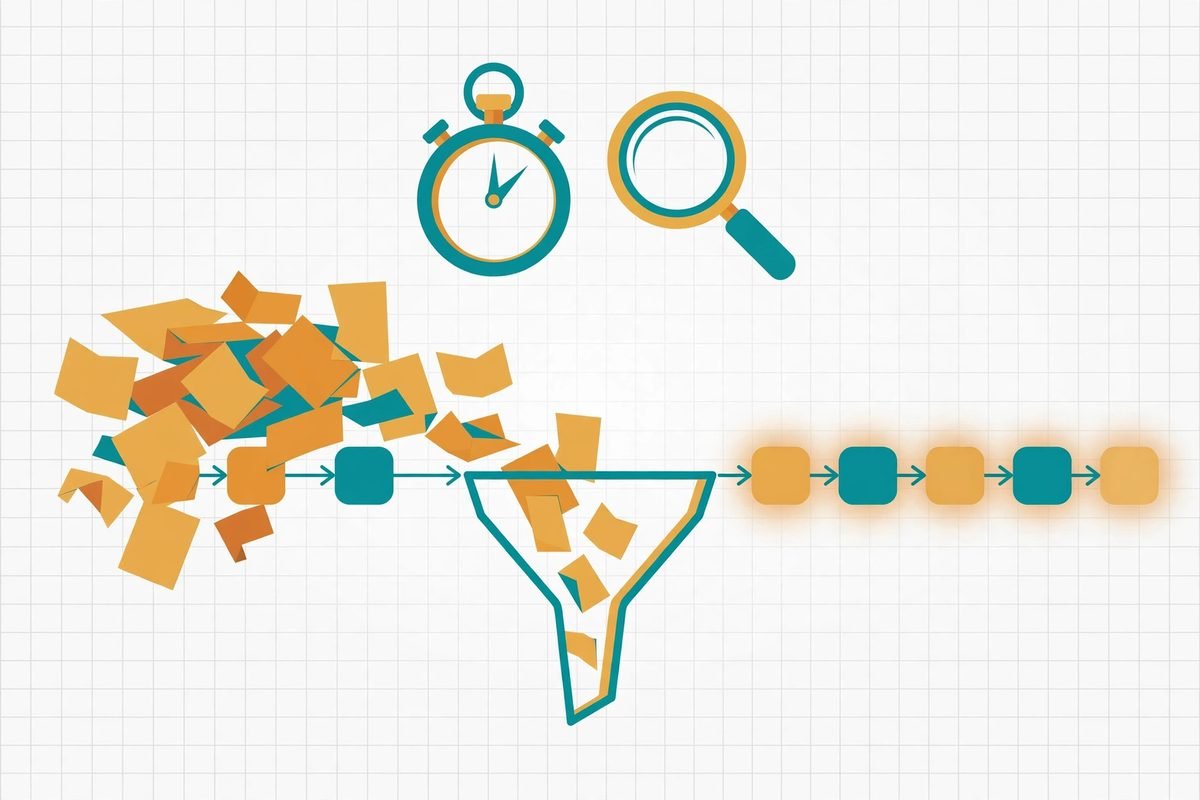
An AI practitioner put it bluntly in a recent video: before asking whether AI can fix a problem, determine what the problem actually costs you — most businesses never do the costing step, so they automate trivial irritations while expensive problems sit untouched (on costing problems before automating). The same theme comes from the founder of an AI agency, who argues that most people build automations for trivial tasks like email summarisation while ignoring the high-value workflows that would justify the effort (critique of low-impact automations). Automate the expensive problem first. The baseline tells you which problem that is.
Step two: build the true cost stack
Most ROI claims die here, because the cost side gets counted at the subscription price and nothing else. One practical guide to measuring marketing automation ROI warns that real costs typically include platform fees, build time, content creation, integration work, and ongoing maintenance. We cost every automation project across five lines:
- Software: the workflow platform itself. For small businesses in 2026 this is typically £20–£300/month for tools like n8n, Make, or Zapier, plus any API usage (LLM calls, SMS, WhatsApp Business fees). Budget £600–£3,600 a year.
- Build: the hours to design, build, and test. A focused lead follow-up flow might take 10–20 hours of specialist time; a multi-system back-office pipeline can run 40–80. Price your team’s hours honestly, or get a fixed quote.
- Data work: cleaning the data the automation depends on. Garbage CRM data produces garbage automated follow-ups, and fixing it is always part of the real cost.
- Training: the hour or two of staff onboarding, plus documentation. Small line, often zero, but include it.
- Maintenance: workflows break when APIs change and business rules shift. Budget roughly 2–4 hours a month of someone’s time per active automation, or a support retainer.
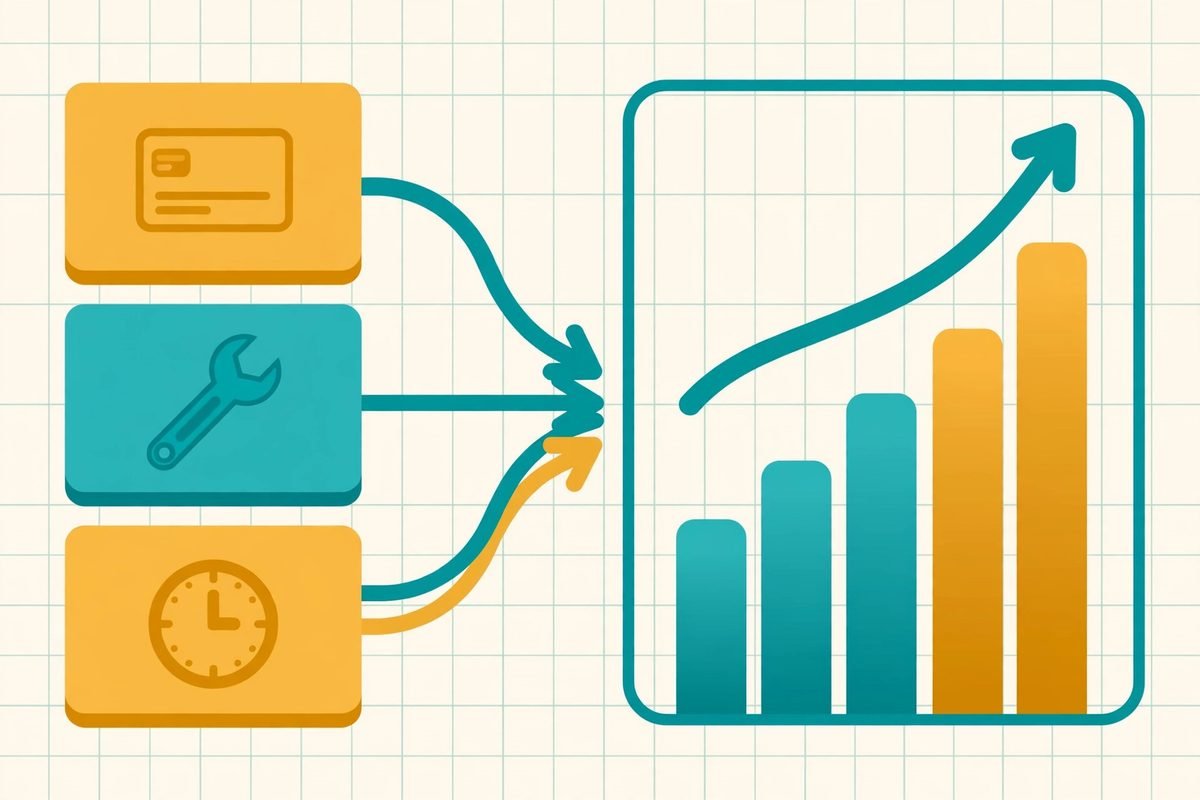
A realistic year-one cost stack for a small business automating three core workflows: £1,200 software + £3,000 build + £1,800 maintenance ≈ £6,000. That number is what the ROI formula should divide by — not the £49/month subscription on the pricing page.
A worked example: lead follow-up automation
Numbers make this concrete, so here is a hypothetical worked example using typical figures we see in service businesses. Suppose a 12-person agency gets 60 enquiries a month through its website and social channels. The office manager spends 8 hours a week chasing them — logging details, sending intro emails, booking calls, nudging non-repliers.
Baseline: 8 hrs/week × £35/hr loaded cost = £280/week ≈ £14,560/year in staff time. Speed: average first response 11 hours. Failure: 1 in 4 enquiries gets no follow-up at all, because the manager is busy. With 60 enquiries and a 15% close rate on followed-up leads, the 15 lost enquiries a month cost roughly 2.25 deals — at £2,500 average value, that is £5,625/month, or £67,500/year in leaked revenue.
Automation: an n8n workflow that captures every enquiry instantly, sends a personalised first response within 2 minutes, books calls directly into the calendar, and runs a 4-touch follow-up sequence over 14 days, escalating to a human when a lead replies with interest. Build cost ~£3,500, software ~£60/month, maintenance ~£150/month.
After (typical outcome, measured over 6 months): manager time drops to 2 hrs/week (only handling hot replies) — 6 hrs/week recovered ≈ £10,920/year. First response falls to under 5 minutes. Missed follow-ups drop to near zero, and the close rate on previously-lost leads recovers roughly half the leaked revenue: ~£33,750/year. Total value ≈ £44,670/year against a year-one cost of ≈ £6,020. ROI ≈ 642%.
Year two is better: the build cost is gone, so the denominator shrinks to ~£2,500 while the value compounds. This is the honest shape of automation ROI — a front-loaded cost, a 3–6 month payback ramp, then steadily improving returns. Independent benchmarks line up: small businesses implementing AI workflows commonly report 2–5× returns within 3–6 months (AI automation for small businesses), MNB Research’s work with Indian SMEs shows ~3× average returns over 12 months with most projects paying back in 4–8 weeks (AI automation for Indian SMEs), and one detailed 2026 cost breakdown puts typical first-year returns for service businesses at 4–12× (small business automation ROI breakdown).
What people get wrong about automation ROI
From our experience, three mistakes account for most disappointed automation projects:
- They automate a task instead of a bottleneck. Saving 2 hours a week on social post scheduling while invoicing bleeds £5,000 a month in late payments is ROI theatre. The baseline exercise exists precisely to stop this.
- They count gross savings as ROI. Recovering £40,000 of staff time with a £35,000 implementation and £8,000 a year of maintenance is a loss, not a win. The denominator is the full cost stack, not the subscription line.
- They measure once, if at all. Automation returns drift: volumes change, tools raise prices, exception rates creep up. The businesses that keep getting value re-measure quarterly and kill workflows whose numbers stop working. Salesforce’s SMB Trends research found 91% of small and mid-sized businesses using AI tools report revenue gains — but gains only persist if someone watches the dashboard.
A related trap: valuing recovered time at zero. If automation frees up your office manager for 6 hours a week and those hours go to higher-value work, that value is real — but only if the hours actually get redeployed. If they dissolve into a longer lunch and general slack, book only the revenue and error terms in your ROI. Honest accounting beats optimistic accounting; it is also what makes the next automation project easier to approve.
The metrics dashboard: what to track monthly
You do not need enterprise software for this — a spreadsheet with one row per workflow and these columns is enough:
- Runs: how many times the workflow fired. A workflow that runs 3 times a month cannot justify much spend.
- Success rate: runs that completed without error or human rescue. Below ~95%, fix the workflow before expanding it.
- Hours recovered: the baseline weekly hours minus current weekly hours, × the role’s loaded cost.
- Cycle time: how fast the process completes now versus baseline (first-response time, invoice-to-payment days).
- Exceptions: how often a human had to intervene. Rising exceptions are the early warning that a workflow is decaying.
- Net value this month: recovered time value + recovered revenue − that month’s costs.
Review it for 30 minutes a month with whoever owns the process. When a workflow’s net value goes negative for two consecutive months, it gets fixed or retired. That single rule separates automation that compounds from automation that quietly becomes a liability.
Frequently asked questions
How long does it take for business automation to pay for itself?
For the high-value workflows — lead follow-up, invoice chasing, appointment reminders — most small businesses see measurable improvement within 30 days and full payback within 2–6 months. Complex multi-system projects can take 9–12 months. If your baseline shows a cheap problem (under a few thousand pounds a year), payback may never arrive — which is exactly what the baseline is there to tell you before you spend anything.
What is a good ROI for business automation?
Industry benchmarks cluster around 2–5× returns within the first 3–6 months and 4–12× over the first year for service businesses that automate revenue-touching workflows. Treat anything above 10× with scepticism — it usually means the baseline was priced with optimism or the cost stack was undercounted. A solid, honestly measured 3× is better than a fantasy 20×.
How do I value time saved if I can’t hire fewer people?
Use the “redeployment test”: price recovered hours only at the value of the work they actually move into. If a manager’s 6 freed hours become 6 hours of customer retention calls, value them at the revenue those calls protect. If the hours dissolve into general busyness, book them at zero and let the revenue and error terms carry the ROI. Either way, write down your assumption — future you will want to check it.
Should setup and maintenance time count in the cost?
Yes — this is the single most common reason ROI claims fall apart. The subscription is often the smallest line in the true cost stack: build hours, data cleanup, training, and ongoing maintenance usually exceed it in year one. A vendor quoting ROI on software cost alone is quoting you a fraction of the denominator.
What is the biggest ROI killer in automation projects?
Automating the wrong process — usually the most visible irritant rather than the most expensive problem — followed closely by never measuring a baseline, which makes failure invisible. The fix is procedural: price the problem first, automate second, and re-measure quarterly. Projects run this way almost never surprise you.
Measuring ROI on business automation is not a one-off exercise — it is the discipline that makes every subsequent automation decision easier. Start with one process, take a two-week baseline, cost it honestly, automate the expensive problem, and let the numbers decide what comes next. If you want help with the baseline or the build, our n8n workflow automation service starts every engagement with exactly this measurement step — and you can talk to us about which of your processes would pay back first.