
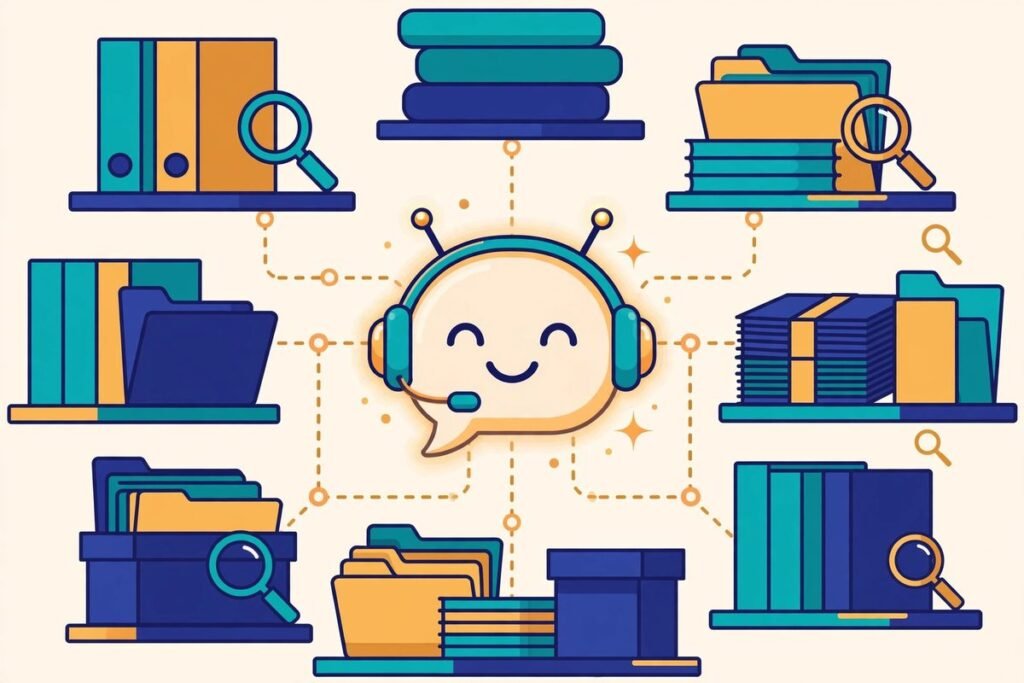
If you have ever watched a general-purpose AI chatbot answer a question about your business with total confidence — and be completely wrong — you have met the biggest blocker to putting AI in front of customers. The model does not know what you know. Your refund policy changed three weeks ago; its training data stops long before that. Your pricing, processes, and product manuals never lived inside it. Most teams discover at this point that they do not have an “AI problem”; they have a knowledge problem.
This post is for business owners and operations managers who want a chatbot that answers from their own documents instead of inventing answers. By the end, you will understand how a RAG chatbot for business documents works in plain terms, what it costs, how to keep it from leaking private data, and when you should not build one.
Why generic AI chatbots fail businesses
Picture the classic failure: a support engineer asks the company chatbot what the refund policy is for orders placed after a warehouse closure last month. The chatbot, built on a general-purpose language model, answers confidently. It is also wrong, because the policy changed three weeks ago and the model’s training data stops long before that. Nothing about the prompt was wrong. The model simply had no way to know what it was never told.
This is why retrieval-augmented generation, or RAG, has quietly become the default way companies connect language models to their own data. It is not a single product; it is a pattern: search first, then generate — hand the model real documents instead of asking it to recall facts. The market is following: the RAG market was estimated at $1.94 billion in 2025 and is projected to reach $9.86 billion by 2030, a 38.4% compound annual growth rate, according to a MarketsandMarkets report cited in a recent developer deep-dive on RAG.
McKinsey’s State of AI survey from August 2026, covering 1,719 participants across 97 countries, found that chatbots were the most widely scaled AI application, with 47% of organisations using them across the enterprise — as reported in a practical guide to document-grounded chatbots. The winners are the companies whose bots answer from real, current company knowledge.
What RAG actually is, in plain terms
Strip away the jargon and RAG does something intuitive: before the chatbot answers, it looks things up. You ask a question. The system searches your documents for the passages most relevant to that question. It hands those passages to the language model along with your question and says, in effect: “Answer using only this.” The model then writes a natural-language answer grounded in your material, ideally citing where each fact came from.
The critical property: the model never “learns” your data in the training sense. Change the refund policy PDF, re-index, and the bot’s next answer reflects the change. That is the fundamental difference from fine-tuning, where new knowledge means retraining.
What’s new in RAG in 2026
If your mental model of RAG is from 2023 — a demo that indexes a few PDFs — the landscape has moved on. A few developments worth knowing about:
- GraphRAG is going mainstream. Gartner flagged retrieval-heavy architectures like GraphRAG as a top data and analytics trend for 2026, predicting 40% of enterprises will adopt GraphRAG techniques by 2029 to improve factual accuracy. It builds a knowledge graph over your documents so the bot follows relationships (products → policies → exceptions), not just keywords.
- Sovereign RAG is a board-level topic. Across Asia Pacific, enterprises are moving from experimental chatbots to RAG systems inside national borders and corporate infrastructure, driven by stricter data rules — RAG delivers outputs that are “far more accurate, traceable and business specific,” per the APAC enterprise AI outlook.
- Agentic RAG is the next step. Instead of one retrieve-then-answer pass, agentic systems plan multi-step research: query several sources, compare results, refine before answering. The approach is already winning industry awards in 2026.
- Small businesses are the fastest-growing segment. SMEs are adopting RAG at the highest growth rates, driven by low-cost cloud platforms and managed RAG services — no ML team or private infrastructure required.
The takeaway for a business owner: RAG is no longer a research project. It is a commodity architecture with managed options at every price point, which means the decision is now about execution quality, not technology access.
How a RAG chatbot works, end to end
There are four stages, and understanding them is what separates a chatbot that works from a demo that embarrasses you in production.
1. Connect and ingest
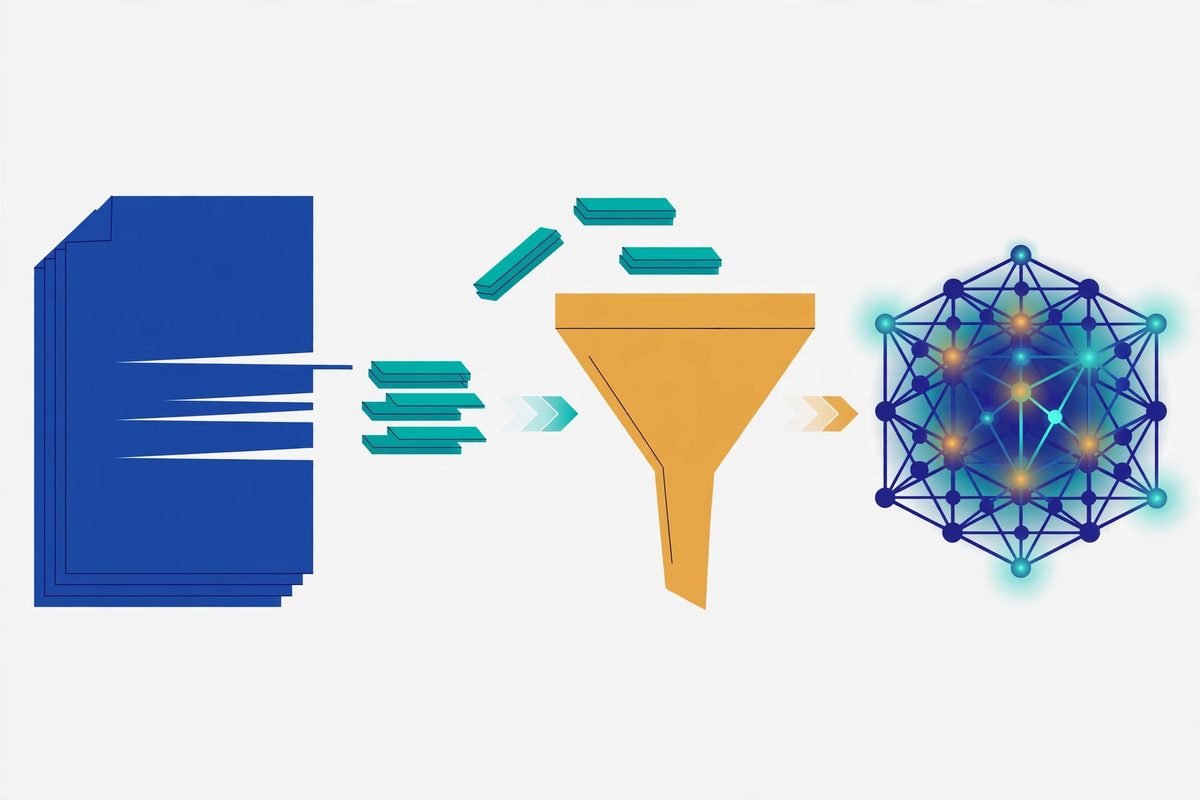
Documents are pulled from where they live: SharePoint, Google Drive, Confluence, shared drives, your website. Scanned documents must be OCRed before they are usable — easy to skip, expensive to discover later. Every source needs a refresh schedule, because a chatbot answering from last year’s price list is worse than no chatbot.
2. Chunk and embed
Each document is split into chunks — typically a few paragraphs — and every chunk becomes a vector embedding, a numeric representation of the passage’s meaning. Chunks are stored in a vector index (Chroma, Qdrant, Supabase pgvector, or similar) with metadata: source, date, owner, and — critically — access rights. Chunk size is the most-tuned parameter in a RAG system: too large and the model drowns in irrelevant text; too small and answers lose context.
3. Retrieve
When a question arrives, it is embedded the same way and the index returns the closest chunks. Production systems combine vector search with keyword search (hybrid retrieval), then rerank the top candidates — keeping 3 to 5 strong passages instead of 20 mediocre ones. Retrieval is also where permissions must be enforced: filter to documents the asker may see before generating anything.
4. Generate with citations
The retrieved passages and the question are passed to the language model with a strict instruction: answer only from the provided context, and say you do not know if the answer is not there. Good implementations force the model to cite which passage supports each claim, and show the source to the user beside the answer. That visible citation is what turns silent errors into visible, reportable ones.
RAG vs fine-tuning: which do you need?
This is the question we get asked most, and the answer is usually clearer than people expect:
- Choose RAG when your knowledge changes. Policies, prices, catalogues, documentation — anything updated more than a few times a year belongs in a retrieval index, not in model weights.
- Choose RAG when answers must be traceable. “Here is the document and paragraph it came from” ends disputes. Fine-tuned models cannot cite sources.
- Choose fine-tuning when you need behaviour, not facts. Tone of voice, response format, domain reasoning style — fine-tuning teaches the model how to talk, not what is true.
- Use both when it matters. Many serious deployments fine-tune a smaller model for the company’s voice and wrap it in RAG for the company’s facts. Different problems, different tools.
A rule of thumb from experience: if someone proposes fine-tuning to fix “the bot doesn’t know our new pricing,” they are solving the wrong problem with the expensive tool. Update the document, re-index, done.
What people are actually asking about RAG
Watch what practitioners and business owners discuss online and two anxieties dominate — both legitimate, both solvable:
“It answers with total confidence — and the fact isn’t in my documents”
This is the failure mode that quietly kills trust: the bot invents a clause or price, cites a page that says the opposite, and nobody notices until a customer complains. The fixes are unglamorous: a hard system prompt (“answer only from the provided context”), forced per-claim citations verified against the source passages, reranking before generation, and — most importantly — a clean abstain path. If the evidence is weak or contradictory, “I don’t have enough information” beats a confident wrong number every time.
“Can it leak one customer’s data to another?”
Yes — if built carelessly. The known incident pattern: a RAG backend indexes help articles, past tickets, and invoices into one store, retrieves by semantic similarity without filtering by owner, and one customer asks “show my last invoice” and receives another customer’s. The fix is architectural: enforce access control before retrieval by injecting the authenticated user’s identity as a mandatory filter, and test like an attacker, including prompt-injection attempts. Permissions are part of the retrieval design, not a feature bolted on later.

From our experience: what makes RAG succeed or fail
After building automation systems for years, here is the honest version of what the tutorials skip. The model is rarely the hard part. The real work, in order:
- Document quality is the real project. Messy PDFs, scanned images with no OCR, three conflicting versions of the same policy — the retrieval layer is only as good as what you feed it. Budget real time for cleaning and deduplicating. A demo on one clean document proves the concept; production is won in the other 4,999 documents.
- Permissions design comes first, not last. Decide up front who may see what, and make sure every document carries ownership metadata. Retrofitting access control onto a flat index is painful.
- Evaluate like it matters. Collect 20 questions your customers or staff actually ask — from emails, chat logs, support tickets — run them through the bot, and mark each answer right, partly right, or wrong. Do not launch until every answer is right or the bot safely says it does not know. Re-run the set monthly; document drift is silent.
- Know the real costs. Embeddings are cheap. The ongoing costs are per-answer model calls and re-indexing when documents change. For a bot handling a few hundred questions a day, the AI bill is typically tens of dollars a month — but cache repeated questions anyway.
- When NOT to build one. A 10-question FAQ that changes yearly is served better by a rule-based widget. If answers carry legal liability, the bot should draft and a human should approve. RAG scales access to documented knowledge; it does not replace expertise.
On the build side, the pragmatic stack for small and mid-size businesses is refreshingly boring: documents synced from Drive or SharePoint, an n8n workflow handling the ingest-and-index pipeline, embeddings in a managed vector store like Supabase pgvector, and a chat widget on the website. No GPU servers, no ML team — just solid plumbing. If you want this kind of document-grounded automation designed around your systems, our AI integration team builds exactly these pipelines.
Frequently asked questions
How much does a RAG chatbot cost for a small business?
A basic build — ingest from Drive or SharePoint, a managed vector store, a website widget, and evaluation on your real questions — typically lands in the low thousands of dollars one-time, plus tens of dollars a month in AI usage. The variable is the state of your documents: messy, scattered material adds cleanup time.
Is my company data safe in a RAG chatbot?
It can be, but safety is designed, not default. Documents should stay in infrastructure you control, embeddings should inherit document-level access rights, and retrieval must filter by the asker’s permissions before generating. Ask any vendor how they enforce per-user access control — a vague answer is a red flag.
RAG vs fine-tuning: which should I choose?
RAG for knowledge that changes and whenever answers must cite sources. Fine-tuning for behaviour like tone and format. Most serious deployments use RAG first and add fine-tuning only if the model’s voice genuinely needs shaping.
Can a RAG chatbot connect to SharePoint, Google Drive, or our wiki?
Yes — connecting to existing repositories is the standard first step. The pipeline pulls from SharePoint, Drive, Confluence, or shared drives on a schedule, OCRs scanned files, and re-indexes changed documents. The main work is mapping permissions and setting refresh frequency per source.
How do you stop a RAG chatbot from making things up?
Four layers: retrieve well (hybrid search plus reranking), instruct strictly (answer only from the provided context), verify (per-claim citations checked against the source passages), and abstain gracefully when evidence is weak. Then measure faithfulness on a fixed set of real questions monthly — accuracy alone hides hallucination.
A RAG chatbot is not magic; it is good information architecture with a fluent interface on top. Done well, it turns the knowledge already in your documents into answers your customers and team can use — with sources attached. Done carelessly, it is a confident liar with your logo on it. The difference is never the model; it is the retrieval, the permissions, and the evaluation discipline. If you would like help scoping one, talk to us — we will tell you honestly whether your use case needs it.