

AI agent pricing per task cost is the number most buyers never see on a pricing page, and it is the number that decides whether an agent saves money or quietly becomes one of your largest software bills. Vendors sell seats, tokens, credits, conversations and resolutions, and each unit sounds reasonable on its own. The bill you actually pay depends on how many of those units a task consumes, how often the agent fails, and what happens on top of the headline rate. This guide explains the four pricing models, works through real 2026 rates, names hidden costs, and gives you a forecasting method you can run in an afternoon.
This is written for business owners buying or building an agent. If you take one idea away, take this: never compare two agents by headline price. Compare them by cost per correct task, the all-in cost of one task completed properly, with failures, retries and handoffs included.
The four ways you actually pay for an agent
Almost every agent price you will meet in 2026 is one of four models, or a blend of two. The model matters more than the rate, because each one puts a different risk on a different party. When the agent fails, somebody still pays. The pricing model decides who.
1. Per seat: you pay for people, not work
Per-seat pricing charges a fixed monthly fee for each named human user. It is easy to forecast and looks like every other software subscription. It works well for copilots, where a human sits at a desk and the software amplifies them. It breaks for agents, because the whole point of an agent is that it does work without a human in the seat. An agent processing 10,000 cases a month is not a seat, and seat counts do not move when the workload does.
2. Per token or credit: you pay for consumption
Token pricing bills the text a model processes, metered separately for input and output, usually quoted per million tokens. Credits are the same meter with a friendlier name. This model is honest in one sense, because you pay for what actually ran. It is treacherous in another, because you pay for how the vendor’s architecture runs, not for what you got. An agent works in a loop, re-reading its instructions and everything that has happened so far at every step. A chat costing a few cents as a one-shot answer can cost more than a dollar as a 20-step agent run. Failed runs, retries and detours bill exactly like perfect ones.
3. Per task, conversation or session: you pay for effort
This model charges for each unit of agent work, whether or not it succeeded: a conversation handled, a session opened, an action taken. Freshdesk’s Freddy AI Agent, for example, has been reported at 49 cents per session, billed per 24-hour session whether or not the session was resolved. Salesforce Agentforce has been reported at 2 dollars per conversation or 10 cents per action. Per-task pricing is easy to budget when volume is predictable, but it still charges you for attempts. A task the agent starts, fumbles and hands to a human still appears on the invoice.
4. Per outcome or resolution: you pay for completed work
Outcome pricing charges only when a defined result is achieved, typically a resolved customer conversation. Published rates reported in October 2026 include Intercom Fin at 0.99 dollars per resolution, Zendesk at 1.50 dollars on committed volume and 2.00 dollars pay-as-you-go, HubSpot at 0.50 dollars, and Help Scout at 0.75 dollars. The appeal is obvious: if the agent does not resolve it, you do not pay for it. The catch is in the definition, which differs by vendor, and some charge separately for handoffs and lead qualifications.
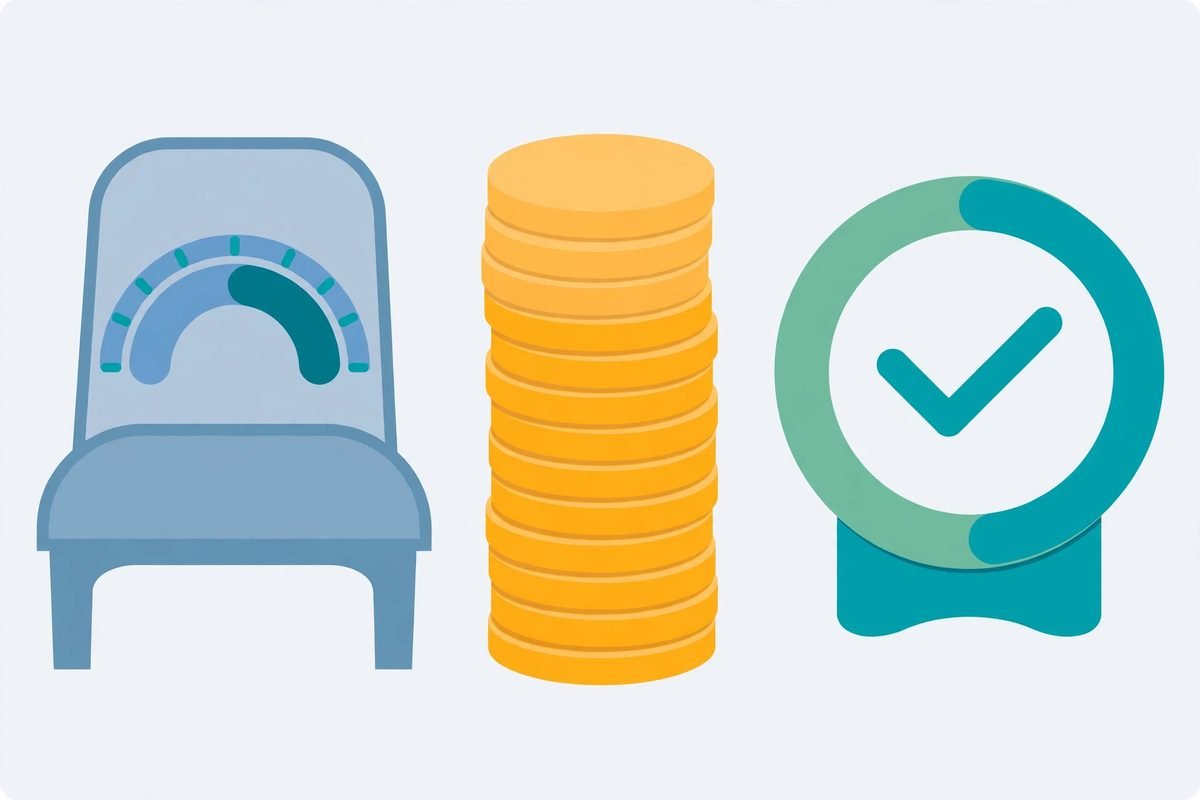
AI Agent Pricing Per Task Cost in Practice: A Worked Example
Take a support team handling 3,000 conversations a month, where the agent resolves half. At 0.99 dollars per resolution, the AI line is 1,500 times 0.99, or 1,485 dollars a month before helpdesk seat fees. At 2.00 dollars pay-as-you-go, the same workload is 3,000 dollars; at 0.50 dollars, it is 750 dollars. The workload did not change, yet the bill moved by a factor of four.
From the token side, one detailed October 2026 analysis put a typical 20-step agent task on a mid-tier model at roughly 0.30 dollars with prompt caching and 1.45 dollars without it. A small model brought it under 10 cents; a flagship roughly doubled it. Step count, context size and caching move the cost more than the rate card does: a 40-step run on a cheap model can cost more than a 12-step run on a dearer one.
Then divide by your success rate, because failed runs cost money too: cost per correct task equals cost per run divided by success rate. A run costing 0.31 dollars becomes 0.34 dollars per success at 90 percent, 0.44 dollars at 70 percent, and 0.61 dollars at 50 percent. Measure success rate: it is the biggest lever on your real bill.
The seat trap: when seats hide the real bill
The most expensive mistake we see is buying an agent on seats and then discovering the AI line underneath. Several support products combine both: a seat fee for each human agent plus a per-resolution fee for the AI. At low volume, seats dominate; at high volume, the AI line does. One comparison found that at 10,000 conversations a month, per-resolution charges alone reached roughly 4,950 dollars for one vendor and 7,425 dollars for another, dwarfing seat fees.
Five costs the pricing page hides
- Minimums and commitments. Some vendors set a monthly minimum, such as 50 outcomes a month, or charge a higher pay-as-you-go rate outside a committed volume. A low headline rate on committed volume is not the rate you pay in a quiet month.
- Billable outcomes beyond resolutions. A vendor may charge its resolution rate for a configured handoff or disqualification, and much more for a lead qualification, reported at 9.99 dollars in one case. Ask for the full list of billable outcome types, not just the headline one.
- Seats on top of outcomes. If the AI runs inside a helpdesk, you may pay seat fees for your human team plus the AI rate. Model both lines together, at your real headcount and your real volume.
- Failed runs and retries. Token and per-task models charge for attempts. Outcome models mostly do not, which is their main advantage. Either way, budget for your measured failure rate, not for a perfect run.
- Price changes and overage rates. Model prices move, sometimes sharply and on short notice, and overage rates above an included allowance are often higher than the base rate. One 2026 analysis flagged a flagship model doubling its price within weeks of a launch window. Build a buffer into any annual forecast, and check what the contract says about price changes.
From our experience: what actually moves the bill
MTD Technologies has spent 9+ years building web, mobile and AI systems across 300+ projects, and the agent bills we see follow a pattern. The rate card is rarely the problem. The problem is usually a task defined so loosely that the agent takes 30 steps to do a 10-step job, a success rate nobody measured, an undesigned human handoff, or a vendor price change nobody noticed until the invoice arrived. Fixing the task definition and the success rate usually saves more than switching vendors.
Two honest limitations are worth stating plainly. First, outcome pricing is hardest to contract for complex outcomes such as a funded loan or a collected invoice, which need attribution rules and quality terms vendors are often reluctant to guarantee. Second, the cheapest model per token is not the cheapest per task: a small model needing three attempts can cost more per correct task than a larger model that gets it right first time.
How to forecast your bill in one afternoon
- Count your monthly tasks. Use real volumes from the last three months: conversations, tickets, documents, calls or whatever unit the agent will handle. Note seasonality, because a quiet-month minimum and a peak-month overage are different problems.
- Measure or estimate the success rate. If the agent already runs, measure it. If it does not, pilot on 200 real tasks and count clean completions, handoffs and failures separately. Do not use the vendor’s demo success rate.
- Price one correct task, three ways. Run your worked example under the vendor’s seat, token and outcome models at your volume. Include seats, minimums, handoffs and a 20 percent buffer for price and volume movement.
- Set a kill switch. Agree a monthly cap, an alert at 80 percent of budget, and a rule for what happens when it trips: pause, throttle or fall back to a cheaper model. A cap you cannot enforce is not a control.
- Re-forecast quarterly. Model prices, success rates and volumes all move. A forecast built once and trusted for a year is how a 750-dollar bill becomes a 3,000-dollar bill without anyone changing a setting.
If you are building a custom agent rather than buying one, the same method applies, with the build cost included: an upfront fee plus monthly running costs, often the right choice for deep, regulated workflows no off-the-shelf tool reaches. Custom or bought, the bill is still tasks multiplied by cost per correct task, plus the fixed lines. Our AI integration and automation services and n8n workflow automation services both start from that calculation.
Frequently asked questions
What is the cheapest AI agent pricing model?
There is no universally cheapest model. At low volume, a flat subscription or a low per-resolution rate is usually cheapest. At high volume, the per-unit rate dominates, and a cheap-looking token model can overtake an outcome model if the agent takes many steps or fails often. Compare on cost per correct task at your volume, not on the headline rate.
How much does a resolved support conversation cost in 2026?
Published rates reported in October 2026 cluster between 0.50 and 2.00 dollars per resolved conversation, depending on vendor and commitment: HubSpot at 0.50 dollars, Help Scout at 0.75 dollars, Intercom Fin at 0.99 dollars, and Zendesk at 1.50 dollars committed or 2.00 dollars pay-as-you-go. Always check the vendor’s current pricing page before budgeting, because these rates change.
Why is my token bill higher than the rate card suggested?
Because agents re-read context at every step, so a multi-step task consumes far more input tokens than a single chat. Prompt caching, shorter tool outputs and fewer steps cut the bill more than switching to a slightly cheaper model. Measure tokens per correct task, not tokens per call.
Is outcome pricing always better than per-task pricing?
Not always. Outcome pricing protects you from paying for failures, which is a real advantage. But it depends on a definition of success both sides accept, and it can cost more per unit than per-task pricing when success rates are high. If your agent resolves 90 percent of tasks, a low per-task rate may beat a higher outcome rate. Run both numbers.
When should a business avoid per-seat agent pricing?
When the agent’s value is autonomous work rather than assisting a seated human. If the agent processes cases, calls or documents without a person in the loop, seat counts will not track the work, and you will either overpay for idle seats or under-budget for the volume the agent actually handles. Seat pricing still fits copilots used by a fixed team.
The bottom line is unglamorous and useful: price the correct task, not the attempt, the seat or the token. Do that calculation honestly, with your volumes and success rate, and most pricing pages become comparable. If you want help running it for your workflows, talk to us with your last three months of volumes, or browse our AI tools directory. Further reading: independent 2026 comparisons of agent pricing models, chatbot pricing and token-based pricing.