
LLM context window limits for business are easy to misunderstand, because the headline number sounds like a solution. A vendor announces a one-million-token window and it feels as though your whole document archive can finally be poured into a single prompt. In practice, the window is a ceiling, not a guarantee. What matters for your business is not how much text a model can accept, but how much of it the model can actually use, at what cost, and with what reliability. This guide explains that difference in plain terms, with the numbers and trade-offs we use when designing document workflows for clients.
If you run a business that depends on documents — contracts, policies, support histories, manuals, tender files, compliance records — this is now a purchasing and architecture decision, not a curiosity. Choose the wrong pattern and you pay for tokens you do not need and get confident replies that quietly miss the clause in the middle of the file. Choose well and the same model becomes a genuinely useful analyst for a bounded set of documents, backed by retrieval for everything else.
LLM Context Window Limits for Business in Plain Numbers
A token is a chunk of text, roughly three to four characters in English, or about three quarters of a word. That gives a useful rule of thumb: one million tokens is roughly 750,000 words, or around 2,500 pages of ordinary text. A 200,000-token window holds roughly a 500-page book. A 128,000-token window holds roughly 96,000 words. Those conversions matter because business documents are rarely measured in tokens. A contract pack, a year of support tickets, or a policy manual only becomes intelligible once you translate it into pages and words.
By late 2026, a one-million-token window is common at the frontier, and some open-weight models claim far more. A few years ago, feeding a single long contract to a model meant aggressive chunking and hoping the answer did not depend on a cross-reference three sections away. Today, a whole contract, a board pack, or a medium-sized codebase can often fit in one prompt. The mistake is to treat that capacity as the whole story.
First, the system prompt, the conversation history, and every retrieved document all share the same window. Third, providers price long inputs differently: some apply surcharges above a threshold, and cached or repeated inputs are often priced differently again. Check the current price page for the model you use, as tiers change often.
Why Models Lose Track in the Middle
The most important research finding in this area is also the most counter-intuitive: a model can have the answer inside its window and still fail to use it. A widely cited study, often called lost in the middle, found that models recall information near the start and the end of a long context far more reliably than information buried in the middle, with accuracy drops of twenty percentage points or more in controlled tests. Later work on context rot in long-context document analysis has confirmed the broader pattern: as inputs grow, reasoning degrades even when the relevant facts are present.
In business terms, the middle of your document is the danger zone. The termination clause on page 47 of a 60-page agreement or the exception tucked into a policy appendix are exactly the facts a stuffed prompt is most likely to underweight. A needle-in-a-haystack test flatters long-context models: finding one fact is easier than synthesising twenty facts spread across a file, and multi-fact recall is where long windows degrade first.
That does not make long context useless. It makes it a tool with a known failure mode, which you design around. Put the question and the critical instructions at the end, after the documents, so they benefit from recency. Keep the most decision-critical passages near the start or the end of the assembled context where you control ordering. And never accept a long-context answer on a high-stakes document without a citation check: ask the model to quote the passage it relied on, then verify that passage in the source document yourself. Citation discipline, not window size, is what separates a usable system from an unreliable one.
Long Context vs Retrieval: The Cost and Accuracy Trade-Off
Retrieval-augmented generation, or RAG, takes the opposite approach: instead of stuffing everything into the prompt, it searches your documents first and sends only the most relevant passages to the model. The trade-off is stark, and published long-context vs RAG comparisons put numbers on it, as does a 2026 comparison of advertised LLM context windows. One 2026 head-to-head benchmark found long-context prompting scored higher on correctness but at roughly twenty-six times the per-query token cost of retrieval. Other production analyses have reported far larger gaps for high-volume workloads, because a retrieval query may send a few thousand tokens while a stuffed prompt sends hundreds of thousands, every single time.
Do the arithmetic for your own volume before you choose. At a few dollars per million input tokens, a single one-million-token call costs a few dollars in input alone. That is trivial for a monthly board-pack review and ruinous for a customer-facing assistant answering thousands of questions a day. Retrieval, by contrast, costs cents per query in model tokens, plus the fixed cost of running the search index. Latency follows the same pattern: long prompts take longer to process, which matters for anything a customer waits on, and matters less for an overnight batch job.
Accuracy is not a one-way street either. Retrieval fails when it fetches the wrong passages: a superseded policy version or a chunk that cuts a sentence in half. Those failures are the leading cause of bad RAG answers, and they are fixed with better chunking, hybrid keyword-plus-semantic search, reranking, and version control — unglamorous engineering, but it works. Long context fails differently: it sees everything and still reasons worse as the pile grows.
The Hybrid Pattern We Recommend for Most Businesses
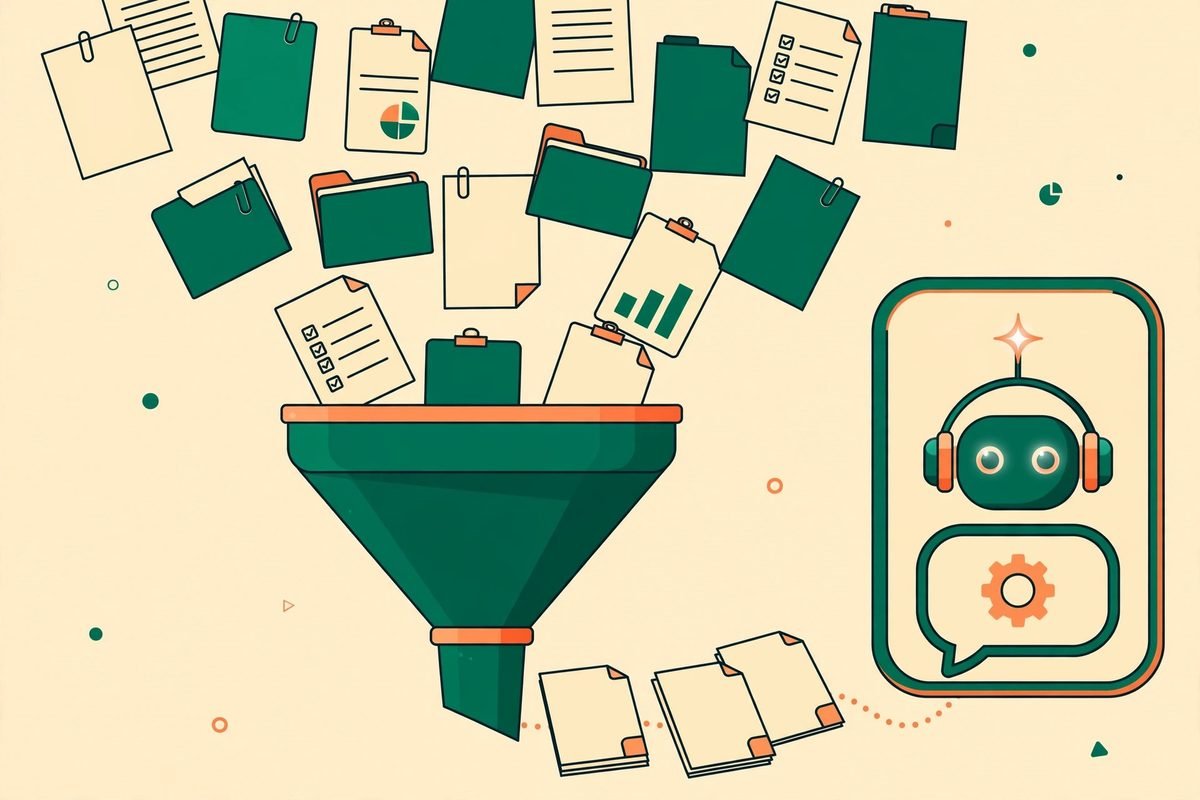
For most businesses we build, the default architecture is hybrid, and it is deliberately boring. Retrieve a generous shortlist — typically 50,000 to 200,000 tokens of the most relevant material — then let a long-context model reason over that shortlist. Simple questions are answered from retrieval alone; complex synthesis questions get the larger, curated context. Only a minority of queries need the full window, which is where the cost saving comes from: research on adaptive routing found most queries could be resolved by the cheap retrieval step, with only harder ones escalated.
- Bounded corpus, one-off analysis: a single contract, tender, or report pack that fits comfortably, with a human checking citations — long context is the simplest choice.
- Large or growing corpus, repeated questions: a knowledge base, ticket archive, or policy library — retrieval is structurally necessary, because no window holds everything and documents change daily.
- Regulated or auditable answers: anything where you must show your source — retrieval wins on citations and access control, because each passage can be traced to a document and a version.
- Multi-hop analysis across connected documents: questions that chain entities across files — consider a knowledge-graph layer over retrieval, which follows relationships rather than relying on text similarity alone.
Freshness is the tiebreaker many teams forget. A stuffed prompt is a snapshot: if a price or policy changes after you assembled it, the model keeps answering from the old version until someone rebuilds the prompt. Retrieval reads the current version at query time, which alone settles the argument for any corpus that changes during the working day.
From Our Experience: What Actually Goes Wrong
Across more than nine years and 300-plus projects at MTD Technologies, the document-AI failures we see follow a pattern, and window size is rarely the root cause. The first failure is version chaos: the same policy in three versions, with no canonical copy, so retrieval returns the wrong one and nobody notices because the answer sounds fluent. Fix the source of truth before you buy a bigger model. The second is chunking by accident: PDFs split mid-table and scanned pages with no text layer. A model cannot reason over a table it was never given in a readable form, however large its window.
The third failure is cost blindness. A team prototypes with a stuffed prompt, loves the demo, and only discovers the bill when the workflow goes live at volume. We now insist on a simple cost model before any document workflow ships: tokens per query, queries per day, and the monthly total at both the prototype model and the production model. Often the fix is not a cheaper model but a smaller prompt — better retrieval, prompt caching for repeated instructions, and summarised context for background material that does not need to be verbatim.
A Practical Decision Checklist
- How many documents, in pages, does a typical question actually need? If the answer is under twenty documents, long context is plausible; if it is thousands, retrieval is mandatory.
- How often do those documents change? Daily changes favour retrieval; a frozen pack favours a stuffed prompt.
- How many queries a day, and what is the token bill at that volume? Model it before you commit.
- Must every answer carry a citation to a specific document version? If yes, design for retrieval and provenance from day one.
- Who checks the answer before it reaches a customer or a regulator? High-stakes answers need a human checkpoint whatever the architecture.
- What does failure look like? A missed clause, a stale price, or a wrong citation — and which pattern makes that failure less likely for your documents?
If you are weighing a document workflow and want an honest answer about which pattern fits your corpus, our AI integration and automation team builds these systems for clients, and our AI tools directory tracks the models and tools behind them. For a scoped conversation about your own documents, talk to us — bring a sample pack and a real question, and we will test the pattern against it before recommending anything.
Frequently asked questions
How many pages fit in a one-million-token context window?
Roughly 2,500 pages of ordinary text, or about 750,000 words. In practice the usable space is smaller, because the system prompt, conversation history, and instructions share the same window, and reliable recall drops well before the window is full.
Does a bigger context window mean I can drop retrieval (RAG)?
Only for a small, stable corpus and low query volume. For a large or fast-changing document store, retrieval is still necessary: no window holds everything, retrieval reads the current version at query time, and it costs far less per query at scale.
Why does AI miss facts in the middle of a long document?
Models attend most reliably to the start and end of a long context and less reliably to the middle, a pattern confirmed by lost-in-the-middle research and later context-rot studies. Multi-fact questions suffer most. Ordering critical passages near the start or end, and requiring citations, reduces the risk.
How much does a long-context query cost?
It depends on the model and its pricing tier, but a full one-million-token input costs a few dollars per call at frontier pricing, versus cents for a retrieval query that sends only a few thousand tokens. Multiply by daily query volume before choosing, and check current provider pricing, which changes frequently.
When should a business use long context instead of retrieval?
Use long context for bounded, one-off analysis of a single pack — a contract review, a tender comparison, a board pack — where a human checks the citations. Use retrieval for repeated questions over a large, changing corpus, and a hybrid of the two for most production systems.
What solves document work is a deliberate choice — long context where the corpus is bounded, retrieval where it is large or changing, and a hybrid where the volume justifies it — plus clean source documents, version control, and a human checking anything that matters.