

FreeToken local LLM serving desktop open source is the most interesting sentence in local AI right now, because it promises something that sounded impossible a year ago: datacenter-scale model serving on the machine already sitting under your desk. FreeToken, the open-source project from FlashML, has picked up more than 16,000 GitHub stars since July 2026 by claiming it can run 290-billion-parameter-plus frontier mixture-of-experts (MoE) models locally on a gaming PC at interactive speeds. This guide explains what FreeToken actually does, which models it runs, how to set it up, what it costs in hardware, and where the honest limits are — so you can judge whether local serving belongs in your business, or whether the cloud still wins for your workload.
What FreeToken Is
FreeToken is an edge-native MoE serving engine. That phrase does a lot of work, so let us unpack it. A mixture-of-experts model is not one giant brain that fires all at once. It is a collection of smaller specialist sub-networks, called experts, plus a router that picks only a handful of experts for each token. A 290-billion-parameter MoE model therefore does not need 290 billion parameters in fast memory at once; it needs the experts that are actually active, plus a smart way to fetch the rest. FreeToken is the engine that makes that fetching fast enough to feel interactive on consumer hardware.
Checked on 3 November 2026, the project has over 16,400 stars and more than 1,600 forks, is written mainly in Python, and is released under the Apache 2.0 licence, which permits commercial use under its terms. That licence covers the engine only — always check each model checkpoint’s own terms before putting it into a client product. Traditional serving engines such as vLLM and SGLang were built for datacenter GPUs; FreeToken borrows ideas from those projects but tunes execution for the hardware people already own.
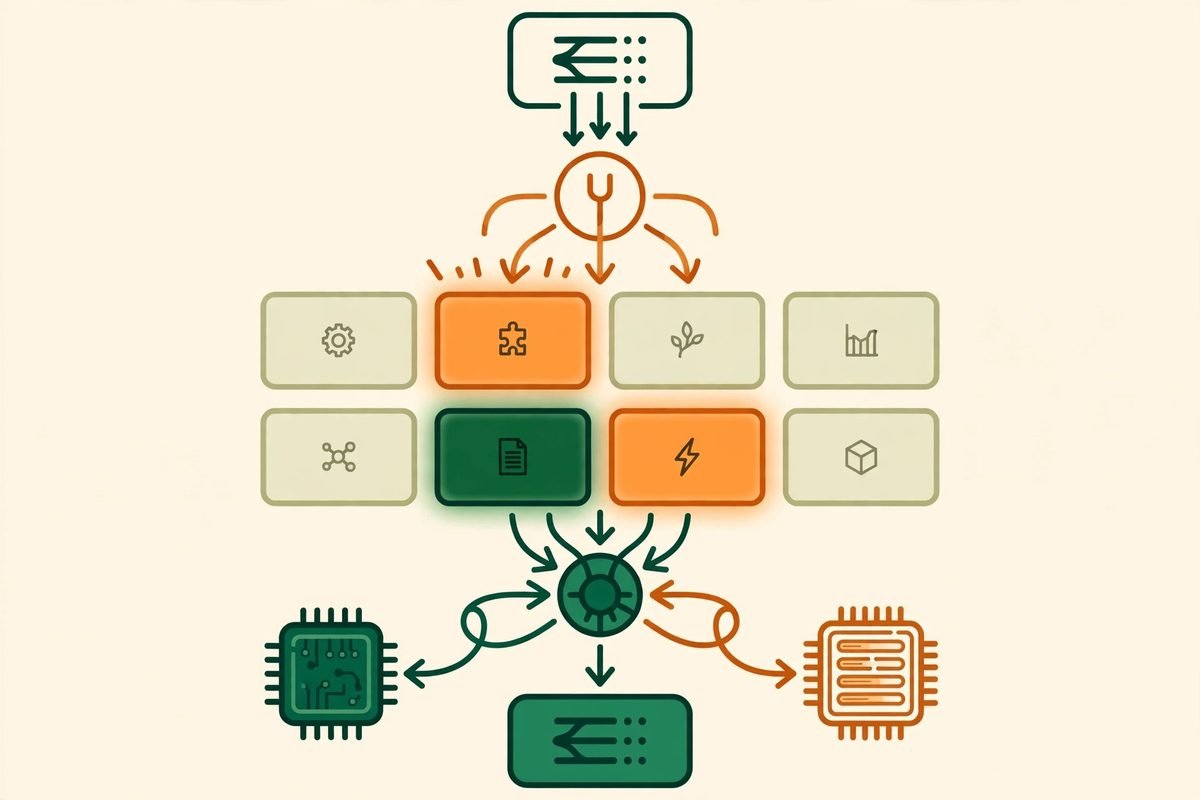
What FreeToken Can Do
FreeToken’s feature list reads like a checklist of the problems that make local MoE serving hard. Each one solves a bottleneck that would otherwise kill performance on a desktop.
- Bandwidth-adaptive CPU-GPU co-execution. FreeToken’s q-star policy splits work between the CPU and GPU according to available bandwidth, instead of forcing everything through the graphics card.
- Full-layer double-buffered prefill streaming. While the model processes your prompt, the next layer’s weights are loaded in the background.
- Global LRU expert caching. Recently used experts stay cached, so repeated topics do not trigger repeated disk reads.
- Semantic-aware caching for agentic context edits. When an agent makes a tool call or revises a thinking block, FreeToken can reuse the parts of the context that did not change instead of recomputing everything.
- Elastic memory management. Video memory can be reallocated at runtime between expert caches and key-value (KV) memory without restarting the engine or reloading weights.
- Its own fast weight format, FTW. Weights in FTW load faster than raw checkpoints, at the cost of a conversion step and occasional migration friction.
On the compatibility side, FreeToken serves both the OpenAI API and the Anthropic API, so existing clients and coding agents can point at a local server by changing a base URL. It supports frontier open-weight MoE models including DeepSeek-V4-Flash, Qwen3.6-35B-A3B and GLM-5.2, across quantisation formats including MXFP4, NVFP4, FP8 and BF16, and it is built for NVIDIA RTX 30, 40 and 50 series graphics cards. It also ships a desktop app for Windows and Linux with a graphical console, for teams that do not want to live in a terminal.
How FreeToken Works Under the Hood
Think of a MoE model as a large company where only a few departments work on any given task. A dense model calls everyone into every meeting. A MoE model calls only the departments relevant to the question. The router’s job is to decide who gets called, and the serving engine’s job is to have those departments’ files ready before they are needed.
On a desktop, the files do not all fit in video memory. A 290-billion-parameter model, even in a 4-bit quantised format, is far larger than the 8, 12 or 16 gigabytes on a typical consumer card. FreeToken therefore treats the whole machine as the memory hierarchy: hot experts live on the GPU, warm experts live in system RAM, and cold experts live on disk. The engine predicts, prefetches and caches across that hierarchy, overlapping weight movement with computation so the GPU rarely waits.
Quantisation is the other half of the trick. A model stored in BF16 uses two bytes per parameter; the same model in NVFP4 or MXFP4 uses roughly half a byte per parameter. That is a fourfold reduction in the amount of data that must move, at the cost of some precision. For most business workloads that trade is worth it; for exact numeric work, test first.

Why FreeToken Is Trending Now
Three forces are colliding, and FreeToken sits at their intersection. First, open-weight frontier models keep getting better, and several of the strongest releases are MoE models. Second, API prices and rate limits make heavy agent workloads expensive: an agent that loops through tools for an hour can burn through far more tokens than a human chat session. Third, privacy rules and client contracts increasingly forbid sending sensitive documents to a third-party API. A team that can run a frontier-class model on its own hardware, with no data leaving the building, solves all three at once — if performance is genuinely usable.
The timing also matters. The project appeared in July 2026 and has been updated almost continuously since, including on the day this article was written. A fast-moving project is a good sign for capability and a warning sign for stability: features and formats can change under you, and the 472 open issues on the repository at the time of writing show an active but still maturing codebase. Pin versions and test upgrades in staging before updating production.
From Our Experience: Where Local Serving Wins, and Where It Does Not
At MTD Technologies, we have spent over nine years building web, mobile and AI systems for clients, and the pattern we see with local models is consistent: local serving wins on privacy, latency for steady workloads, and marginal cost once the hardware is paid for. It loses on peak capacity, on the newest closed models, and on operational effort. If your workload is bursty or customer-facing at scale, the cloud still wins. If your workload is a small team running agents all day against internal documents, local serving can pay for its hardware in months of saved API bills — provided someone on the team owns the setup.
Three practical gotchas deserve emphasis. First, disk space and download time are real costs: a large MoE checkpoint can be hundreds of gigabytes, and the first download plus FTW conversion is an afternoon, not a coffee break. Second, a gaming PC is not a server: put local serving on a dedicated machine, not a developer’s daily workstation. Third, do not judge a MoE model by its total parameter count. A 290-billion-parameter MoE model may activate only a few tens of billions of parameters per token, so its quality sits closer to a strong mid-size dense model than to a 290-billion-parameter dense model. Compare on your own benchmarks, not on headline numbers.
Getting Started With FreeToken
The quickest honest path is the command-line install, because it exposes what is actually happening. The desktop app at flashml.ai is the friendlier route if you prefer a graphical console.
- Install FreeToken with acceleration support:
uv pip install "freetoken[accel]". Alternatively, clone the repository and install it in editable mode with the same extras. - Download a supported checkpoint from Hugging Face, for example Qwen3.6-35B-A3B, and note its path or repository ID.
- Launch the server:
ft serve --model ~/models/Qwen3.6-35B-A3B. The server is ready when the log reports that the API server is ready on 127.0.0.1:1919. - Check what is being served with
curl http://127.0.0.1:1919/v1/models, then send a chat completion request to/v1/chat/completionswith that model ID, just as you would against the OpenAI API. - For interactive use, run
ft shellto attach to the server, orft shell --model ~/models/Qwen3.6-35B-A3Bto start an engine and chat in one process. - To point a coding agent at your local server, run
ft launch claude— the same command supports Codex, OpenCode, OpenClaw and other agents — and preview the configuration changes first with--dry-run.
Start with a smaller model such as Qwen3.6-35B-A3B before attempting the largest checkpoints. It validates your setup on a model one good consumer card can handle, before you commit to a multi-hundred-gigabyte download.
Models FreeToken Supports
FreeToken loads Hugging Face safetensors checkpoints directly, and its documentation lists known-good checkpoints whose kernels are tuned. The headline families include DeepSeek-V4 and V4.1-Flash, GLM-5.2 and 5.3-Flash, Qwen3.6 and Qwen3.5 MoE models, Qwen3.8-Flash-Next, gpt-oss 120b and 20b, Gemma-4, MiniMax-M2.5 and M3, and several vision-capable variants including Qwen3-VL. Other checkpoints of the same architectures generally work too, but known-good checkpoints are where you should start.
For teams evaluating local serving, the practical shortlist is simple: Qwen3.6-35B-A3B for a strong general model on one card, DeepSeek-V4-Flash for a larger frontier MoE when you have workstation-class hardware, and GLM-5.2 for an alternative frontier option in NVFP4. Benchmark all three on your own prompts before standardising.
Responsible Use and Honest Limitations
Local serving improves privacy, but it does not remove responsibility. Your prompts and documents stay on your machine, which helps with client confidentiality and data-protection requirements, but you are now the operator: you own updates, access control, logging and backups. Lock down the server port if the machine is shared, and read each checkpoint licence, not just the engine licence.
The limitations are equally plain. FreeToken is NVIDIA-focused in its consumer hardware support, so teams on other graphics hardware should verify compatibility before planning around it. The project is months old, its weight format is still evolving, and its headline claim of 290-billion-parameter models on a gaming PC depends on the specific model, quantisation, system RAM and disk speed involved — it is a ceiling demonstrated under favourable conditions, not a guarantee for every desktop. Run a pilot before migrating a real workflow.
Frequently Asked Questions
What is FreeToken local LLM serving desktop open source, in one sentence?
It is an open-source engine that runs large mixture-of-experts language models locally on consumer desktop hardware, using CPU-GPU co-execution and expert caching to make frontier-scale models interactive without a datacenter.
Can FreeToken really run a 290-billion-parameter model on a gaming PC?
That is the project’s stated goal and headline claim for frontier MoE models, and it is plausible for MoE architectures because only a subset of experts is active per token. In practice, the result depends on the model, the quantisation format, system RAM, disk speed and GPU. Pilot it on your own hardware before promising it to a client.
Which models should I try first with FreeToken?
Start with Qwen3.6-35B-A3B, which the project’s quick start uses and which runs well on a single strong consumer card. Then try DeepSeek-V4-Flash or GLM-5.2 if you have workstation-class hardware and want a larger frontier MoE model.
Does FreeToken work with Claude Code and other coding agents?
Yes. FreeToken serves OpenAI-compatible and Anthropic-compatible APIs, and its ft launch command writes provider configuration for Claude, Codex, OpenCode, OpenClaw and other agents, with a dry-run option to preview changes first.
Is FreeToken free for commercial use?
FreeToken itself is released under the Apache 2.0 licence, which permits commercial use under its terms. The models you run through it carry their own licences, so check each checkpoint’s terms separately before commercial deployment.
FreeToken is neither a magic replacement for the cloud nor a toy: it is a serious, fast-moving attempt to move frontier-model serving onto hardware teams already own. If your team runs agents all day and guards client data carefully, a pilot costs little more than a download and an afternoon. Browse more open-source tools in our AI Tools Directory, or talk to us about AI agent development and AI integration and automation — and if local serving fits your roadmap, contact MTD Technologies and we will help you scope the pilot properly.